Biltmore Estate vs Oheka Castle: America’s Two Greatest Mansions Compared
Автор: The Manor Codex
Загружено: 2026-02-18
Просмотров: 17
Описание:
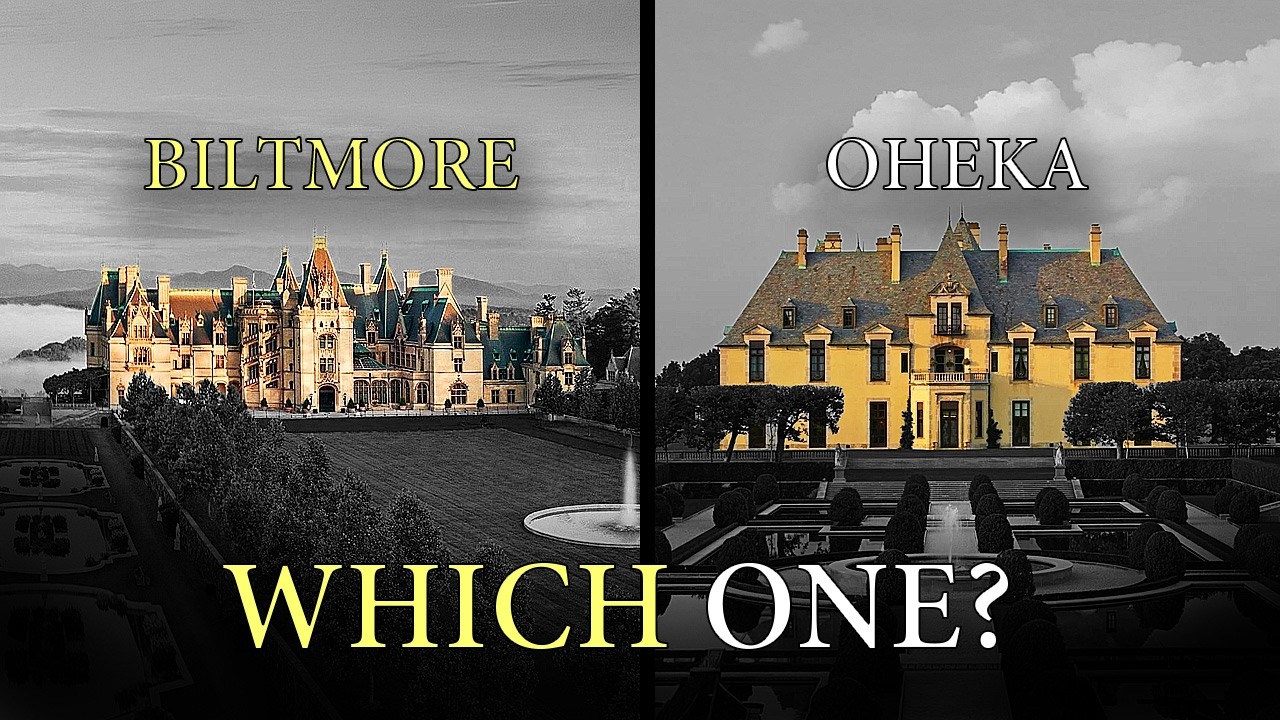
Biltmore Estate in North Carolina and Oheka Castle on Long Island: two monuments to American wealth, built at opposite ends of the Gilded Age and shaped by very different ambitions. In the late nineteenth and early twentieth centuries, industrial fortunes reached unprecedented scale. George Vanderbilt and Otto Hermann Kahn each used that wealth to construct estates that went far beyond private homes. These were statements of power, culture, and permanence, translated into stone, steel, and landscape. Completed in 1895, Biltmore emerged as the largest private residence ever built in the United States, a French Renaissance–inspired palace supported by vast agricultural lands, forests, and an entire planned infrastructure. Oheka, finished in 1919, took a different approach. Modeled on European châteaux, it rose above Long Island as a compact but intensely concentrated display of wealth, engineered with modern materials and designed to impress through symmetry, elevation, and control of its surroundings. Both estates featured cutting-edge technology, imported craftsmanship, and interiors designed to reinforce status at every turn. Behind their grand facades, both properties relied on complex systems of labor and maintenance. Large domestic staffs, industrial-scale kitchens, heating plants, and service corridors kept daily operations invisible to guests. These houses projected effortless luxury, but only through constant expense, coordination, and manpower. As the Gilded Age gave way to economic upheaval and social change, the logic that sustained such estates began to collapse. Biltmore survived through continued family stewardship and adaptation, eventually opening to the public as a working estate and historic site. Oheka faced abandonment, subdivision, and near ruin before restoration efforts transformed it into a preserved landmark with a new commercial role. Their divergent paths reflect different solutions to the same problem: how to keep monuments to extreme private wealth alive in a world that no longer produces them. Together, Biltmore and Oheka serve as parallel case studies. One emphasizes scale, land, and continuity. The other emphasizes image, reinvention, and recovery. Both stand as reminders that grandeur is not self-sustaining. It demands purpose, resources, and constant intervention. These estates endure not because of their original wealth alone, but because later generations found reasons, and means, to keep them standing.
Copyright & Fair Use Disclaimer
• This video is a non-commercial, educational history documentary created for commentary, criticism, and research.
• Some archival photos and footage are used under the principles of Fair Use (Section 107, U.S. Copyright Act) for purposes such as criticism, comment, news reporting, teaching, scholarship, and research.
Повторяем попытку...
Доступные форматы для скачивания:
Скачать видео
-
Информация по загрузке: