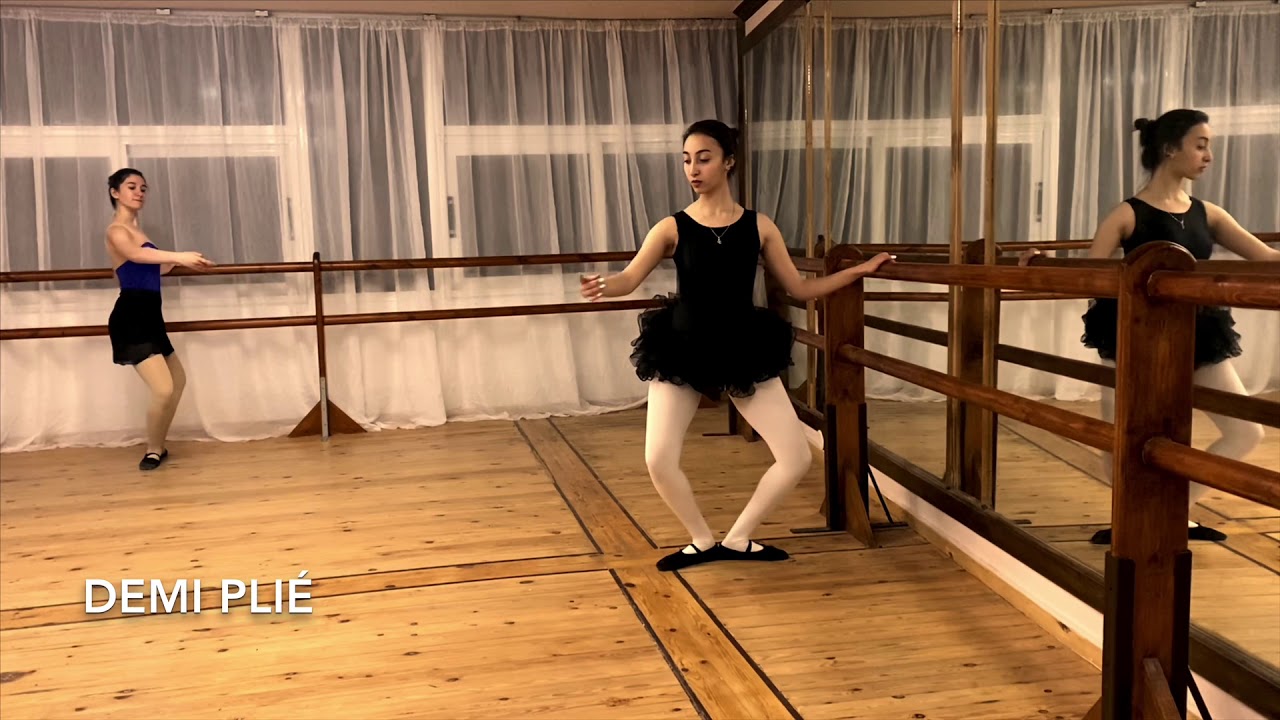
Positions of the arms & feet - Relevé - Passé
Автор: MB Ballet Academy
Загружено: 2020-06-21
Просмотров: 713
Описание:
**positions of the arms & feet
First Position : Premier
[pruh-MYAY]
Arms
Arms held in front in an oval shape. Fingers grouped elegantly and naturally. Hands curved. Middle fingers curved in slightly more than the others. Thumbs relaxed, not sticking up. Hands are held even with the height of the dancer's belly button.
Feet
Toes turned out to the side with the dancer's heels touching. The whole leg must Turn-out at the hip (not just the feet).
—————————————
Second Position: deuxième
Arms
Arms opened wide, but kept in front of the dancer's shoulders. Arms held slightly curved without dropping elbows.
Feet
Standing with feet apart, toes turning out. Toes on the same line as First Position. The space between feet is approximately the length of one of the dancer's feet. The whole weight of both feet must be on the floor.
—————————————
Third Position: Troisième
[trwah-ZYEM]
Arms
One arm held above and slightly in front of the dancer's head with the other held out to the side.
Feet
One foot is crossed halfway in front of the other. Even weight should be kept on both feet and legs must Turn-out at the hip.
—————————————
Fourth Position: Quatrième
[ka-tree-EM]
Arms
On arm held above and slightly in front of the dancer's head. The other arm is held out to the side in a gentle curve.
Feet
One foot is placed exactly in front of the other. The space between feet is approximately the length of one of the dancer's feet.
—————————————
Fifth Position: Cinquième
[sen-KYEM]
Arms
Both arms are held above the head make an oval shape that frames the dancer's face. The fingers should be slightly in front of the head.
Feet
Feet turned out, fully crossed and touching each other.
**Relevé
[ruhl-VAY]
Relevé is a classical ballet term meaning “raised.” It describes the action when a dancer rises up and seemingly is standing “on their toes” in a demi-pointe or a fully en pointe.
It can be done in many different positions and on one or both legs. For example, a dancer can do a relevé in all the positions of the feet (first, second, fourth and fifth), and also in positions like arabesque or passé
The first being demi-pointe, which is usually done in flat ballet shoes. A dancer relevéing to demi-pointe will raise their heels while trying to relax their toe joints so they can have be in a “high demi-pointe” which would describe the dancer’s heel being high off the ground. The toes remain flat and relaxed on the floor.
When a relevé is described going to full pointe, or en pointe, it is usually done by a female dancer in pointe shoes. This is because it is unsafe and unpractical to rise on to the tips of the toes if not properly supported by pointe shoes.
A male dancer in flat shoes will never, or should never, attempt to go on full point when doing a relevé, again, since it is not safe and there is not a step in classical ballet that calls for it.
Relevé is a step that builds a lot of strength in a dancer’s feet, calves, and thighs that allows him or her to do many types of jumps and turns.
**Passé [pa-SAY] Retiré [ruh-tee-RAY] raccourci [ra-koor-SEE]
means when a foot is placed near or on the other knee The working leg is raised to the side, with knee sharply bent so the toe is pointed next to the supporting knee (front, side, back). where a dancer’s leg is bent upwards, with their toes typically connected to the other leg ideally at 90 degrees
Повторяем попытку...

Доступные форматы для скачивания:
Скачать видео
-
Информация по загрузке: