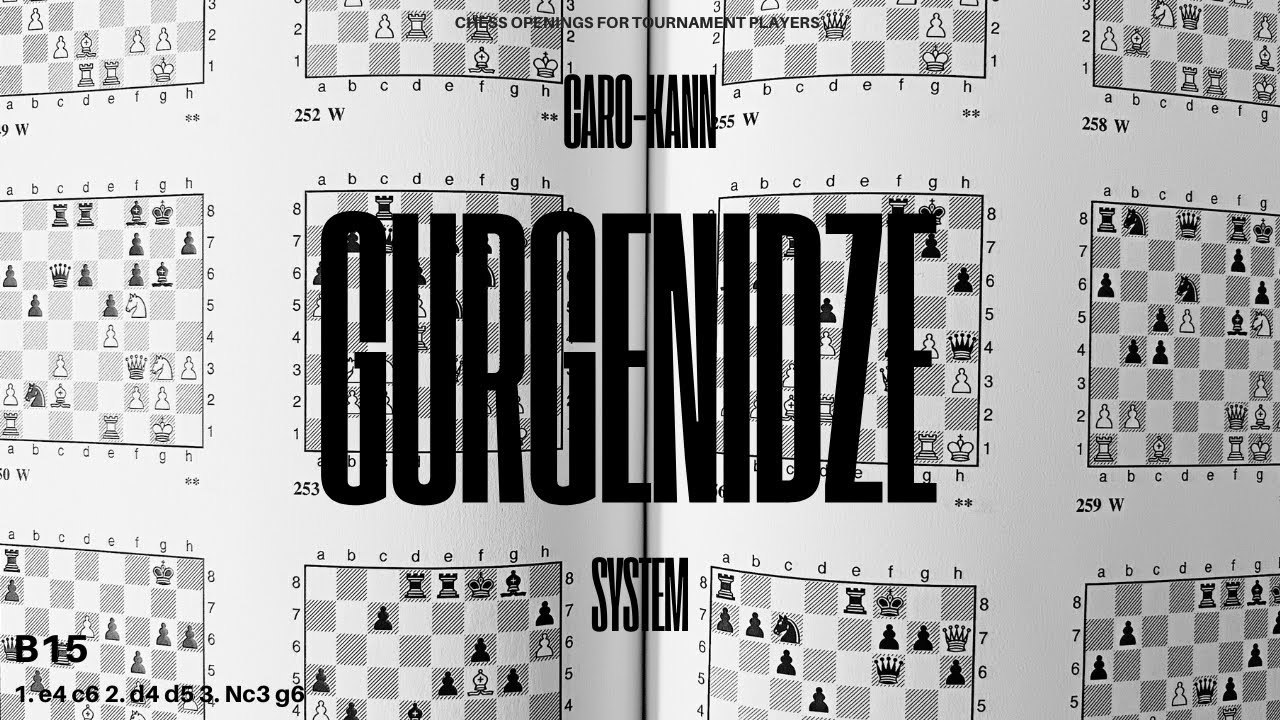
Caro-Kann, Gurgenidze System (g6) · Complete Chess Openings
Автор: Hanging Pawns
Загружено: 2026-01-20
Просмотров: 2385
Описание:
The Gurgenidze System in the Caro-Kann: theory, strategy and resources.
Full Caro-Kann repertoire for black: https://go.noctie.ai/caro-kann-for-black
Annotated Caro-Kann repertiores and a full PGN: / caro-kann-for-148266906
Books on the Caro-Kann: https://chessreads.com/caro-kann
Anti Caro-Kann repertoire for white: https://go.noctie.ai/caro-kann-for-white
If you go premium on Noctie use the code "HPYEAR" for a 20% discount.
Watch the introduction to the Caro-Kann: • Introduction to the Caro-Kann Defense · Co...
The main alternative to the Gurgenidze is dxe4, which leads to these four options for black:
Study the Classical (Bf5) variation: • Caro-Kann, Classical Variation (Bf5) · Com...
Study the Karpov (Nd7) Variation: • Caro-Kann, Karpov Variation (Nd7) · Comple...
Study the Tartakower (exf6 after Nf6): • Caro-Kann, Tartakower Variation (exf6) · C...
Study the Bronstein Larsen (gxf6 after Nf6): • Caro-Kann, Bronstein-Larsen Variation (gxf...
The Gurgenidze system is a great alternative to dxe4 against the Nc3 Caro-Kann. It was named after Bukhuti (Buchuti) Ivanovich Gurgenidze, a Georgian Grandmaster born in 1933, who was among the top Soviet players in the late 60s and 70s.
My score with the Gurgenidze is great in tournament play. More so than the results, I never got a bad position with it, nor did I struggle out of the opening. Even though the move is frowned upon by the engines, it gives black an easy game, especially compared to several lines in the Karpov, Tartakower, or the Bronstein-Larsen. One of the main ideas of the Gurgenidze is pressure on d4. After the bishop develops to g7, white will be forced to defend the pawn. Nf3 would, in that case, be one of the few possible defenders, and it could be pinned with Bg4. The long-term consequence, and the key strategic point behind the opening, is that the c3 knight stays put. Black hasn't traded on e4 yet, so the knight blocks white's c pawn from moving, making it harder to break black's solid center.
The main downside of g6 from a classical perspective, is that white is given the option to transpose into an advance Caro-Kann structure in which black has committed to g6. That may mean little to you, but in the advance, both f6 and h6 are critical moves black plays, and, more importantly, black hasn't developed the queen's bishop yet. It will never sit comfortably on f5, g6, or h7 since the g6 pawn is preventing that.
0:00 Introduction to the Gurgenidze System
01:45 History of the Gurgenidze System
12:38 Resources on the Gurgenidze System
16:01 Strategy of the Gurgenidze System
32:18 Theory of the Gurgenidze System
01:07:28 Conclusion
This is the sixth of 20 videos in the Caro-Kann series. Unlike my previous Caro-Kann series, this one is more detailed, better structured, and it covers every variation playable by both sides. I have also had 7 years of tournament experience playing 1...c6, so I'm a lot more confident that I can explain ideas behind it in a better and easier-to-understand way.
Повторяем попытку...
Доступные форматы для скачивания:
Скачать видео
-
Информация по загрузке: