EXAMINING THE INTELLECTUAL QUALITY OF PRESERVICE SCIENCE TEACHERS’ CLASSROOM PEDAGOGY: A CASE STUDY.
Автор: ISTES Organization
Загружено: 2022-05-03
Просмотров: 42
Описание:
EXAMINING THE INTELLECTUAL QUALITY OF PRESERVICE SCIENCE TEACHERS’ CLASSROOM PEDAGOGY: A CASE STUDY OF ONE ASPECT OF THE PRODUCTIVE PEDAGOGIES FRAMEWORK
Nazeem Edwards, Stellenbosch University, South Africa
(International Conference on Education in Mathematics, Science and Technology (ICEMST)) which took place on March 24-27, 2022, Antalya, Turkey, https://www.2022.icemst.com/ organized by International Society for Technology, Education and Science (ISTES)-http://www.istes.org)
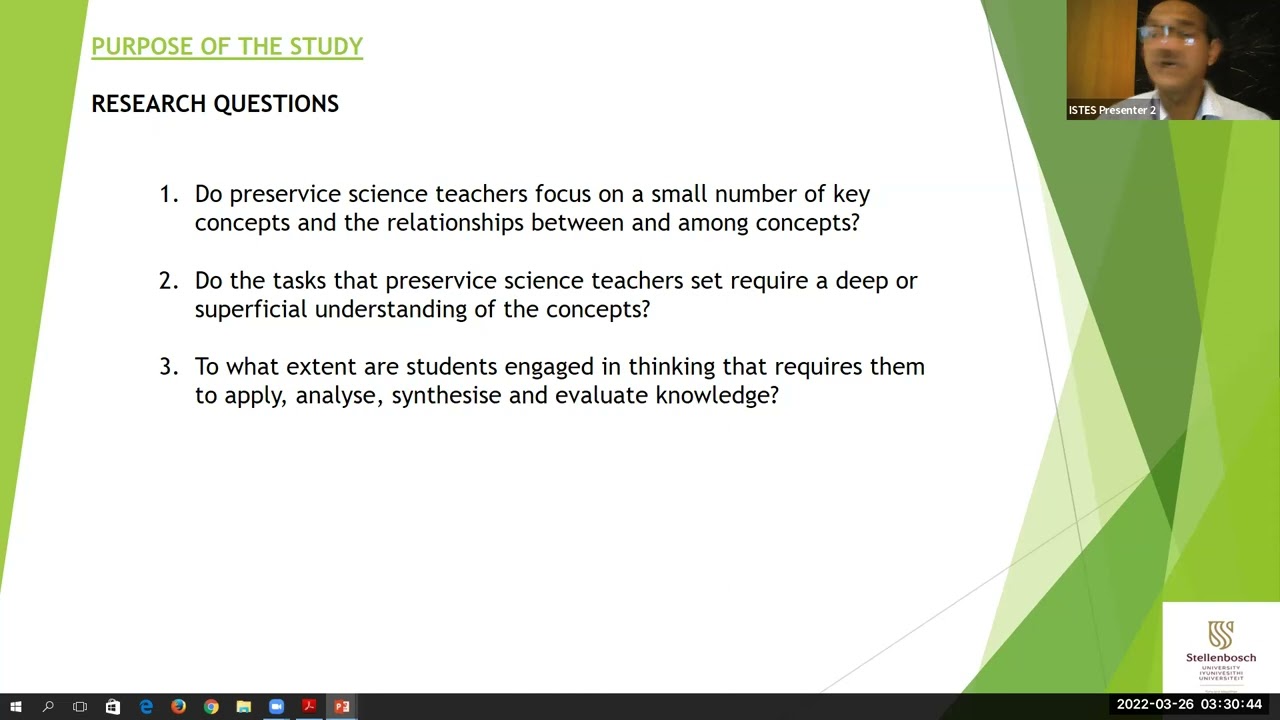
The New South Wales Department of Education and Training (2003) posited that a pedagogy that focuses on intellectual quality benefits students in terms of their learning outcomes. “Intellectual quality refers to ensuring the teacher is setting high expectations and a culture of inquiry in the classroom” (Drew, 2019). The Productive Pedagogies framework also suggests that these classroom practices work in tandem with the social constructivist view of classroom instruction (Bature and Atweh, 2016). In this study, the following questions that relate to intellectual quality are posed: 1. Do preservice science teachers focus on a small number of key concepts and the relationships between and among concepts? 2. Do the tasks that preservice science teachers set require a deep or superficial understanding of the concepts? 3. To what extent are students engaged in thinking that requires them to apply, analyse, synthesise and evaluate knowledge? The study follows a qualitative case study design of a convenient sample group of eleven (11) preservice science teachers at a university in South Africa. Video recordings of the science lessons that they taught were analysed in terms of the key concepts, understanding and higher-order thinking. The findings show that eight of the 11 lessons were Physics lessons of which four focused on motion, two on electrostatics and one each on refraction and gravity respectively. The Chemistry lessons were on the atomic model, chemical and physical change, and phases of matter. The Physics lessons promoted deep understanding by focusing on relationships between concepts, and the students were required to engage in higher-order thinking such as inverse proportionality. The Chemistry lessons focused on concepts where the learners could use their prior knowledge such as atomic structure and phases of matter. None of these lessons required higher-order thinking. This area requires attention in the preparation of these preservice teachers.
Повторяем попытку...
Доступные форматы для скачивания:
Скачать видео
-
Информация по загрузке: