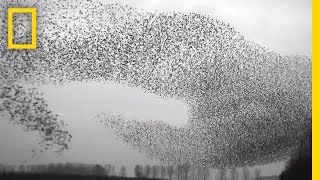
European Starlings (Invasive Nuisance Birds)
Автор: Salvage
Загружено: 2021-05-18
Просмотров: 123
Описание:
Northeast Ohio.
"First brought to North America by Shakespeare enthusiasts in the nineteenth century, European Starlings are now among the continent’s most numerous songbirds. They are stocky black birds with short tails, triangular wings, and long, pointed bills.
All the European Starlings in North America descended from 100 birds set loose in New York's Central Park in the early 1890s. The birds were intentionally released by a group who wanted America to have all the birds that Shakespeare ever mentioned. It took several tries, but eventually the population took off. Today, more than 200 million European Starlings range from Alaska to Mexico, and many people consider them pests.
Though they’re sometimes resented for their abundance and aggressiveness, they’re still dazzling birds when you get a good look. Starlings are chunky and blackbird-sized, but with short tails and long, slender beaks. In flight their wings are short and pointed, making them look rather like small, four-pointed stars (and giving them their name). Covered in white spots during winter, they turn dark and glossy in summer. For much of the year, they wheel through the sky and mob lawns in big, noisy flocks.
Starlings are boisterous, loud, and they travel in large groups (often with blackbirds and grackles). They race across fields, beak down and probing the grass for food; or they sit high on wires or trees making a constant stream of rattles, whirrs, and whistles.
Starlings are common in towns, suburbs, and countryside near human settlements. They feed on the ground on lawns, fields, sidewalks, and parking lots. They perch and roost high on wires, trees, and buildings.
Because of their recent arrival in North America, all of our starlings are closely related. Genetically, individuals from Virginia are nearly indistinguishable from starlings sampled in California, 3,000 miles away. Such little genetic variation often spells trouble for rare species, but seems to offer no ill effects to starlings so far.
Starlings are great vocal mimics: individuals can learn the calls of up to 20 different species. Birds whose songs starlings often copy include the Eastern Wood-Pewee, Killdeer, meadowlarks, Northern Bobwhite, Wood Thrush, Red-tailed Hawk, American Robin, Northern Flicker, and many others.
Starlings turn from spotted and white to glossy and dark each year without shedding their feathers. The new feathers they grow in fall have bold white tips – that’s what gives them their spots. By spring, these tips have worn away, and the rest of the feather is dark and iridescent brown. It’s an unusual changing act that scientists term “wear molt.”
A female European Starling may try to lay an egg in the nest of another female. A female that tries this parasitic tactic often is one that could not get a mate early in the breeding season. The best females find mates and start laying early. The longer it takes to get started, the lower the probability of a nest's success. Those parasitic females may be trying to enhance their own breeding efforts during the time that they cannot breed on their own."
Cited from AllAboutBirds.org
https://www.allaboutbirds.org/guide/E...
While I was unable to find a source for this, I have heard that the U.S. government distributed recipes for starlings during the Great Depression as a sort of two-fold measure; people would have a different source of meat, and hunting starlings would cut down on the invasive population.
Повторяем попытку...

Доступные форматы для скачивания:
Скачать видео
-
Информация по загрузке: