The Power of the Powerless - Václav Havel - Explained
Автор: Nomundor
Загружено: 2026-01-26
Просмотров: 98
Описание:
The Power of the Powerless - Vaclav Havel - Explained
In 1978, a Czech playwright named Václav Havel wrote an essay that would provide the theoretical foundation for the liberation of Eastern Europe. "The Power of the Powerless" wasn’t just a political manifesto; it was a profound psychological and existential analysis of how modern societies—both East and West—can trap individuals in a "panorama of everyday life" built on lies.
In this video, we break down Havel’s most important concepts:
1. The Post-Totalitarian System
Havel argues that his society was no longer a "classical dictatorship" ruled by a small group of soldiers or police. Instead, he labels it "post-totalitarian," a system where power is exercised through an all-embracing, secularized ideology that offers a ready answer to every question. This system is characterized by "social auto-totality," where every citizen—from the prime minister to the shopkeeper—is both a victim and a supporter of the system.
2. The Story of the Greengrocer
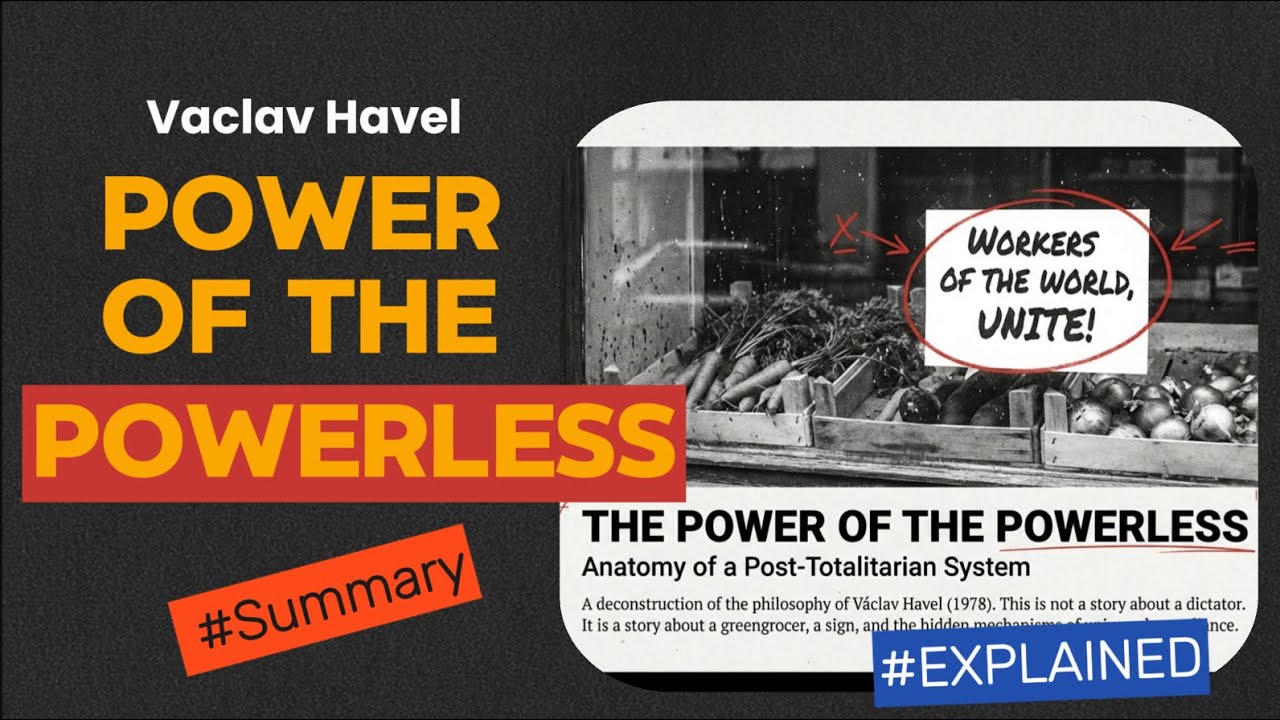
To explain how power works, Havel tells the story of a greengrocer who places a "Workers of the World, Unite!" slogan in his shop window. The greengrocer doesn't necessarily believe the slogan; he displays it as a sign of obedience to ensure his peace and security. Ideology acts as a "bridge of excuses," allowing individuals to hide their lack of freedom behind a facade of "high" principles.
3. Living Within a Lie vs. Living Within the Truth
When the greengrocer stops putting up slogans, stops voting in farcical elections, and begins to say what he really thinks, he steps out of "living within a lie" and begins "living within the truth". This act is described by Havel as a "bacteriological weapon". Even a single individual who refuses to play by the rules can shatter the system's "world of appearances" and reveal that the "emperor is naked".
4. Parallel Structures and the Parallel Polis
When people are denied influence over official structures, they begin to create an "independent life of society". This includes samizdat literature, private seminars, and unofficial concerts—what Václav Benda called the "parallel polis". These structures allow people to live authentically alongside the official system.
5. The Existential Revolution
Havel warns that the crisis of "post-totalitarianism" is a variant of a global failure in modern technological society. He calls for an "existential revolution"—a moral reconstitution of society that rehabilitates values like trust, openness, responsibility, and solidarity.
6. Modern Perspectives: Is Havel Relevant Today?
We also look at modern interpretations of Havel’s work, such as those by Andrew J. Spencer, who suggests that the concept of "social auto-totality"—where regular people enforce conformity on one another—can be seen in contemporary Western cultural pressures regarding diversity and social ethics.
Key Takeaway: The "powerless" are only powerless as long as they choose to live within the lie. The moment they choose to live in truth, they become the most significant threat to a system built on deception.
--------------------------------------------------------------------------------
Sources used in this video:
• Havel, V. (1978). The Power of the Powerless.
• "The Power of the Powerless - Risemee" (Summary analysis).
• Spencer, A. J. (2021). Vaclav Havel and the Power of the Powerless - Ethics and Culture.
If you enjoyed this deep dive into political philosophy, please like, subscribe, and hit the notification bell!
#VaclavHavel #PoliticalPhilosophy #ThePowerOfThePowerless #ExistentialRevolution #Totalitarianism #Ethics #History
Повторяем попытку...
Доступные форматы для скачивания:
Скачать видео
-
Информация по загрузке: