Insufficient Markers of Senescent Cells | Aging-US
Автор: Aging-US
Загружено: 2022-03-16
Просмотров: 132
Описание:
Aging (Aging-US) published this research paper in Volume 9, Issue 8, entitled, "p16(Ink4a) and senescence-associated β-galactosidase can be induced in macrophages as part of a reversible response to physiological stimuli" by researchers from Everon Biosciences, Inc., Buffalo, NY; Department of Cell Stress Biology, Roswell Park Cancer Institute, Buffalo, NY; Department of Tumor Immunology, Roswell Park Cancer Institute, Buffalo, NY.
DOI - https://doi.org/10.18632/aging.101268
Corresponding authors - Olga Chernova - [email protected], and Andrei Gudkov - [email protected]
Abstract
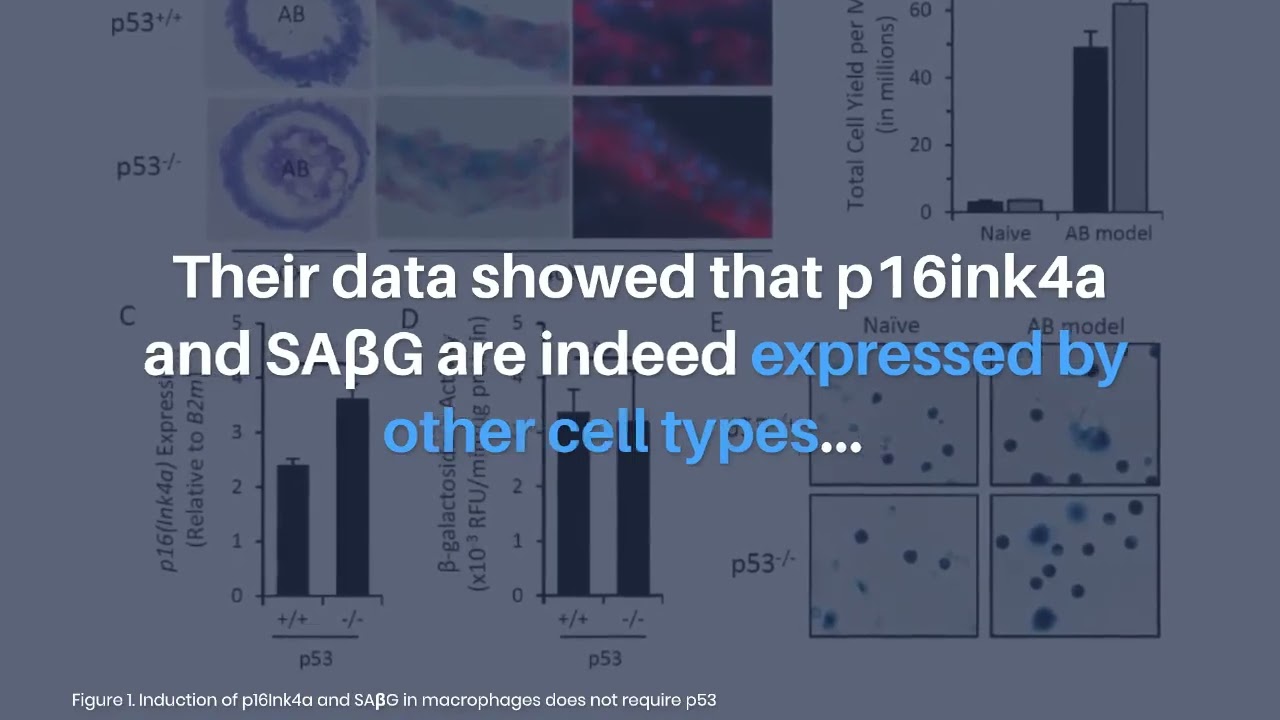
Constitutive p16Ink4a expression, along with senescence-associated β-galactosidase (SAβG), are commonly accepted biomarkers of senescent cells (SCs). Recent reports attributed improvement of the healthspan of aged mice following p16Ink4a-positive cell killing to the eradication of accumulated SCs. However, detection of p16Ink4a/SAβG-positive macrophages in the adipose tissue of old mice and in the peritoneal cavity of young animals following injection of alginate-encapsulated SCs has raised concerns about the exclusivity of these markers for SCs. Here we report that expression of p16Ink4a and SAβG in macrophages is acquired as part of a physiological response to immune stimuli rather than through senescence, consistent with reports that p16Ink4a plays a role in macrophage polarization and response. Unlike SCs, p16Ink4a/SAβG-positive macrophages can be induced in p53-null mice. Macrophages, but not mesenchymal SCs, lose both markers in response to M1- [LPS, IFN-α, Poly(I:C)] and increase their expression in response to M2-inducing stimuli (IL-4, IL-13). Moreover, interferon-inducing agent Poly(I:C) dramatically reduced p16Ink4a expression in vivo in our alginate bead model and in the adipose tissue of aged mice. These observations suggest that the antiaging effects following eradication of p16Ink4a-positive cells may not be solely attributed to SCs but also to non-senescent p16Ink4a/SAβG-positive macrophages.
Sign up for free Altmetric alerts about this article - https://oncotarget.altmetric.com/deta...
Author interview - • Aging-US | Dr. Andrei Gudkov on Markers of...
Keywords - aging, macrophage, senescent cell, p16(Ink4a), beta-galactosidase
About Aging-US
Launched in 2009, Aging-US publishes papers of general interest and biological significance in all fields of aging research and age-related diseases, including cancer—and now, with a special focus on COVID-19 vulnerability as an age-dependent syndrome. Topics in Aging-US go beyond traditional gerontology, including, but not limited to, cellular and molecular biology, human age-related diseases, pathology in model organisms, signal transduction pathways (e.g., p53, sirtuins, and PI-3K/AKT/mTOR, among others), and approaches to modulating these signaling pathways.
Please visit our website at http://www.Aging-US.com and connect with us:
SoundCloud - / aging-us
Facebook - / agingus
Twitter - / agingjrnl
Instagram - / agingjrnl
YouTube - / agingus
LinkedIn - / aging
Pinterest - / agingus
Aging-US is published by Impact Journals, LLC: http://www.ImpactJournals.com
Media Contact
18009220957
[email protected]
Повторяем попытку...
Доступные форматы для скачивания:
Скачать видео
-
Информация по загрузке:


