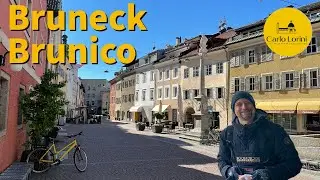
Bruneck-Riscone Sunset Walk🇮🇹A Midsummer Evening in the Italian Alps🌇Summer Twilight Walk in Bruneck
Автор: Leo Spekulatius
Загружено: 2025-07-30
Просмотров: 63
Описание:
Bruneck-Riscone Sunset Walk🇮🇹A Midsummer Evening in the Italian Alps🌇Summer Twilight Walk in Bruneck
Bruneck (German pronunciation: [ˈbrunɛk] ⓘ;Italian: Brunico [bruˈniːko] or [ˈbruːniko] Ladin: Bornech or Burnech; Latin: Brunecium or Brunopolis) is the largest town in the Puster Valley in the Italian province of South Tyrol.
Bruneck rises up in the middle of a wide valley (perhaps an ancient lake basin) and lies at the confluence of the Ahr with the Rienz, which itself flows into the Eisack river. Here the northern Tauferer Ahrntal side valley and the southern Val Badia of the Gran Ega creek join the broad Pustertal. Bruneck wide valley, located between the two straits of Kiens downstream and Percha upstream, delimited to the South by the circular elevation of Kronplatz and opened to the North in the Tauferer Tal (Val di Tures), owes its conformation and extent to the action of glaciers and, subsequently, to the erosive action of the waters. [4]The municipal area stretches from the slopes of the Zillertal Alps in the west to the Rieserferner Group of the High Tauern range in the east. In the south rises the Kronplatz massif, part of the Dolomites, the Bruneck Hausberg with the Messner Mountain Museum Corones building designed by Zaha Hadid on top at an elevation of 2,275 metres (7,464 ft) and a popular ski area.
The Bruneck town centre is located about 35 kilometres (22 mi) east of Brixen and 70 kilometres (43 mi) of the regional capital Bolzano. To the east, the town is 40 kilometres (25 mi) from Winnebach (part of Innichen) on the border with East Tyrol in Austria.
The wide valley where today the city of Bruneck rises up was initially uninhabited until it was occupied by the Romans; the local populations, because of the danger of flooding of the river Rienz, used to live on the sides of the valley or in the neighbouring hills. The valley floor was soon to be populated since the Puster Valley was the main arterial road used to connect Northern Italy to the Danube area of Europe. In 1901, following the passage of the Pustrissa countship from Henry IV to the Bishop of Brixen Altvino, the episcopal administration was established in the village of St. Caterina. Nearby the small village of Ragen rose up as well as some farmsteads, which, after a donation from the noblewoman Svainilde, around 1000, became part of the possessions of the Brixen bishops.
The town was probably named after its founder, the Brixen prince-bishop Bruno von Kirchberg, and first appeared as Bruneke in a deed issued on 23 February 1256. At that time, the town consisted of two rows of houses forming a narrow lane. During the turbulent times of the interregnum upon the death of the Hohenstaufen emperor Frederick II in 1250, the prince-bishop had a fortress erected above the town, which was first mentioned in 1276. The castle was significantly enlarged under Prince-Bishop Albert von Enn, who also had the town walls and moat completed until 1336.
Soon thereafter, further rows of houses were built outside the eastern gate. These led to the small Church of Our Lady (today's Church of the Assumption of Mary). The first church inside the town walls (at first only a small chapel) was built beneath the castle by the Brunecker burgher Niklas von Stuck. This church is today the Rainkirche. In 1358, Heinrich von Stuck, brother of Niklas, brother, funded the hospital/almshouse that was built in the following years. Soon the town received the right to hold a weekly market and impose high justice. A castle leader occupied the fortress as the bishop's representative.
In the 14th and 15th centuries, there was brisk trade between Augsburg and Venice. Some of the traded goods were brought through the Puster Valley and often stored long-term in Bruneck on the Ballplatz. This soon brought the town prosperity and fame. In this time, the Puster Valley painting school was founded by the painter Hans von Bruneck and others. The great masters Michael and Friedrich Pacher studied at this school. In 1500, the Puster Valley was reunited with Tyrol because of a testamentary contract between the house of Habsburg and the counts of Görz. The town of Bruneck remained an episcopal possession.
In 1610, Bruneck, which had previously belonged to the parish of St. Lorenzen, became a parish in its own right. The first parish priest documented was Johann Herlin in 1613. In 1626, the Capuchin order came to Bruneck. The Fathers built themselves a monastery at the "Spitalangerle", which still exists today. On 11 April 1723, the worst fire in the town's history occurred. In 1741, a convent was built by the Ursulines. In Oberragen, not far from the church, a fire broke out, which soon spread by the strong east wind across a large part of the town, mostly destroying it.
#Walking in the Italian Alps #italy #walking #Bruneck
Повторяем попытку...

Доступные форматы для скачивания:
Скачать видео
-
Информация по загрузке: