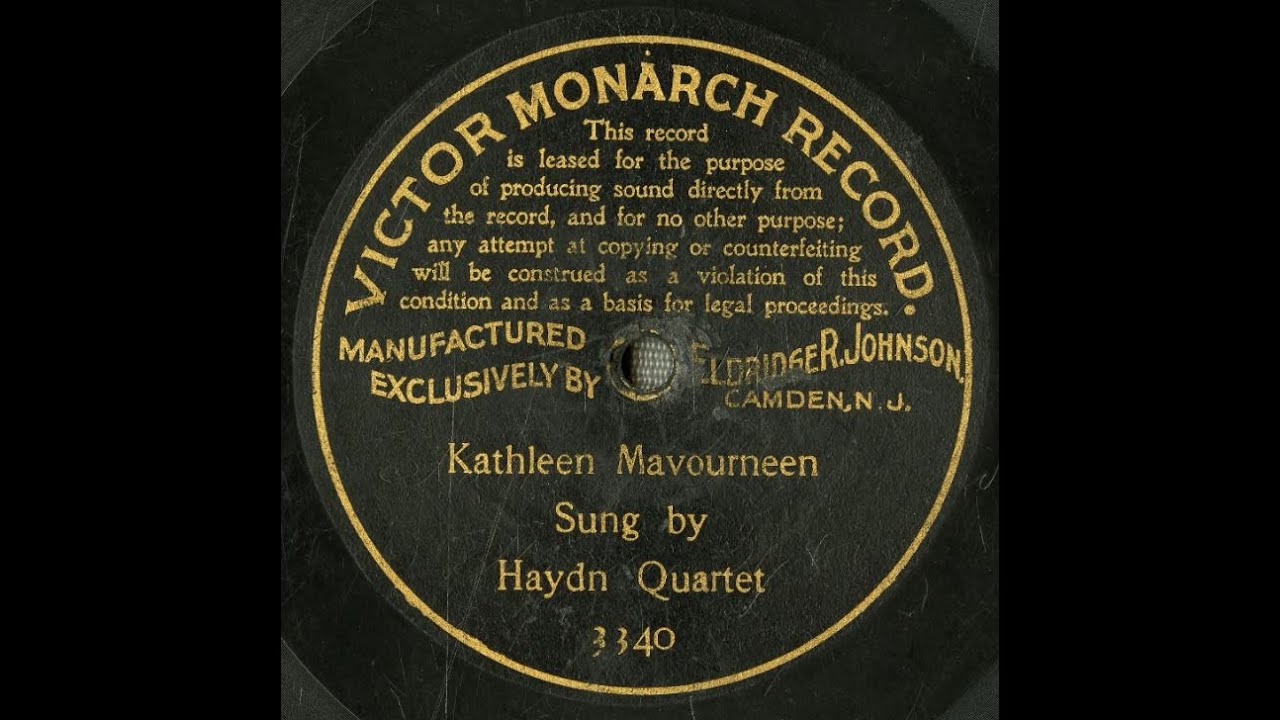
"Kathleen Mavourneen" Haydn Quartet Harry Macdonough, S. H. Dudley, William F. Hooley, John Bieling
Автор: Tim Gracyk
Загружено: 2025-10-21
Просмотров: 39
Описание:
Kathleen Mavourneen! The grey dawn is breaking,
The horn of the hunter is heard on the hill
The lark from her light wing the bright dew is shaking
Kathleen Mavourneen! What slum bring still.
Oh hast thou forgotten how soon we must sever?
Oh hast thou forgotten this day we must part,
It may be for Years, and it may be forever
Oh why... art thou silent, thou voice of my heart,
It may be for Years and it may be forever,
Then why art thou silent Kathleen Mavourneen.
Kathleen Mavourneen! Awake from thy slumbers,
The blue mountains glow in the sun's golden light,
Ah! where is the spell that once hung on my numbers,
Arise in thy beauty, thou star of my night
Arise in thy beauty, thou star of my night
Mavourneen, Mavourneen, my sad tears are falling,
To think that from Erin and thee I must part,
It may be for Years, and it may be forever,
Then why art thou silent thou voice of my heart ,
It may be for Years...and it may be forever,
Then why....art thou silent Kathleen Mavourneen.
If you saw the Gettysburg made-for-TV film, you may recall Confederate General Lewis Armistead talking about how Hancock's wife sang this song in California when the three (and others) were at a social gathering. It was years earlier. He talks about this song when speaking to Pete Longstreet on the night before Pickett's Charge on July 3, 1863, Armistead's troops attacked the Union line commanded by Hancock. Armistead was wounded.
One of the three most popular quartets of the acoustic recording era (along with the Peerless and American), the Haydn Quartet made many records from 1898 to 1914. The quartet's Victor discs, cut from the earliest days of the Victor company through 1914, were especially popular. On most Victor discs, the singers are first tenor John Bieling, second tenor Harry Macdonough, baritone S. H. Dudley, and bass William F. Hooley.
The Haydn was the same as the Edison Male Quartet, which had been established in 1894 (by the time the Haydn name was adopted for Berliner discs, original Edison Quartet members Roger Harding and James Reynard had left). The March 1899 issue of The Phonoscope indicates that Haydn members at that time were a tenor named "Belling" (this was Charles Belling, not an error for "Bieling" though Bieling did sing at times for the quartet), tenor Jere Mahoney, S. H. Dudley, and William F. Hooley.
A National Gram-o-phone Company catalog dated April 1899 establishes that two sets of tenors were used around this time--Fred Rycroft and Charles Belling for records of a "serious" nature, such as hymns, and Bieling and Mahoney on lighter numbers (it seems Bieling and Mahoney did not have trained voices, so they were less suited for sacred numbers). It states, "Records by this Quartet, Messrs. Rycroft, Dudley, Belling, and Hooley, are of the highest class. Each member of the Quartet is a soloist of marked ability, and their selections are especially well sung. Since our last catalogue issue two new tenors have been added to the Haydn Quartet. The comedy and lighter records are still sung by the old Quartet, but the sacred and standard quartets are sung by Messrs. Rycroft and Belling, tenors of Trinity Church Choir, and Messrs. Dudley and Hooley, basses."
Harry Macdonough began recording for Berliner in September 1899, and he evidently replaced Mahoney around this time. Macdonough was versatile, and Charles Belling must have decided he was no longer needed--around this time he left. It is likely that Bieling and Rycroft alternated as first tenor, depending on the music, until the end of the Berliner era, around June 1900. Presumably Bieling was first tenor on Victor discs in 1900, Rycroft gone.
The name "Haydn" was chosen in memory of composer Franz Joseph Haydn. The quartet's repertoire shared nothing with Haydn's works, but quartets were sometimes named after famous composers. Other examples include the Mozart Male Quartet, which made Berliner discs in late 1896; the Mendelssohn Mixed Quartet, which made Victor discs beginning in 1902 and Columbia records in 1903; the Handel Mixed Quartet, which made a Victor disc in 1906; and the Gounod Mixed Quartet, which made Okeh discs.
The quartet's members must not have known the standard pronunciation of "Haydn" since the quartet's name was always pronounced to rhyme with "maiden." In fact, in 1912 spelling of the quartet's name was changed to "Hayden" to conform to the pronunciation that members had been using. The Pronunciation Table at the back of Victor catalogs gives different pronunciations for the names Haydn (the composer is "High-dn") and Hayden (the quartet is "Hay-den").
The quartet made its Berliner debut on June 27, 1898. Dudley was the group's manager.
Повторяем попытку...
Доступные форматы для скачивания:
Скачать видео
-
Информация по загрузке: