Nature of Sources and Historical Construction || Podcast ||
Автор: CodeYourSelf
Загружено: 2026-01-03
Просмотров: 1
Описание:
Sources of Ancient Indian History
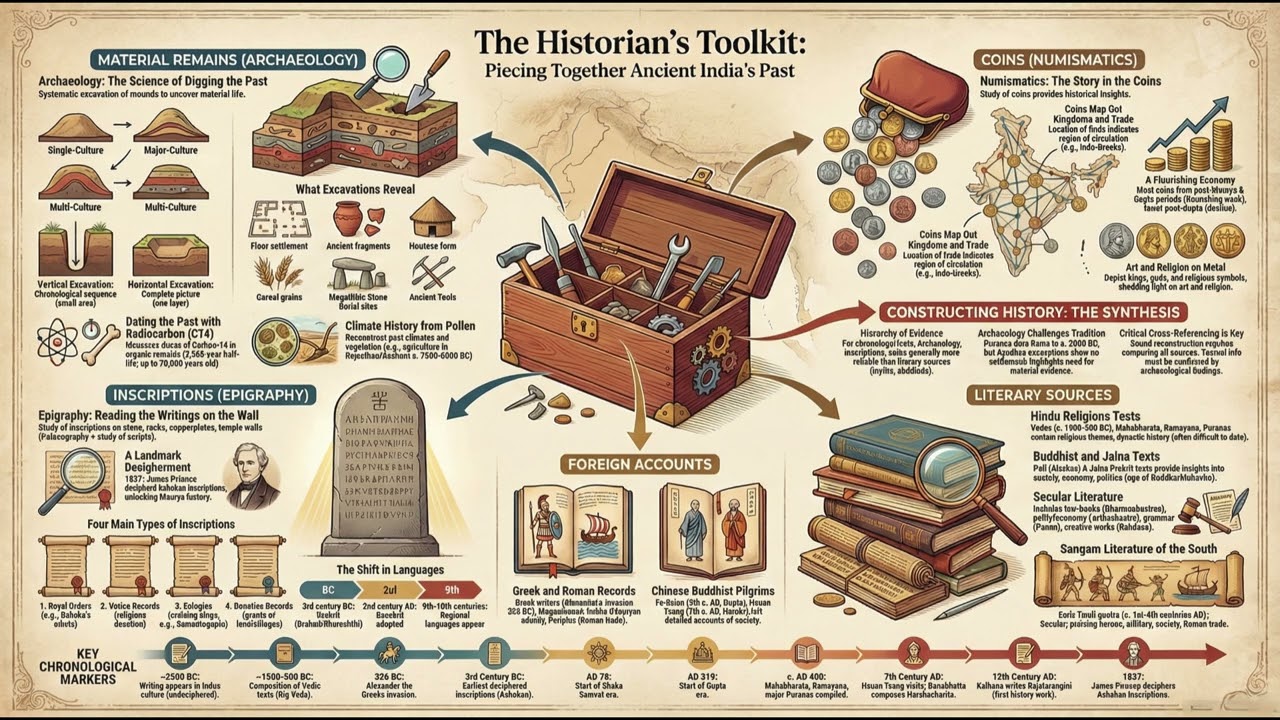
1. Prehistory concerns the period with no written sources, while history is based on written material. Archaeology is used to study prehistory through material remains like tools and fossils, and it remains a vital source for historical periods, helping to corroborate or challenge information found in literary texts, especially for pre-Ashokan times.
2. The three types of mounds are single-culture (representing only one culture), major-culture (one dominant culture with others of secondary importance), and multi-culture (several important cultures in succession). They can be excavated vertically (lengthwise digging to see a sequence of cultures) or horizontally (digging the whole mound to get a complete picture of one period).
3. Radiocarbon dating measures the loss of radioactive Carbon 14 (C14), which is present in all living objects and decays at a uniform rate after death. By measuring the remaining C14 content, the age can be determined based on its half-life of 5568 years. Its primary limitation is that it cannot date any object older than 70,000 years.
4. The large number of coins from the post-Maurya period (made of lead, copper, silver, gold, etc.) and the significant quantity of gold coins issued by the Guptas indicate that trade and commerce flourished during these eras. Conversely, the scarcity of coins from the post-Gupta period suggests a decline in trade and commerce.
5. The four main types of inscriptions are: royal orders on administrative, social, or religious matters; votive records expressing devotion by followers of various religions; eulogies praising the achievements of kings and conquerors; and donative records documenting gifts of land, cattle, and other items for religious purposes.
6. James Prinsep was a civil servant working for the East India Company in Bengal. In 1837, he was the first person to successfully decipher the Ashokan inscriptions, which were primarily written in the Brahmi script, a feat that had eluded Indian pandits and earlier British scholars.
7. The Mahabharata began as Jaya, a collection of 8800 verses about victory. It expanded to 24,000 verses and became known as Bharata, containing stories of the Bharata tribe. Its final compilation reached 100,000 verses and was named the Mahabharata, incorporating narrative, descriptive, and didactic material from the later Vedic period to the Gupta period.
8. Sangam literature is a body of secular Tamil poetry composed by poets in assemblies (Sangams) patronized by chiefs and kings, compiled during the first few centuries AD. It is a major source for the social, economic, and political life in deltaic Tamil Nadu, providing details on heroes, military exploits, and trade with foreigners like the Yavanas (Greeks/Romans).
9. The Indika by Megasthenes provides valuable information on Maurya administration and society, and its mention of "Sandrokottas" (Chandragupta Maurya) served as the sheet anchor for ancient Indian chronology. The Periplus of the Erythrean Sea, written by an anonymous author, describes Roman trade routes and commerce with India in the Indian Ocean, Red Sea, and Persian Gulf.
10. The text argues that archaeological evidence is more reliable because it provides tangible, datable proof that can challenge tradition-based timelines. For example, Puranic traditions might date Rama of Ayodhya to 2000 BC, but excavations show no settlement at that time. Similarly, coins, inscriptions, and archaeological finds are considered more important than mythologies in the epics, which may serve to validate social norms rather than record factual events.
Повторяем попытку...
Доступные форматы для скачивания:
Скачать видео
-
Информация по загрузке: