The lab of Patsy Dickinson: Students learn about central pattern generators
Автор: Bowdoin College
Загружено: 2016-08-29
Просмотров: 345
Описание:
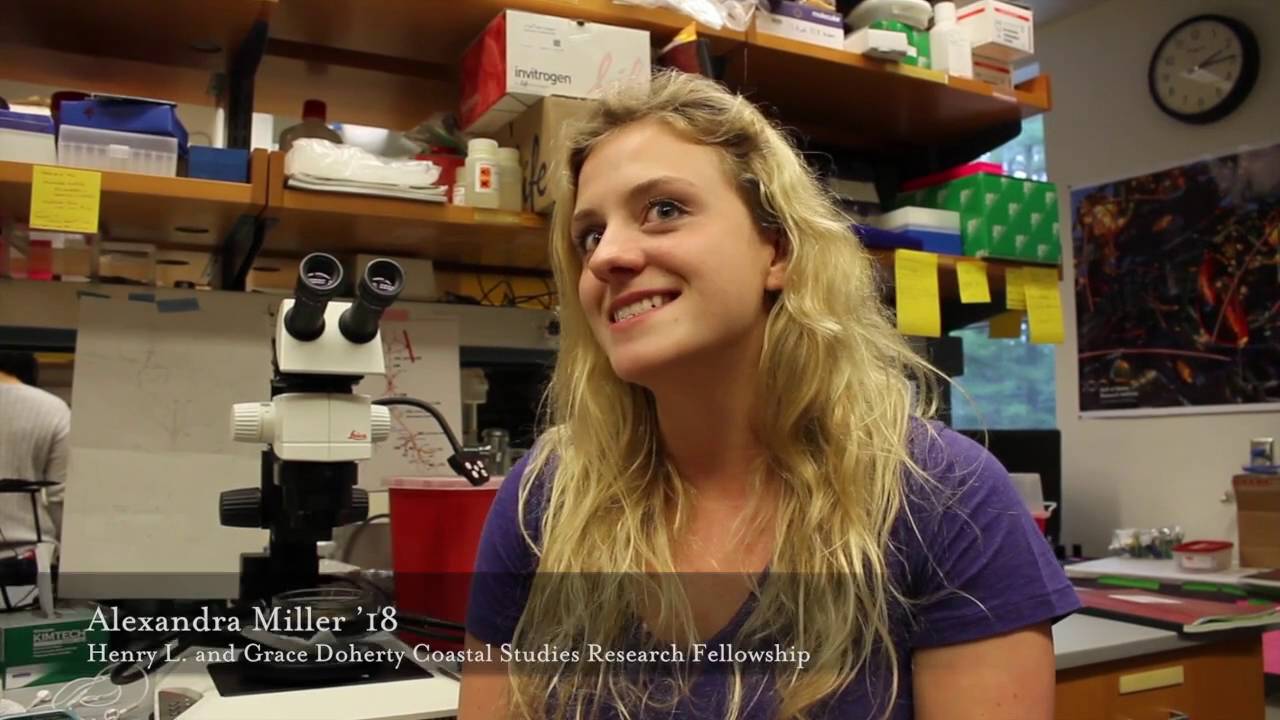
Alexandra Miller ’18 and Scout Gregerson ’18, for example, received Henry L. and Grace Doherty Coastal Studies Research Fellowships to research the stomatogastric nervous systems of crabs, which control movements of the foregut and stomach. “We’re interested in the question of how this system is modulated, or changed, in response to molecules called neuropeptides," Gregerson said. Neuropeptides cause a specific set of neurons to change the pattern in which they are firing. “We use model species, like lobsters or crabs, because they’re very simple but highly analogous to vertebrates, like humans,” she added.
Patrick Walsh ’17, who also had a Henry L. and Grace Doherty Coastal Studies Research Fellowship, researched a neuropeptide that causes a decrease in contraction amplitude in some lobster hearts and an increase in contraction amplitude in others. “Normally a peptide elicits a single physiological response, so seeing a double response is strange,” he said. “It’s thought that the molt cycle might affect it. During molt-cycle phases, lobsters might have to change how strongly the heart beats.”
Walsh added, "By understanding how central pattern generators are modulated in anatomically more simple systems, you can apply what you learn to vertebrates, like people, and how we respond to neuropeptides."
Other student researchers in Dickinson’s lab were Catherine Liu ’19, Sovannarath Pong ’18, Helen Gandler ’17, Xuan Qu ’17, Devlin Shea ’18, Elizabeth Miller ’18, Tess Lameyer ’16, and Meredith Stanhope ’18. All were supported by Henry L. and Grace Doherty Coastal Studies Research Fellowships.
Повторяем попытку...
Доступные форматы для скачивания:
Скачать видео
-
Информация по загрузке: