Chapter SOUND - class 8 (under 30 mins)
Автор: Science, sst by -Keshav Tyagi
Загружено: 2026-01-13
Просмотров: 10
Описание:
Mediums of Sound Travel
Sound can travel through:
Solids
Liquids
Gases
When an object vibrates, it pushes nearby particles. Those particles push the next particles, and this chain continues. Without particles, the sound cannot move forward.
Sound Does NOT Travel in Vacuum
Vacuum is a space with no particles.
Since sound needs particles to travel, it cannot travel in vacuum.
This is why astronauts cannot hear each other in space unless using special radio equipment.
Speed of Sound
Sound travels at different speeds in different mediums:
Fastest in Solids (particles are tightly packed)
Slower in Liquids
Slowest in Gases
Example:
When you place your ear on a railway track, you hear an approaching train earlier through the solid track than through the air.
3. Sound Waves
When sound travels, it does not carry matter with it. It transfers energy from one place to another in the form of waves.
Longitudinal Waves
Sound waves in air are longitudinal.
This means particles of the medium move back and forth in the same direction as the wave travels.
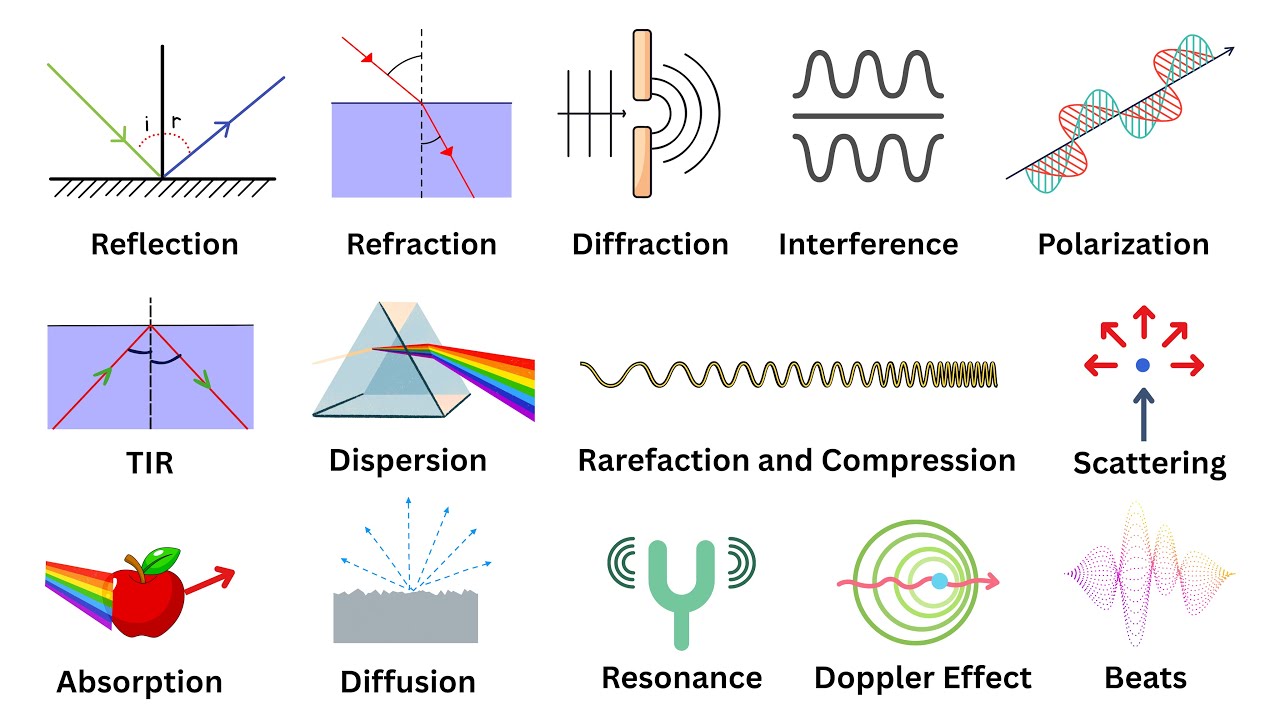
Compressions and Rarefactions
As the sound wave travels:
Compression: particles are pushed together → high pressure region
Rarefaction: particles spread apart → low pressure region
A continuous pattern of compressions and rarefactions forms a sound wave.
4. Characteristics of Sound
Sound has properties that affect how it is heard.
A. Amplitude
Amplitude is the maximum displacement of a particle from its rest position.
It decides how loud a sound is.
Relationship with Loudness
Large amplitude → louder sound
Small amplitude → softer sound
Example:
Speaking loudly increases amplitude.
Whispering lowers amplitude.
B. Frequency
Frequency is the number of vibrations per second.
Measured in Hertz (Hz).
Relationship with Pitch
High frequency → high pitch (sharp sound)
Low frequency → low pitch (deep sound)
Examples:
A mosquito sound is high pitch.
A drum beat is low pitch.
Women often have higher pitch than men.
C. Time Period
The time taken to complete one vibration.
Formula:
Time Period
=
1
Frequency
Time Period=
Frequency
1
If frequency increases, the time period decreases.
D. Loudness
Loudness tells us how strong or weak a sound is.
Measured in Decibels (dB).
Example loudness levels:
Whisper → 30 dB
Normal speaking → 60 dB
Heavy traffic → 80–90 dB
Jet engine → 120 dB
Loud sounds can damage hearing if exposed for long.
5. Audible and Inaudible Sounds
Humans can hear only a small range of sound frequencies.
Human Hearing Range
Humans can hear sounds between:
20 Hz and 20,000 Hz
Infrasonic Sounds
Below 20 Hz
Too low for humans to hear
Used by elephants and whales to communicate over long distances
Ultrasonic Sounds
Above 20,000 Hz
Too high for humans to hear
Used by bats for navigation
Used in medical imaging (ultrasound)
6. Human Voice Production
Sound in humans is created by the voice box (larynx).
Vocal Cords
Inside the larynx are two stretched cords called vocal cords. When air from the lungs passes through them, they vibrate and produce sound.
Differences in Vocal Cords
Men have thicker, longer vocal cords → lower pitch
Women have thinner vocal cords → higher pitch
Children have very thin cords → very high pitch
By tightening or relaxing these cords, we change our pitch while speaking or singing.
7. How We Hear Sound
The hearing process involves several steps:
1. Outer Ear
The pinna collects sound waves.
The waves enter the ear canal.
2. Eardrum
The sound waves hit the eardrum (a thin membrane).
It starts vibrating.
3. Middle Ear
Contains three tiny bones:
Hammer
Anvil
Stirrup
These bones amplify the vibrations and pass them to the inner ear.
4. Inner Ear
Contains the cochlea (a fluid-filled structure).
Vibrations create waves in the fluid.
Hair cells convert vibrations into electrical signals.
5. Brain
The auditory nerve carries signals to the brain.
The brain interprets these signals as sound.
8. Noise and Music
Music
Pleasant, rhythmic, organized, and soothing.
Created by instruments or singing.
Noise
Unpleasant, irregular, and disturbing.
Examples: traffic, construction, loudspeakers.
Noise Pollution
When noise crosses safe levels, it becomes noise pollution.
Sources of Noise Pollution
Honking and traffic
Loudspeakers and DJs
Construction machinery
Industrial machines
Household appliances like mixers
Effects of Noise Pollution
Headaches
Stress and irritation
Difficulty concentrating
Lack of sleep
Risk of hearing loss
Reduced learning ability in children
Ways to Control Noise Pollution
Avoid unnecessary honking
Use soundproofing in noisy areas
Maintain vehicles and machines
Use ear protection in loud places
Reduce speaker volume
Plant trees (trees absorb sound)
Follow restricted hours for loud music
Повторяем попытку...

Доступные форматы для скачивания:
Скачать видео
-
Информация по загрузке: