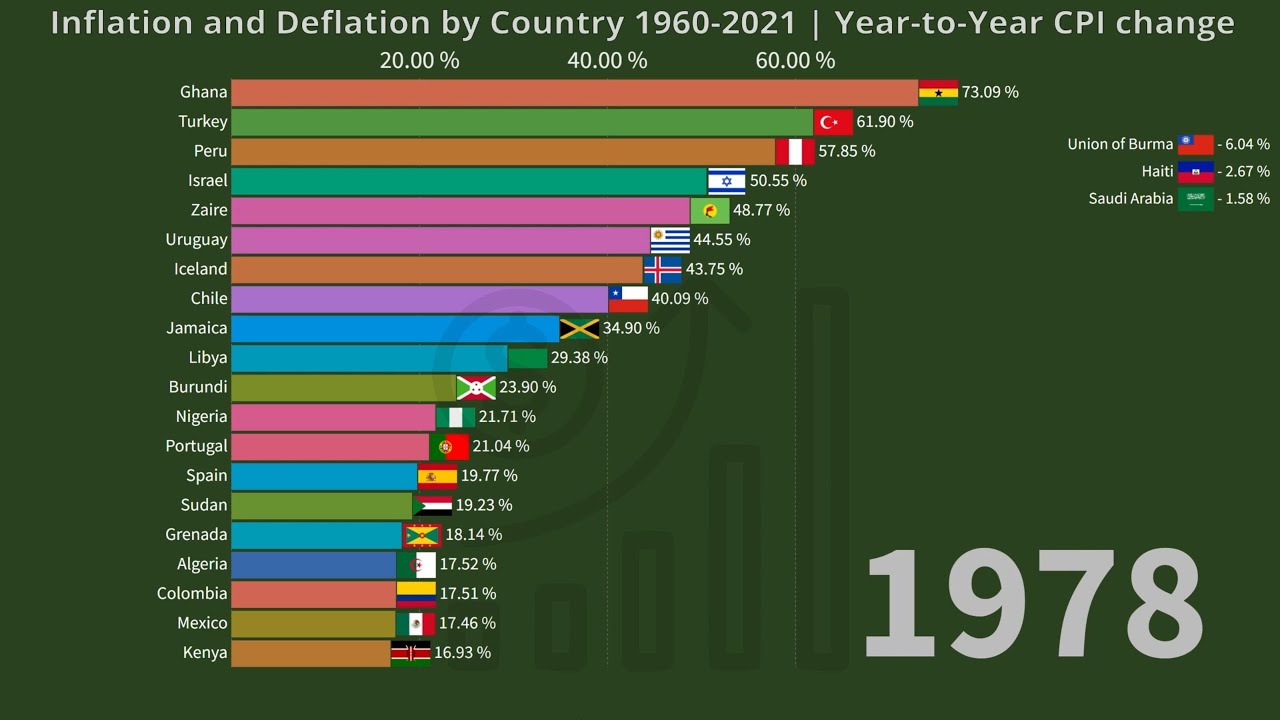
Inflation and Deflation by Country 1960-2021
Автор: What Da Stat
Загружено: 2022-03-26
Просмотров: 250
Описание:
This bar chart race shows the year-to-year inflation and deflation rates by country/territory from 1960 to 2021.
INFLATION is an economic term used to describe a sustained increase in the general price level of goods and services in an economy over a period of time. It is measured by the percentage change in a price index, such as the Consumer Price Index (CPI), over a specified period. Inflation can be caused by a variety of factors, including increased demand for goods and services, a decrease in the supply of money and credit, and rising production costs.
When the general price level rises, each unit of currency buys fewer goods and services; consequently, inflation reflects a reduction in the purchasing power of money. If inflation is not kept in check, it can lead to economic problems, such as reduced purchasing power, reduced competitiveness, and economic instability. Central banks, such as the Federal Reserve in the United States, aim to maintain price stability by controlling the supply of money and credit, and implementing monetary policy to keep inflation within a target range.
DEFLATION is a sustained decrease in the general price level of goods and services in an economy over a period of time. It is measured by the percentage change in a price index, such as the Consumer Price Index (CPI), over a specified period. Unlike inflation, deflation reduces the general level of prices, making each unit of currency worth more in terms of purchasing power.
Deflation can occur when there is a decrease in demand for goods and services, an increase in the supply of money and credit, or a decrease in production costs. However, deflation can also have negative effects on an economy. When prices are falling, consumers may delay purchases in the hope of getting a better price later, leading to decreased demand and economic contraction. Additionally, declining prices can lead to reduced profits for businesses and increased unemployment.
To prevent deflation and maintain price stability, central banks may implement monetary policies, such as lowering interest rates and increasing the money supply, to boost demand and increase inflation. Deflation is considered to be a more difficult economic challenge to tackle than inflation, as the latter can be addressed through traditional monetary policy tools.
Notes:
Numbers are shown when reported.
USSR, German Democratic Republic (East Germany) and Cuba are not included.
Argentina: From 1980, up to and including December 2016, annual inflation was calculated on the basis of the CPI for Greater Buenos Aires; and from January 2017 onwards, calculations are based on the National CPI.
Sources:
IMF, World Bank, Yugoslavia: Ashok Kumar Lahiri and J. van Houten, Yugoslav Inflation and Money (1991)
Music:
Whitesand - The Beast
https://whitesandcomposer.com
https://whitesand.bandcamp.com/
• The Beast - Epic Instrumental Music
Special Effect by:
AA VFX: / dvdangor2011
#inflation #deflation #hyperinflation Data visualization created with flourish.studio Data visualization created with flourish.studio https://flourish.studio
Повторяем попытку...
Доступные форматы для скачивания:
Скачать видео
-
Информация по загрузке: