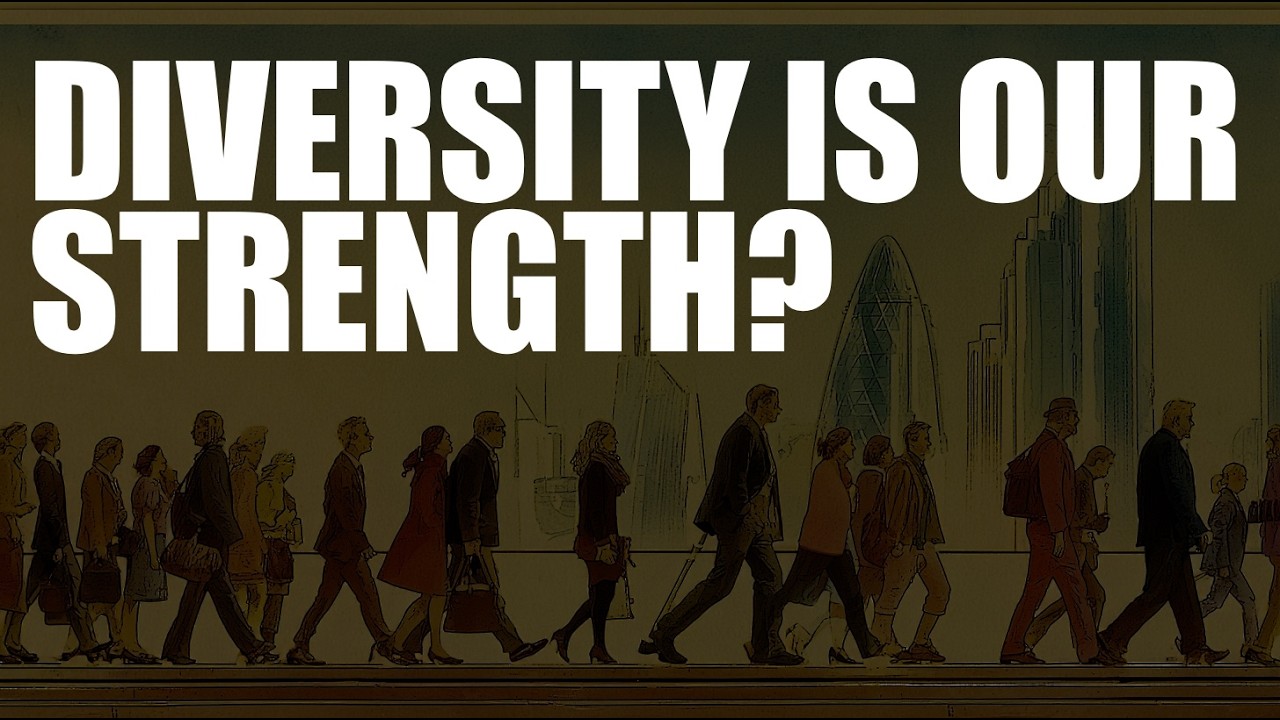
Diversity is our strength?
Автор: MANIQ
Загружено: 2026-02-23
Просмотров: 1
Описание:
There’s a phrase we’ve all heard:
“Diversity is our strength.”
But lately, you hear something else.
“No, diversity is not our strength. Look around. Is it working?”
At first glance, that sounds like a direct attack on multiculturalism.
But I don’t think that’s the whole story.
Because when you really examine the tension in plural societies, the deeper issue doesn’t seem to be diversity itself.
It seems to be something else.
Control.
Speed.
And cultural acceleration.
When people say diversity isn’t working, what are they usually pointing to?
Social fragmentation.
Declining trust.
Parallel communities.
Religious tension.
Political polarization.
Those concerns aren’t imaginary.
Social cohesion matters.
Trust matters.
Shared norms matter.
But here’s the interesting part.
Many of the same problems show up in relatively homogeneous countries too.
Political division.
Institutional distrust.
Economic anxiety.
So if fragmentation exists in both diverse and homogeneous societies, maybe diversity isn’t the root variable.
Maybe modernization is.
Historically, every major wave of demographic change triggered fear.
In the late 1800s, Americans believed Irish Catholics would never assimilate.
Italians were viewed as criminally inclined.
Jews were seen as culturally incompatible.
Those fears felt existential at the time.
Today, those groups are simply considered part of the mainstream.
The pattern is consistent.
Cultural friction spikes.
Then it fades over generations.
The problem is — it takes time.
Usually one or two generations.
And we live in an era that moves at algorithmic speed.
Technology has changed the timeline.
Migration reshapes neighborhoods in years, not decades.
Social media amplifies every cultural clash instantly.
Outrage is monetized.
So instead of gradual adjustment, it feels like permanent agitation.
The integration process is slow.
The emotional reaction is fast.
That mismatch creates tension.
But here’s where things get interesting.
Technology might also be the tool that stabilizes plural societies.
It exposes people to different cultures daily.
It accelerates hybrid identities.
It can fact-check misinformation in real time.
It can increase transparency in governance.
It can challenge our cognitive biases.
If deployed responsibly, AI could function as a quiet corrective layer.
Not replacing human judgment.
But refining it.
And this brings us to a harder question.
Is racism or discrimination logically defensible as a long-term organizing principle?
From a systems perspective, the answer is no.
Societies that restrict opportunity based on race or identity waste human capital.
They reduce innovation.
They fracture trust.
They destabilize themselves.
Discrimination may feel emotionally clarifying in times of uncertainty.
But it is structurally inefficient.
It narrows your talent pool.
It creates internal friction.
And over time, it weakens the system.
So maybe the real issue isn’t diversity.
Maybe it’s whether institutions can manage rapid change competently.
Because diversity amplifies whatever foundation already exists.
Strong institutions?
It compounds innovation.
Weak institutions?
It compounds instability.
Human beings are primitive in many ways.
We evolved in small tribes, not massive pluralistic democracies.
We default to in-group thinking.
We react emotionally before rationally.
But we’re also adaptable.
History shows that moral circles expand.
Tribes become nations.
Nations become alliances.
Rights expand.
Norms evolve.
The question isn’t whether humans are irrational.
We are.
The question is whether technology — especially AI — can help us evolve faster than our tribal instincts can destabilize us.
I’m cautiously optimistic.
Not because humans are perfectly rational.
But because over long arcs, we tend to adapt to survive.
And survival requires cooperation.
Plural societies aren’t doomed.
But they require competent governance, clear civic baselines, and time.
The tension we’re experiencing may not be collapse.
It may be transition.
And transitions are always uncomfortable.
That’s the real conversation.
Not whether diversity is good or bad.
But how we manage change in an age that moves faster than human psychology evolved to handle.
Повторяем попытку...
Доступные форматы для скачивания:
Скачать видео
-
Информация по загрузке:





![Kto strzela w Iran? Trump czy Netan****? Radek Pogoda [Expert w Bentleyu Świat]](https://imager.clipsaver.ru/sd6aQQbH3CE/max.jpg)