How Accessible Work–Life Policies Reduce Absenteeism and Boost Performance
Автор: NewReD Scientific Outreach
Загружено: 2025-10-28
Просмотров: 4
Описание:
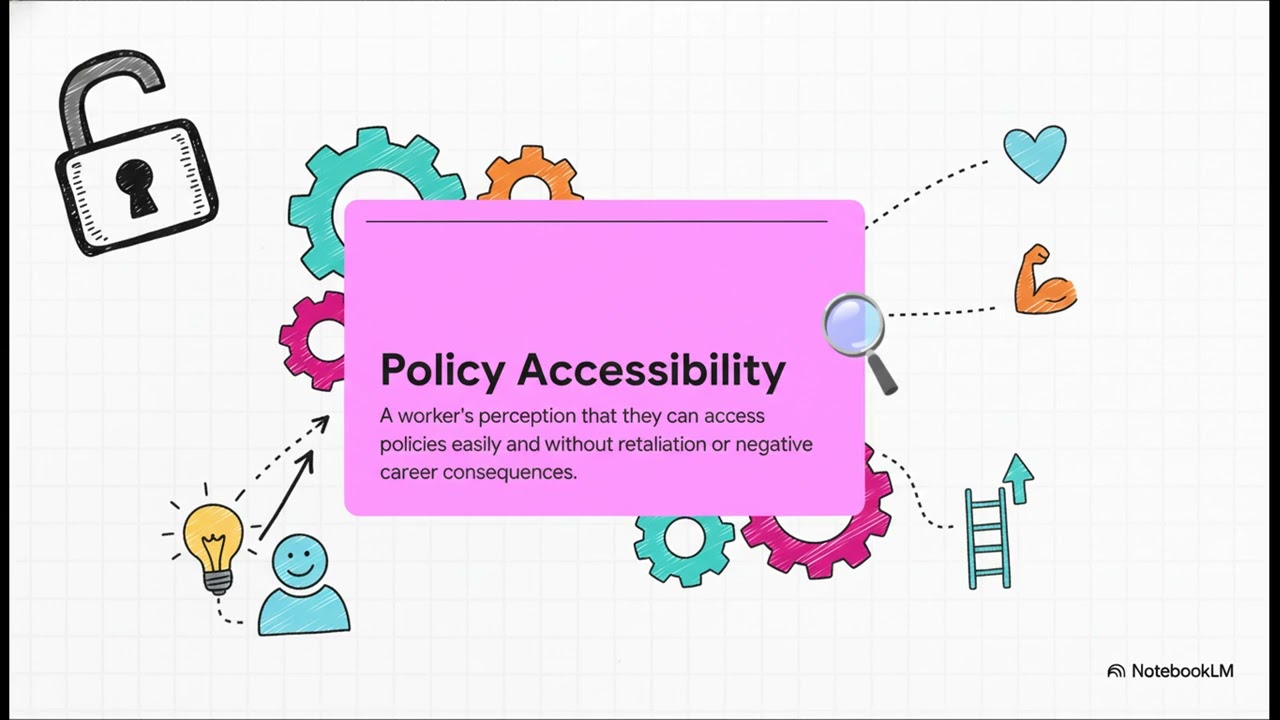
The video examines why well-intentioned employee benefit policies often fail to reduce absenteeism or boost performance. In Spain, absenteeism has reached 5.3%, harming productivity and workplace harmony. Many firms introduce work–life balance measures such as remote work or flexible hours, yet research shows that merely having these policies “on paper” has little real effect. The key issue is perceived accessibility: employees may fear that using these benefits will make them seem less committed or harm promotion prospects. This fear turns progressive initiatives into “paper tiger policies”—impressive but ineffective. When employees genuinely feel safe to use such benefits, stress and work–family conflict decline, improving emotional wellbeing and physical health. Healthier, less-stressed employees are more present, engaged, and productive. Thus, policies do not directly enhance performance; they serve as catalysts for wellbeing, and wellbeing drives better results. The real solution lies in organisational culture: leaders must model the use of these benefits and foster psychological safety, showing that balance and wellbeing are signs of strength, not weakness. By embedding trust and support, companies can transform symbolic policies into genuine tools for health, motivation, and productivity.
Other articles recommended by members of this research team: https://doi.org/10.1108/JKM-07-2022-0537 https://doi.org/10.1016/j.eswa.2021.115005 https://doi.org/10.1504/IJASM.2020.109245 https://doi.org/10.3989/redc.2018.3.1532 https://doi.org/10.4018/JOEUC.364099 https://doi.org/10.1080/13683500.2024.2381241 https://doi.org/10.1016/j.jhtm.2023.08.018 https://doi.org/10.3390/ijerph18041893 https://doi.org/10.1080/09585192.2018.1505762 https://doi.org/10.3390/su12145519 https://doi.org/10.1108/ARLA-08-2015-0202 http://dx.doi.org/10.3926/ic.506 https://doi.org/10.1108/BFJ-04-2022-0388 https://doi.org/10.3145/epi.2023.may.20 https://doi.org/10.1016/j.ijme.2022.100631 https://doi.org/10.1016/j.ijme.2021.100536 https://doi.org/10.1108/ARLA-01-2024-0005 https://doi.org/10.3390/su12125003 https://doi.org/10.1007/S11365-013-0292-1 https://doi.org/10.1016/j.ijhm.2011.08.003 https://doi.org/10.1177/0266242610369753 https://doi.org/10.1016/j.jbusres.2022.113604 https://doi.org/10.1007/s11365-022-00826-1 https://doi.org/10.1016/j.ijme.2021.100547 https://doi.org/10.1080/03075079.2018.1539959 https://doi.org/10.1007/s11365-019-00586-5 https://doi.org/10.1002/bse.2413 https://doi.org/10.1108/IJCHM-09-2020-0981 https://doi.org/10.3390/su12208697 https://doi.org/10.1108/IMDS-07-2015-0315 https://doi.org/10.1108/PR-05-2017-0165 https://doi.org/10.1016/j.jclepro.2015.04.016 https://doi.org/10.1108/SRJ-09-2017-0175 https://doi.org/10.1108/JSBED-07-2020-0257 https://doi.org/10.1108/IJPSM-09-2020-0259 https://doi.org/10.3390/ijerph18158011 https://doi.org/10.1108/BFJ-08-2024-0816
Повторяем попытку...
Доступные форматы для скачивания:
Скачать видео
-
Информация по загрузке:





![4 типа льгот для сотрудников, которые должен знать каждый HR-специалист [ОБНОВЛЕНИЕ]](https://image.4k-video.ru/id-video/boG6mZnPXXA)


