GLASS CALORIMETER || WOOD CALORIMETER || TYPES OF CALORIMTER || CH#07 || CHEMISTRY -I || URDU &HINDI
Автор: Today Chemistry By MUHAMMAD TALHA NOOR
Загружено: 2021-04-03
Просмотров: 366
Описание:
A calorimeter is an object used for calorimetry, or the process of measuring the heat of chemical reactions or physical changes as well as heat capacity. Differential scanning calorimeters, isothermal micro calorimeters, titration calorimeters and accelerated rate calorimeters are among the most common types. A simple calorimeter just consists of a thermometer attached to a metal container full of water suspended above a combustion chamber. It is one of the measurement devices used in the study of thermodynamics, chemistry, and biochemistry.
To find the enthalpy change per mole of a substance A in a reaction between two substances A and B, the substances are separately added to a calorimeter and the initial and final temperatures (before the reaction has started and after it has finished) are noted. Multiplying the temperature change by the mass and specific heat capacities of the substances gives a value for the energy given off or absorbed during the reaction. Dividing the energy change by how many moles of A were present gives its enthalpy change of reaction.
The glass calorimeter is the instrument used in measuring the heat of reaction. If the heat of reaction is large, we can detect exothermic and endothermic reactions by feeling the temperature of the reaction vessel before and after the reaction. If the reaction is
Exothermic, there is a rise in temperature so the reaction vessel feels warm;
Endothermic, there is a fall in temperature so the reaction vessel feels cool.
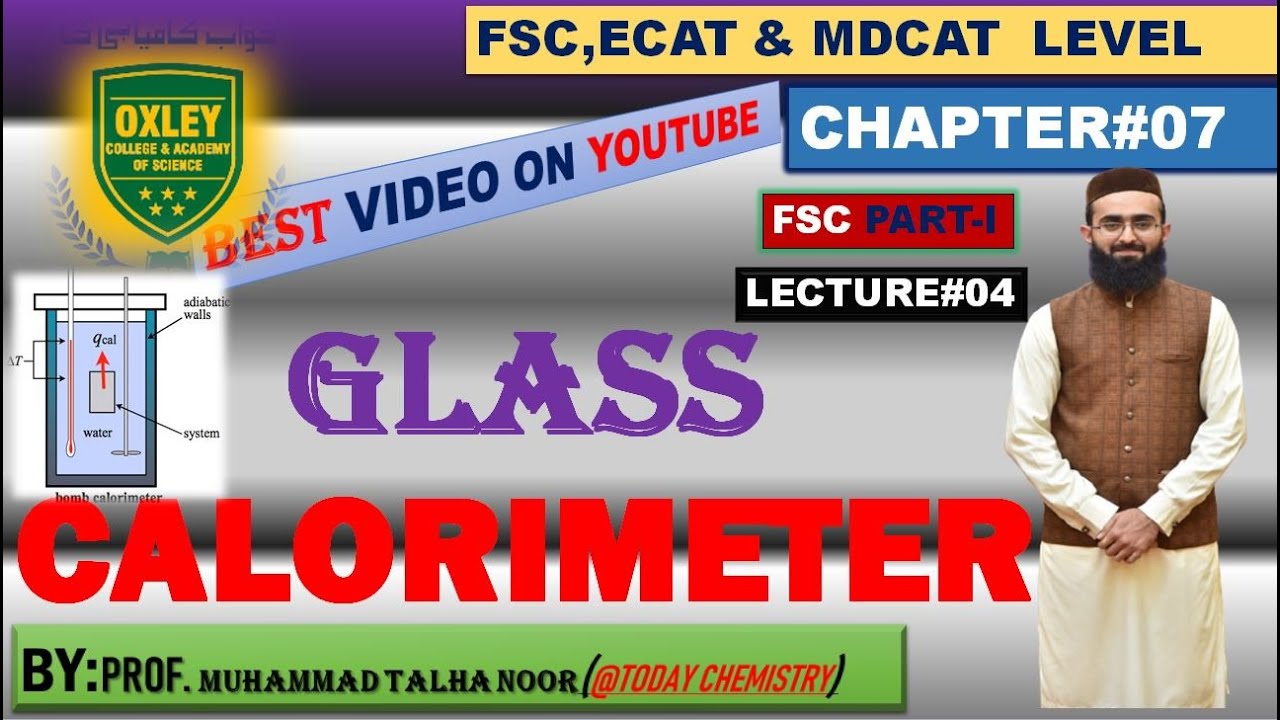
There are several types of calorimeters. The bomb calorimeter is very sensitive and is used in nutrition studies. The glass calorimeter is used to determine the ΔH of most chemical reactions. Reactants in stoichiometric amounts are placed in the calorimeter. As the reaction proceeds, the heat energy evolved or absorbed will either warm or cool the system. The temperatures of the system before and after the reaction are recorded.
In 1761 Joseph Black introduced the idea of latent heat which led to the creation of the first ice calorimeters.[1] In 1780, Antoine Lavoisier used the heat from the guinea pig's respiration to melt snow surrounding his apparatus, showing that respiratory gas exchange is combustion, similar to a candle burning.[2] Lavoisier dubbed this apparatus the calorimeter, based on both Greek and Latin roots. One of the first ice calorimeters was used in the winter of 1782 by Lavoisier and Pierre-Simon Laplace, which relied on the heat required to melt ice to water to measure the heat released from chemical reactions.[3]
Повторяем попытку...
Доступные форматы для скачивания:
Скачать видео
-
Информация по загрузке: