Meeker Massacre! Old West History!
Автор: Family Tree Nuts, History & Genealogy Service
Загружено: 2024-09-09
Просмотров: 4611
Описание:
This massacre in a little town in northwest Colorado led to one of the largest losses of land for native tribes in the Old West. The attempt to Christianize and “civilize” the Indians backed the Ute Nation into a corner and put them in a rage to preserve their way of life. The U.S. army was called in, including some Buffalo Soldiers, to help calm the uprising. But the fire was too hot and exploded into a bloody battle and vicious massacre. There were no winners in this conflict. In this video, I’ll show you the sights and tell the story of what is known today as the Meeker Massacre.
Gold was discovered in Colorado in the late 1850s, and white settlers exploded into the territory, even though much of it belonged the Utes. At that time, the Utes held a large territory of approximately 125,000 square miles. Under the Ute Treaty of 1863, the Utes were confined to a much smaller area of land mostly in western Colorado. Indian agencies were soon established in Colorado. In 1868, the Hunt Treaty was signed which preserved the Ute’s right to hunt in the Glenwood Springs area.
In 1878, Nathan Meeker was appointed as the Indian agent in the White River Indian Agency. Meeker was known for introducing irrigation to the west. His mission was to Christianize them and to “control the nomadic Utes by instilling an agricultural life-style”. The Utes would not and could not conform to the ways of a farmer. Still, Meeker pushed them to build houses and plow fields. Meeker wrote in his letter to the Department of Indian Affairs, “their needs are so few that they do not wish to adopt civilized habits. What we call conveniences and comforts are not sufficiently valued”. The act that lit the match was when Meeker had the Ute’s horseracing track plowed into a field. The Utes began to show anger and resistance, and even physically assaulted Meeker at least once. Meeker began to fear the worst and called for the military to come to the agency.
U.S. Army Major T.T. Thornburgh was sent from Fort Steele, in Rawlings, Wyoming to help maintain the peace. He brought a detachment of three companies, with one hundred fifty-three soldiers, including some Buffalo Soldiers, and twenty-five civilian militiamen. The Utes surely remembered the Sand Creek Massacre fifteen years earlier and felt that they needed to stand up to the soldiers. While the army was in route, they were intercepted by three Ute leaders that told Thornburgh that bringing armed troops onto the reservation would cause an uprising. Major Thornburgh misunderstood the communication with the Utes and thought they were saying that they would not fight.
On 29 September 1879, Major Thornburgh crossed onto the Ute Reservation in what would be called the White River Expedition. The Utes, under the command of Chief Colorow, met up with the army near Milk Creek. Both sides were not sure of the other groups intentions when they came upon each other. A hat was dropped, which was likely by accident, and it was taken as a cue to begin firing. Both sides almost simultaneously fired on the other and the Battle of Milk Creek was on. Joseph Rankin, who was one of the scouts with the army escaped the battle and rode one hundred sixty miles in twenty-seven and a half hours, back to Rawlings, Wyoming. The first thing he did when he got back to Rawlings was to hit Foote’s Saloon where he had a few drinks to calm his nerves. He then went to the Carbon County Clerk to wire the news back east.
Due to Rankin’s heroic ride, the army was reenforced out of Fort Lewis in southern Colorado, by Captain Francis Dodge and his thirty-five Buffalo Soldiers. The battle lasted the next six days. At the end of the fighting, thirty-seven Utes had been killed and thirteen soldiers, including Major Thornburgh. Seventy-five percent of the horses and mules were killed by the Utes.
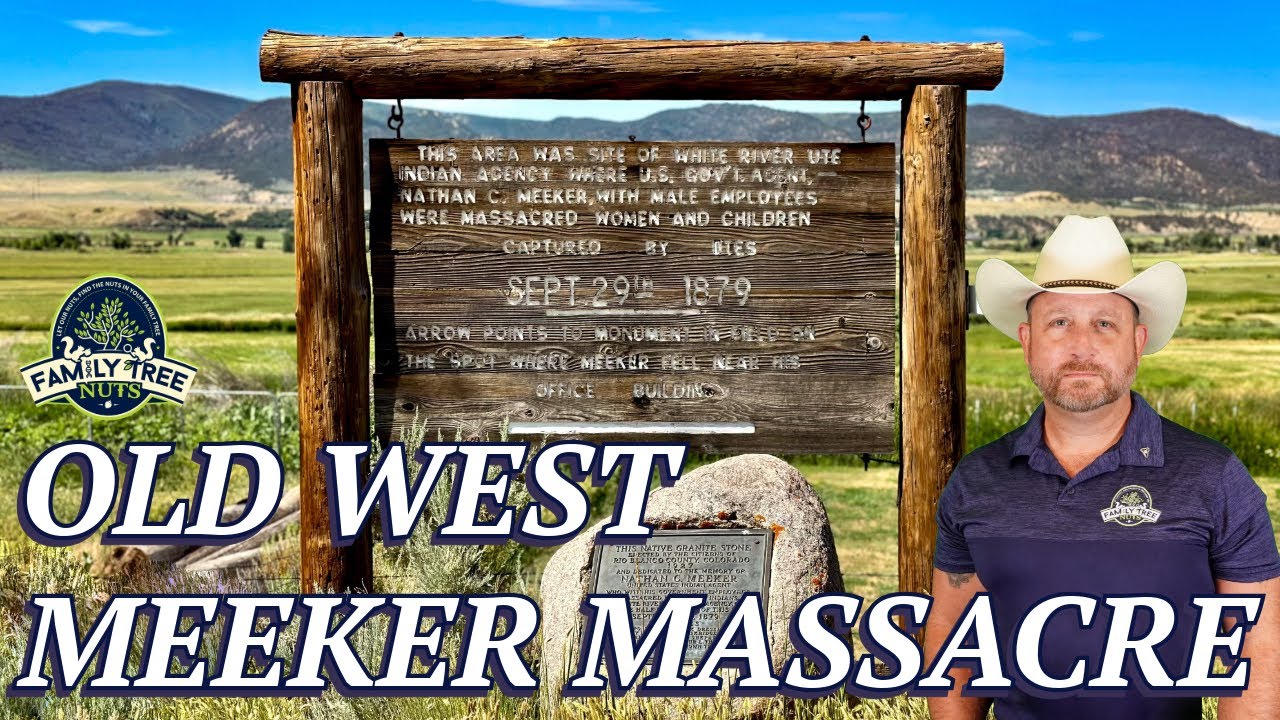
At the same time that the battle with U.S. troops was taking place at Milk Creek, some of the Ute’s attacked the White River Indian Agency and killed every single man working there, including Nathan Meeker. They took Meeker’s wife Arvilla, his daughter Josephine, Flora Price, and her two children as hostages and held them for twenty-three days. Josephine Meeker was a new medical doctor and one of the first female doctors in the old west. This event became known as what was called the “Meeker Massacre”.
The army quickly sent a large occupation force to maintain order in the area. The nation was outraged and called for action. President Rutherford B. Hayes ordered for the Utes to be gathered and under the new treaty, they were put onto three reservations. These reservations exist today as the Southern Ute, the Ute Mountain Ute, and the Uintah-Ouray. The Ute’s had sacrificed almost all of western Colorado.
Checkout our website at: www.familytreenuts.com
Contact us at: [email protected]
Join this channel to get access to perks:
/ @familytreenutshistorygenealogy
Повторяем попытку...
Доступные форматы для скачивания:
Скачать видео
-
Информация по загрузке: