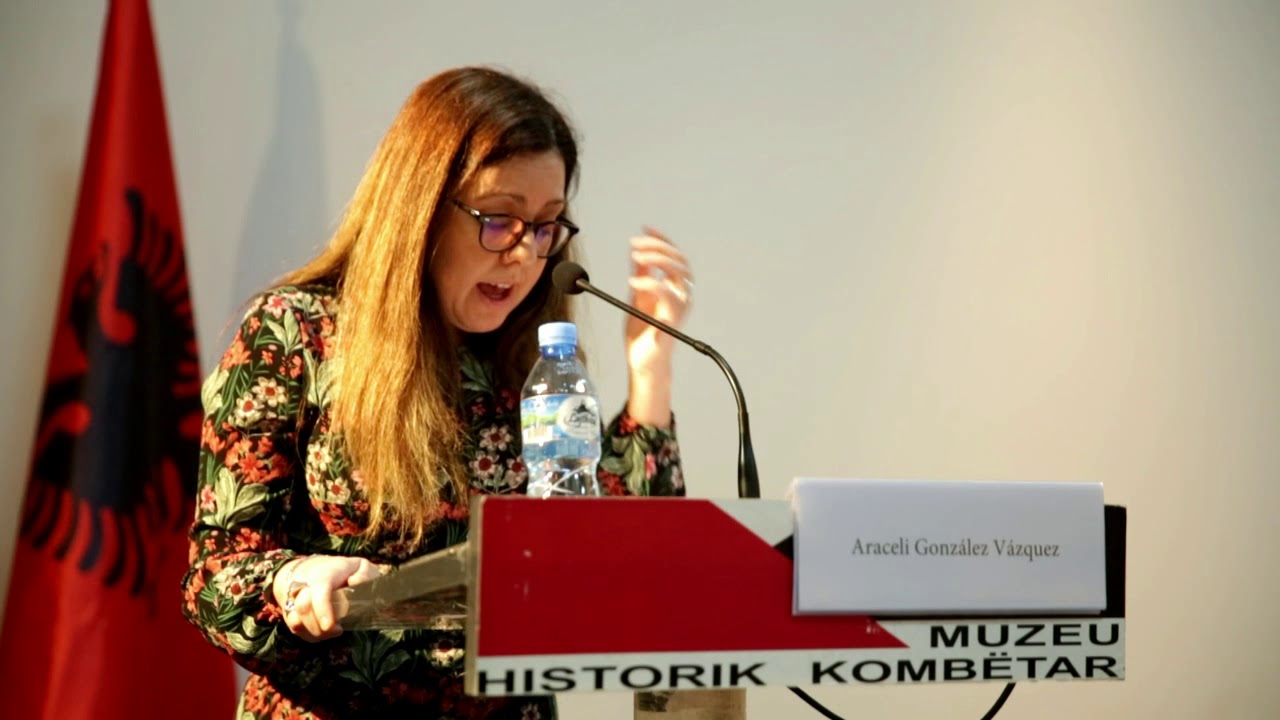
Dick DOUWES: Shrine Politics in Lebanon and Syria: Reorganizing Sacred Space
Автор: Departamenti Etnologjise
Загружено: 2018-03-28
Просмотров: 108
Описание:
Dick Douwes (Sorong, 1957) studied Arabic at Radboud University, Nijmegen, The Netherlands, where he also received his Ph.D. degree. From 1994 to 1998 he was coordinator of the Indonesian Netherlands’ Cooperation in Islamic Studies (INIS) at Leiden University. As of 1998 onwards he was coordinator - later executive director - of the International Institute for the Study of Islam in the Modern World (ISIM) and editor of the ISIM Newsletter/Review. Since 2006 he has been a full professor of Global History, with a particular focus onthe Middle East, at the Erasmus School of History, Culture and Communication, Erasmus University Rotterdam. He published on late Ottoman history in Syria and on religious plurality in the Middle
East, as well as on Muslims in Western Europe.
Abstract:Sacred spaces are scattered all over Lebanon and Syria and shrines, mostly small and of local importance only, but an increasing number attract broader audiences, including visitors from the wider region and the diaspora over the last decades producing an upswing in religious tourism. Shrines and shrine culture is often shared in the sense that sites are held sacred by and are visited by members of various religious communities, in particular shrines dedicated to saintly entities that transgress communal borders such as Mar Ilyas, Mar Jurjus and Khidr. Moreover, rituals intersect, ranging from offerings and making vows, to the use of incense, cloth and candles. Yet, traditional communalities are contested and within various communities voices that express the exclusive nature of its community’s ‘history’ and ‘truth’ have come to the fore, and at times put exclusive claims on sacred spaces and/or promote certain rituals while discouraging others, such as burning candles among the Shiite population in Lebanon because of the ritual’s presumably ‘Christian’ roots. A parallel trend is that within communities certain practices are discouraged or even banned, in what seems to be an effort to conform to more general scriptural ‘Islamic’ norms.
As a result of increased interest in sacred space and rituals, both locally as well as extra-local, shrines are being refurbished, often expanded, often informed by extra-local styles such as the Iranian extravagance concerning shrine structures. Christian shrines attract an ever increasing number of religious tourists from the American diaspora and not unlike the Shiite religious tourism, its particular sacred public presence has increased. In conditions of violence, such as in Syria over the last six years, attempts to destroy shrines
and, contrarily, to have shrines defended by devotees while fostering privileged access, strongly impacts intercommunal relations. In post-war Lebanon attempts have been made to restore the notion of shared sacredness in reconciliation projects. In either way, sacred spaces continue to matter in both urban and rural settings, in defining notions of belonging.
Повторяем попытку...

Доступные форматы для скачивания:
Скачать видео
-
Информация по загрузке: