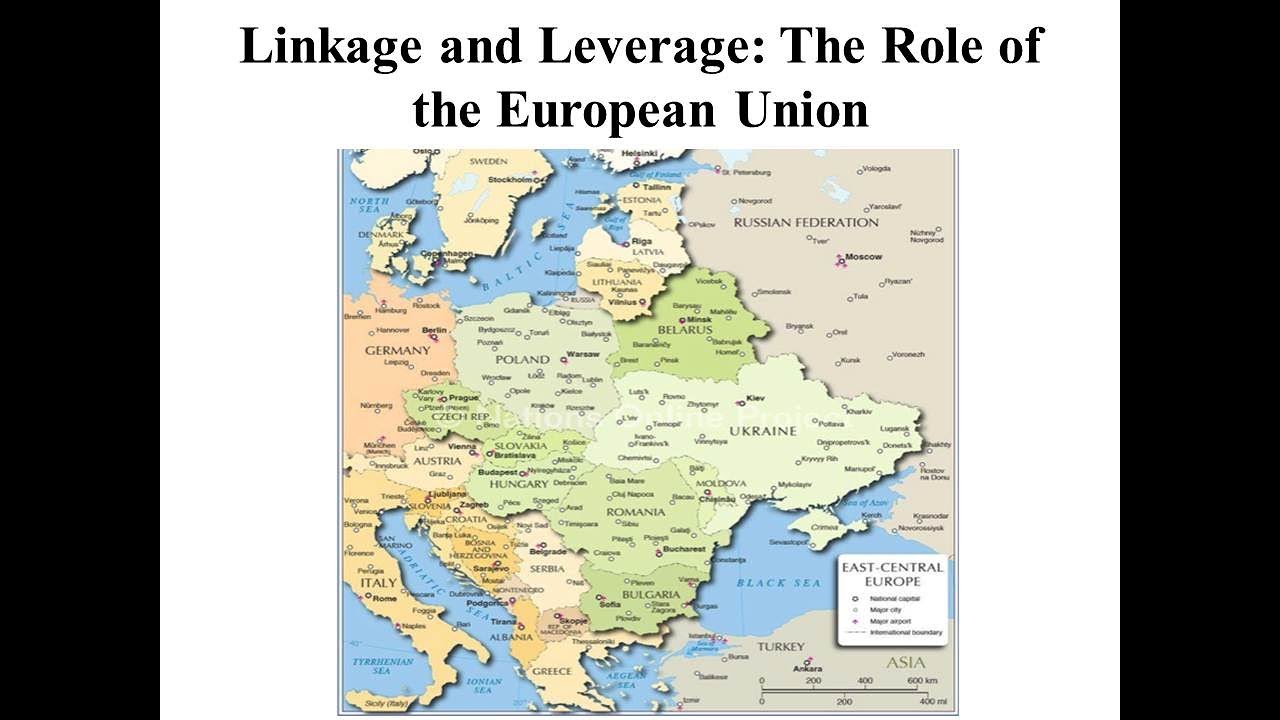
Post-Communist Transition - Linkage and Leverage of the European Union in Democratic Transition
Автор: Michael Rossi Poli Sci
Загружено: 2021-07-01
Просмотров: 1567
Описание:
Michael Rossi
Department of Political Science
Masters Program in United Nations and Global Policy Studies
Rutgers University
June 30, 2021
How does/did the European Union work to guide transitioning countries in Eastern Europe throughout the 1990s and 2000s towards democratic consolidation and eventually membership?
What leverage, passive and/or active, does the EU possess politically and economically towards aspiring states? Does leverage coerce states to make a number of decisions it otherwise might not?
Finally, does this "EU effect" produce only positive outcomes, or can it result in negative effects on public opinion and perception?
This lecture serves as a two-week discussion of the former Communist countries of Central Europe (this week) and Southeastern Europe (next week) and external influence of the EU which serves as a one of a kind organization that provides a roadmap for democratization, democratic consolidation, and eventual membership in an exclusive organization. As the European Union is the most important external influence on the development of these countries over the past three decades, it is crucial to examine how the EU viewed the former Communist bloc, which countries were considered prime candidates for membership early on, and which countries remained in the periphery.
Among other things, this lecture affirms the positive role the EU played in helping shape democracy-as-structure in all countries in Eastern Europe with a clear future membership within its ranks. But the structural approach rooted in technocratic principles of neoliberalism tends to favor economic stability and solvency over social democratic values and welfare. This has contributed much to the receding qualities of liberal democracy in many of these states in the years following EU membership.
The points covered here are connected with specific elements included in the next collection of lectures on Central and Southeastern Europe
The consulting reading for this lecture is Milada Anna Vachudova, Europe Undivided: Democracy, Leverage, and Integration After Communism. Oxford University Press, 2005.
Chapter Markers:
00:00:00 - 00:04:34 - Introduction
00:04:34 - 00:13:00 - The Importance of External Actors in Political Transition
00:13:00 - 00:19:39 - What are Some Reasons for Joining the EU?
00:19:39 - 00:28:41 - The Setting and Dilemma of Europe in 1990 - 1991
00:28:41 - 00:35:35 - Transition Amid Neoliberalism
00:35:35 - 00:40:41 - Linkage and Leverage of the European Union
00:40:41 - 00:50:25 - Passive Leverage
00:50:25 - 00:54:40 - Active Leverage
00:54:40 - 01:01:38 - The Active Leverage of the Copenhagen Criteria and the Aquis Communitaire
01:01:38 - 01:08:30 - So What does it Take to Get into the European Union?
01:01:30 - 01:17:35 - Does this Come with Side Effects?
01:17:35 - 01:21:35 - The EU and the "Stabilitocracy"
01:21:35 - 01:28:07 - Concluding Points on Leverage
Повторяем попытку...
Доступные форматы для скачивания:
Скачать видео
-
Информация по загрузке: