Kīlauea Volcano’s Earthquakes and Eruptions: April - August, 2018
Автор: PacificTWC
Загружено: 2019-05-04
Просмотров: 14822
Описание:
The NWS’s Pacific Tsunami Warning Center (PTWC) mitigates tsunami hazards in Hawai‘i produced by large, distant earthquakes throughout the Pacific Ocean, but PTWC also issues warnings for tsunamis generated by earthquakes within the State of Hawai‘i itself. The last such dangerous tsunami was generated by a 7.7 magnitude earthquake on the Big Island of Hawai‘i in 1975. Small earthquakes generated by volcanic activity are far more common, and typically have a magnitude less than 3.0 and occur a few times a day. That rate changed on the afternoon of April 30, 2018, when an earthquake “swarm” began within Kīlauea Volcano such that earthquakes began to occur far more frequently, about 100 per day.
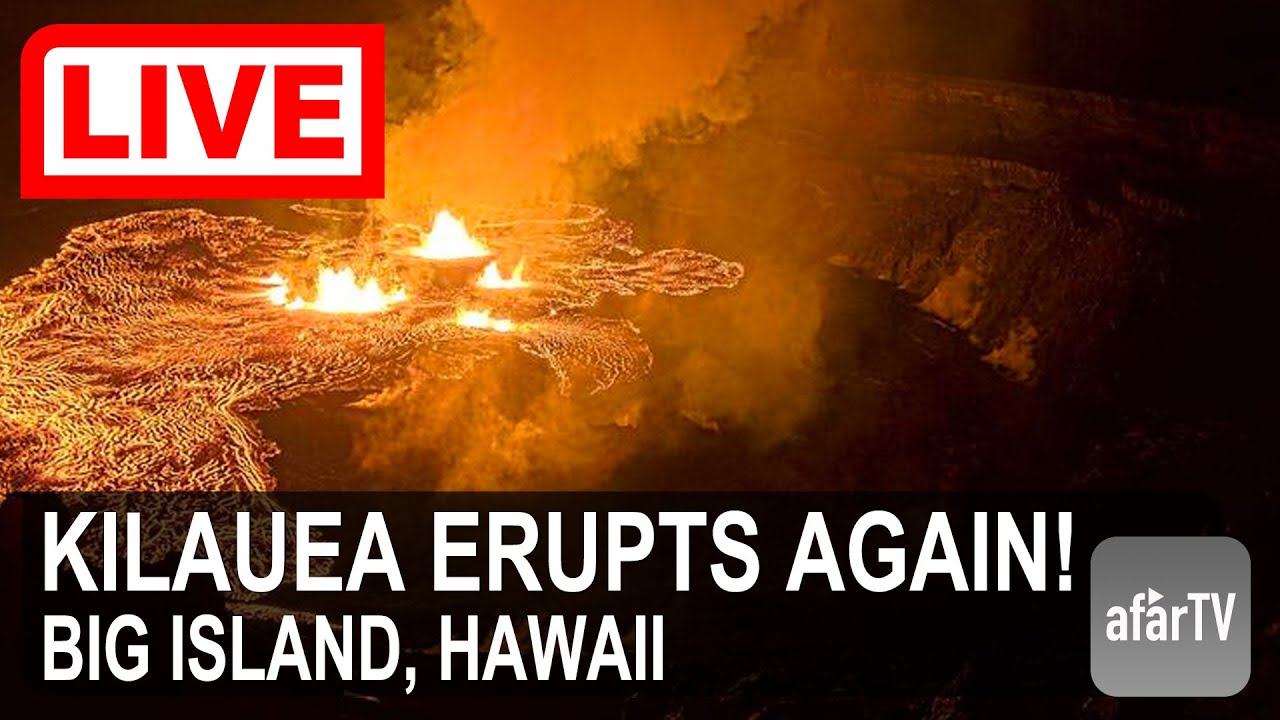
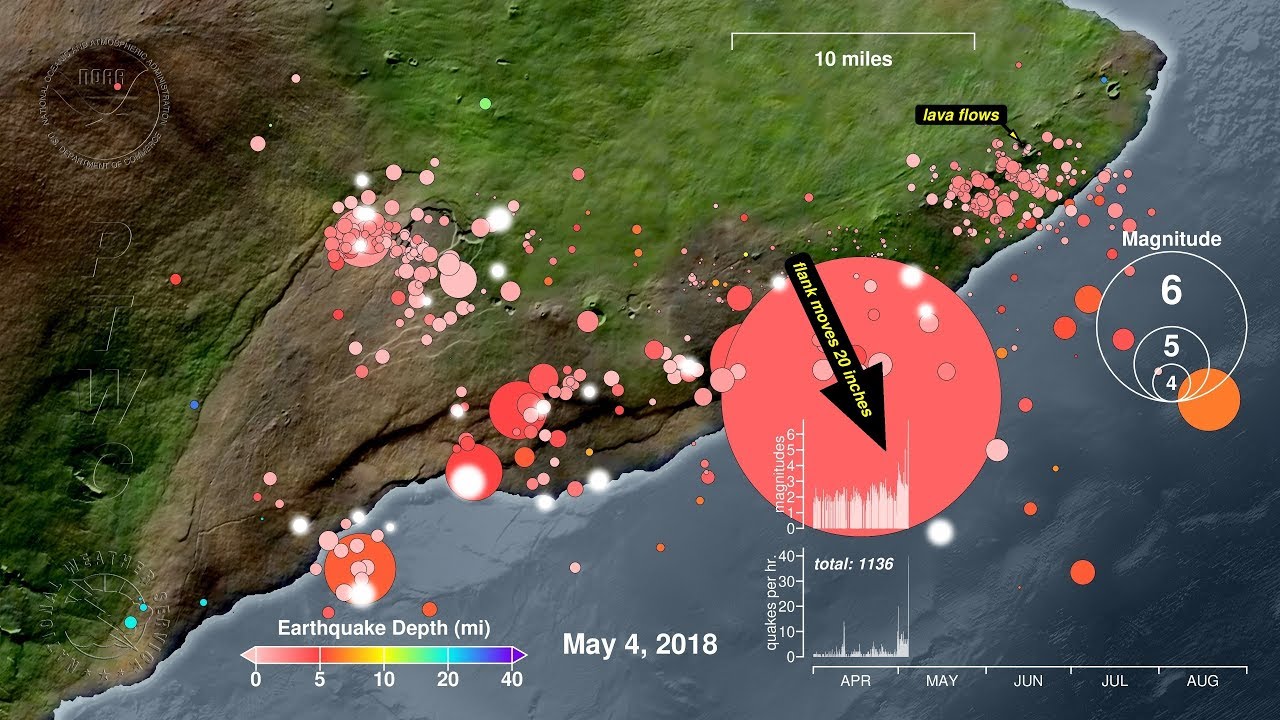
This animation begins a month earlier on April 1 to start with a more typical earthquake pattern and proceeds forward in time at a rate of one day per second of animation time. Circles indicate the locations of earthquakes as they occur, with their sizes indicating their magnitudes and their colors representing their depths. Three days before the swarm began the lava within the "Overlook crater" inside of Halema‘uma‘u overflowed. Then on April 30 the 35-year-old Puʻu ʻŌʻō eruption ceased and its cone partially collapsed. This event coincided with the start of a swarm of volcanic earthquakes on Kīlauea's East Rift Zone, a feature extending from the volcano's summit that carries magma underground through its flanks. Eruptions can take place anywhere along this rift zone as well as at the volcano's summit. Starting with that collapse earthquake activity moved northeast along the East Rift Zone away from Puʻu ʻŌʻō, suggesting the movement of magma below ground in this direction. Magma reached the surface and erupted as lava on the afternoon of May 3, eventually building channelized lava flows, destroying about 700 homes, and covering more than 12 square miles including Kapoho Bay. In this animation a growing orange field represents these lava flows.
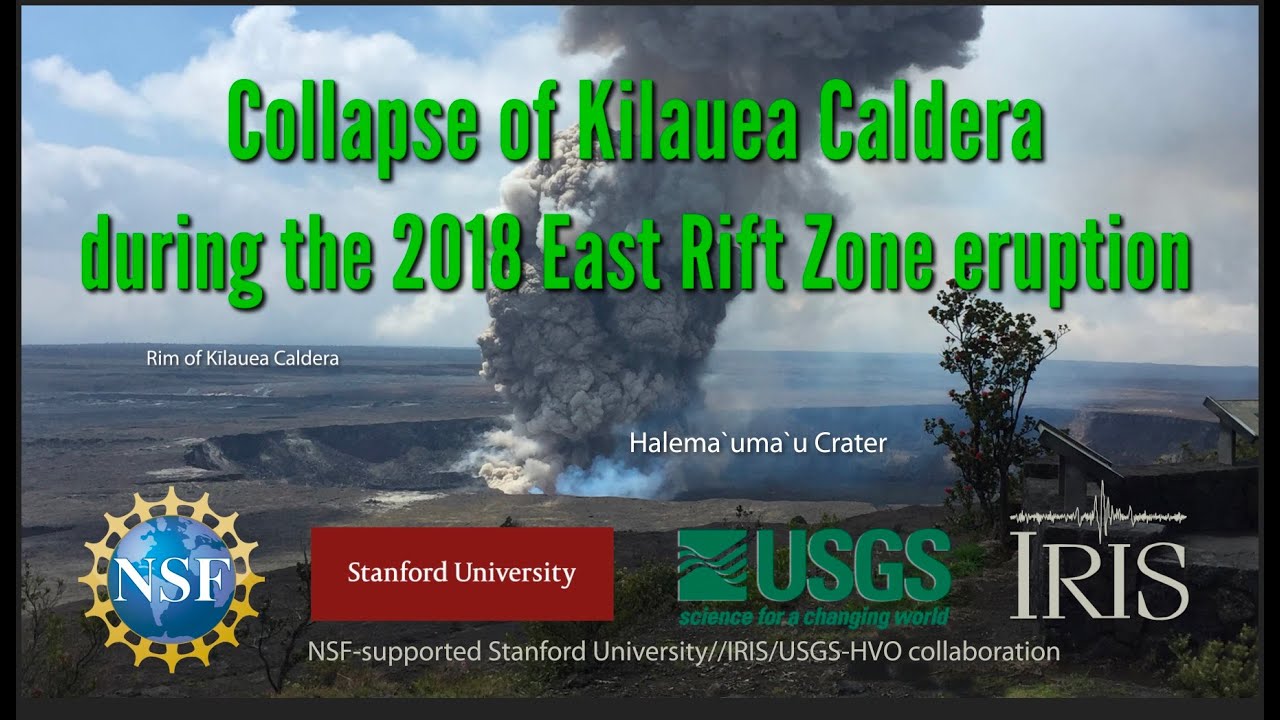
The eruption of lava from the East Rift Zone drew magma away from its reservoir under Kīlauea's summit. Lava began to drain from the “Overlook crater” on May 2 and by May 15 its lava lake had dropped hundreds of feet and was producing explosions, some of which were strong enough to register as magnitude 5.0 earthquakes and send ash clouds to 30,000 ft. above sea level. By the end of May, however, the walls of Halema‘uma‘u had begun to collapse, thus widening itself and burying its “Overlook crater” and ending the explosive activity. Not only was Halema‘uma‘u Crater collapsing, but the entire floor of Kīlauea Caldera was dropping as magma continued to drain from the summit to feed the flank eruption, and this “deflation” of the volcano’s summit generated an unprecedented level of seismic activity with a peculiar pattern.
To help illustrate this pattern this animation includes charts showing some statistics about the earthquake activity shown here. The top graph shows the earthquakes’ magnitudes as they occur. The bottom graph shows the total number of earthquakes per hour. On April 30 the frequency of earthquakes increased to about 100 per day with their magnitudes exceeding 4.0. The largest earthquake struck on the afternoon of May 4 with a magnitude of 6.9. It produced numerous aftershocks and a small, but non-life-threatening, tsunami. This largest earthquake also moved the flank of Kīlauea Volcano as much as 20 inches seaward. With the subsidence of Kīlauea Caldera and the collapse of Halema‘uma‘u the number of earthquakes dramatically increased and by June 15 there were more than 700 per day. These earthquakes would repeatedly grow in number and culminate with a magnitude 5.0+ event every one to two days, pause for a few hours, then start over again. This cycle repeated 62 times with the last of the 5.0+ events on August 2 and ceasing altogether two days later when seismicity suddenly returned to normal background levels, coinciding with the end of the vigorous eruption of lava from the East Rift Zone.
Though PTWC monitors all earthquakes in Hawai‘i , including this volcanic activity, the primary responsibility for mitigating volcanic hazards in the State of Hawai‘i rests with the USGS’s Hawaiian Volcano Observatory who publishes updates and advises local emergency managers.
-----
The Hawaiian Volcano Observatory:
https://volcanoes.usgs.gov/observator...
Origin of earthquakes in the Hawaiian Islands:
• Hawai`i—Origin of Earthquakes & What cause...
Comparison of historic earthquakes in Hawai‘i by magnitude:
• Context: a graphical comparison of earthqu...
Earthquake activity throughout the Hawaiian Islands:
• Earthquakes of the Hawaiian Islands: 1973 ...
Recent earthquake activity on or near the Big Island of Hawaiʻi
• Earthquakes of Hawaiʻi Island: 2013 - 2018
1975 Hawai‘i Island tsunami:
• Tsunami Animation: Hawaii 1975
Повторяем попытку...
Доступные форматы для скачивания:
Скачать видео
-
Информация по загрузке: