PSW 2529 Evidence Based Medicine | Gordon Guyatt
Автор: PSW Science
Загружено: 2026-01-27
Просмотров: 168
Описание:
Lecture Starts at 19:49
www.pswscience.org
January 23, 2026
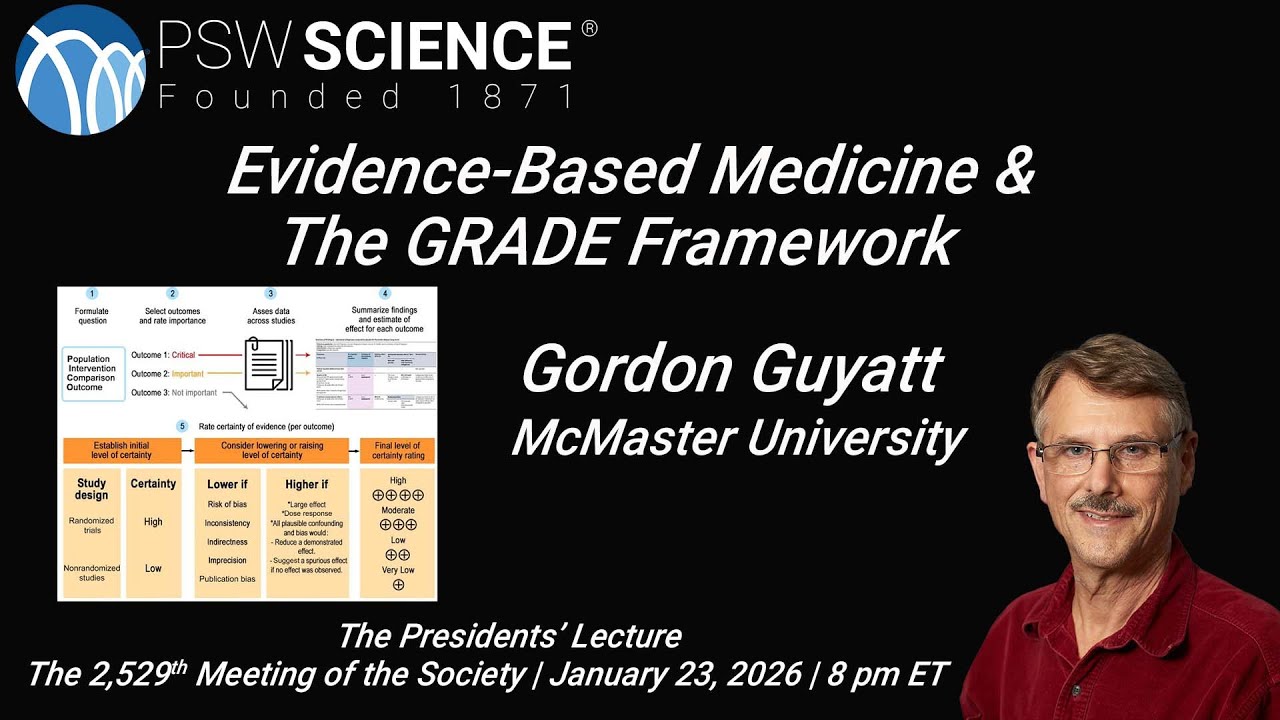
Evidence-Based Medicine & The GRADE Framework
The Past, Present, and Future
Gordon Guyatt
Professor of Medicine and Health Research Methods
McMaster University
Evidence-based medicine (EBM) has achieved wide acceptance, including its incorporation as a required component of undergraduate and postgraduate health sciences training programs throughout North America and, to a lesser extent, internationally. It is now broadly recognized as a core element of medical practice. As a result, only clinicians nearing retirement can readily recall a time before evidence-based medicine was part of routine training and care.
The GRADE approach—*Grading of Recommendations, Assessment, Development, and Evaluation*, a framework for rating certainty of evidence and moving from evidence to recommendations—has reshaped how systematic reviews are conducted and interpreted. It has become a standard component of clinical practice guidelines and health technology assessments, which evaluate the clinical and economic value of health interventions. *UpToDate*, an online clinical decision-support resource, has become a widely used evidence-based reference for clinicians. During the COVID-19 pandemic, evidence-based medicine performed well in guiding individual patient care. The MAGIC initiative (*Making GRADE the Irresistible Choice*) has provided leadership in strengthening how evidence is produced, summarized, and applied across the healthcare ecosystem.
Despite these advances, evidence-based medicine faces persistent challenges. In the public health response to COVID-19, decision-makers often failed to clearly communicate evidence-based principles and, at times, disregarded them. Many EBM educators have been slow to accept that most clinicians will not critically appraise original research articles themselves; and that, instead, education should focus on helping clinicians correctly interpret research results and understand their implications. Shared decision-making—an approach in which clinicians and patients work together to make healthcare choices based on evidence and patient values—remains uncommon in routine practice, despite existing concepts for implementing it efficiently.
In the processing and presentation of evidence, the field has struggled to balance simplicity with necessary complexity. Methodological sophistication has increasingly come at the expense of usability for everyday clinical and public health practice. The global EBM community needs to shift attention away from increasingly technical methods and toward practical solutions that better serve clinicians and policymakers. The GRADE framework has become difficult to use in practice, the Cochrane Risk of Bias 2 tool for randomized trials is hard to interpret, and ROBINS-I (a tool for assessing bias in non-randomized studies) has proven particularly challenging. Newer approaches, such as ROBUST-RCT for assessing risk of bias in randomized trials and *Core GRADE*, aim to simplify and improve how evidence quality is assessed and applied.
This lecture will discuss the advances EBM has brought about in clinical outcomes, some, the challenges to fuller implementation and further improvements, and approaches to meeting those challenges and to improving outcomes for patients universally.
Gordon Guyatt is Professor of Medicine and of Health Research Methods at McMaster University, where he has spent his academic career as a clinician, investigator, and educator. He previously served in senior academic roles within the Department of Medicine and the clinical epidemiology program.
Gordon’s research focuses on clinical epidemiology, evidence-based medicine (EBM), research methodology, and outcomes research. It integrates methodological development with practical clinical questions. He has worked to improve how clinical evidence is generated, appraised, and applied to clinical care and health policy. A consistent emphasis of his work is the measurement and use of patient-important outcomes rather than surrogate endpoints.
Gordon is well known for coining the term “evidence-based medicine” (EMB) and for founding and building an approach to medical education and practice that integrates research evidence with clinical expertise and patient values. He played a leading role in developing the “Grading of Recommendations, Assessment, Development and Evaluation” (GRADE), a systematic framework used in clinical medicine and public health to rate the certainty (quality) of evidence and the strength of healthcare recommendations. And he was instrumental in the creation of the “Users’ Guides to the Medical Literature”, now widely used in teaching how to evaluate and best use medical research in clinical decision-making.
Gordon earned a BA in Psychology, an MD, and an MSc in Clinical Epidemiology at McMaster University.
www.pswscience.org
Повторяем попытку...
Доступные форматы для скачивания:
Скачать видео
-
Информация по загрузке: