What's better? Self Astromodified DSLR or Dedicated astronomy camera (a small test)
Автор: Tehri Skies - Pahadi Astro
Загружено: 2023-08-20
Просмотров: 224
Описание:
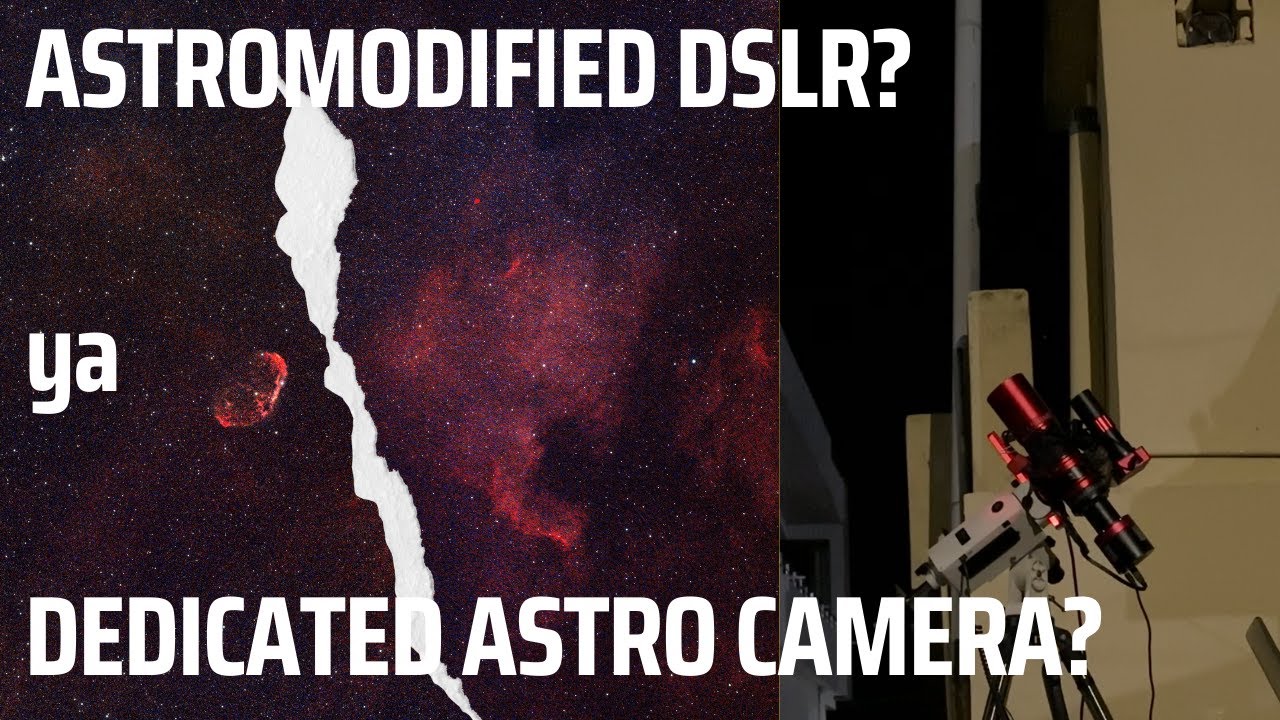
A quick comparison between my self-Astro modified DSLR vs 533MC pro camera. I am happy with the results I got with the DSLR.
Things to consider while choosing between the two.
Self-Modified DSLR:
A self-modified DSLR uses a standard CMOS sensor that has been modified to remove the built-in infrared (IR) filter, allowing for improved sensitivity to H-alpha and other deep-sky emission lines.
The pixel size of a typical DSLR sensor is smaller, which can limit the amount of light each pixel can gather, leading to higher noise levels in low-light conditions.
DSLRs do not usually have active cooling systems, leading to potential thermal noise in long-exposure images.
DSLRs use Bayer matrix color filters over each pixel, which can lead to a reduction in color accuracy and sensitivity in deep-sky imaging.
A self-modified DSLR can be controlled and customized using standard camera settings and software, but might not offer as much flexibility as dedicated astro cameras.
A self-modified DSLR can be used for both daytime photography and astrophotography, offering versatility but potentially requiring more effort to switch between the two.
Modifying a DSLR yourself can be cost-effective, as it involves using an existing camera. However, the modification process might require technical expertise or professional services.
Dedicated Astro CMOS Camera:
Dedicated astrophotography CMOS cameras are designed with specific astronomical applications in mind. They often have larger sensors, lower noise, and better sensitivity to faint light due to specialized cooling systems and optimized pixel designs.
Many astro cameras have larger pixel sizes, allowing them to capture more light and produce images with less noise. However, this might come at the cost of lower resolution compared to DSLRs.
Dedicated astro cameras often come with built-in cooling systems to reduce thermal noise during long exposures, resulting in cleaner images.
Some astro cameras use specialized sensor designs that minimize or eliminate the Bayer matrix, providing more accurate color information and higher sensitivity to faint astronomical features.
Astro cameras often come with software that provides extensive control over exposure settings, cooling, and other parameters tailored for astrophotography.
Dedicated astro cameras are specifically designed for astrophotography, making them more user-friendly for this purpose, but they are not ideal for general photography.
Dedicated astro cameras are designed for astrophotography and can be more expensive due to their specialized features and components.
the choice between a self-modified DSLR and a dedicated astrophotography CMOS camera depends on your budget, technical skills, desired level of image quality, and the specific type of astrophotography you're interested in. A dedicated astro camera often offers superior performance and convenience, while a modified DSLR can provide a more budget-friendly entry into astrophotography.
Повторяем попытку...
Доступные форматы для скачивания:
Скачать видео
-
Информация по загрузке: