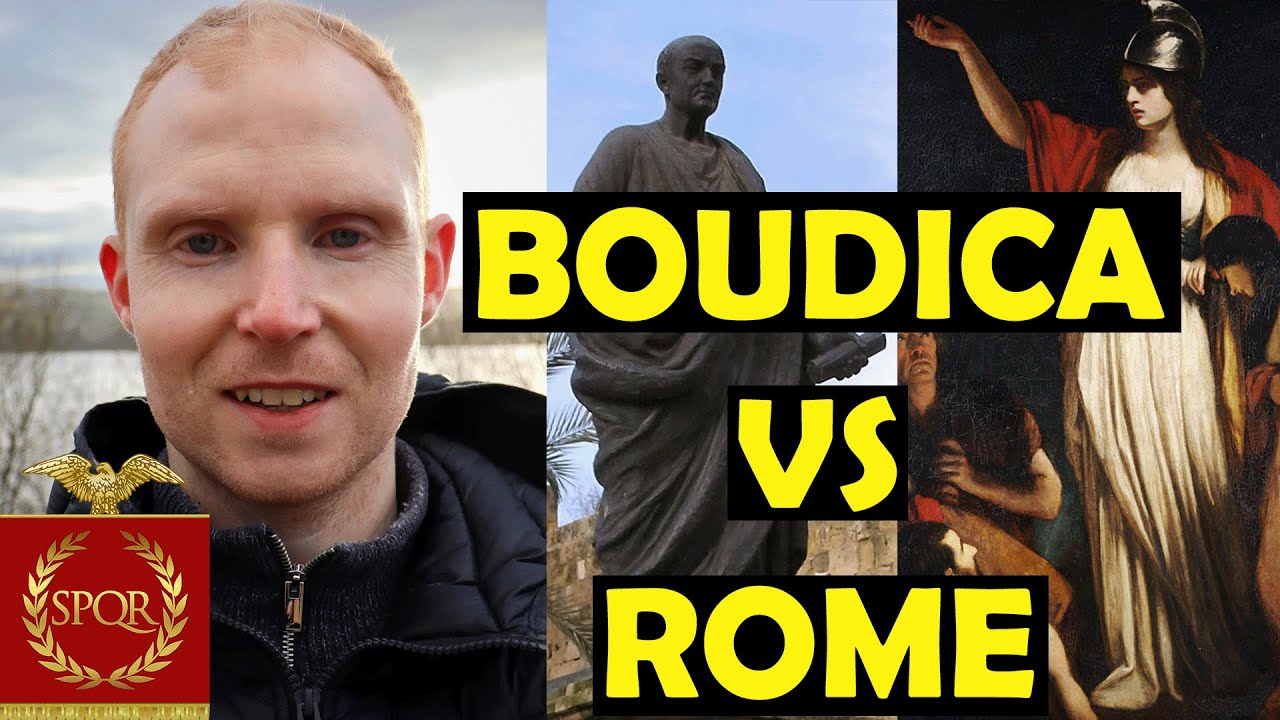
How a Celtic Queen Almost Defeated the Roman Empire in Britain: Boudica’s Revolt
Автор: Celtic History Decoded
Загружено: 2023-03-07
Просмотров: 987
Описание:
Please Buy Me a Coffee: https://www.buymeacoffee.com/CelticHi...
Please donate through PayPal using this link: https://www.paypal.com/donate/?hosted... – [email protected]
Please support this channel on Patreon and get ad-free videos and other benefits: / historydecoded
Subscribe to Celtic History Decoded: / @celtichistorydecoded
Follow Celtic History Decoded on Instagram - / celtichistorydecoded
Subscribe to World History Decoded – / @worldhistorydecoded
How a Celtic Queen Almost Defeated the Roman Empire in Britain: Boudica’s Revolt
The Roman Empire ruled Britain for centuries, starting around 43AD and not leaving until 410 AD, yet it wasn’t all smooth running. In 60 AD, Boudica, the Celtic Queen of the Iceni tribe around the Norfolk region of eastern England today, rebelled against Roman rule, killing tens-of-thousands of occupying Roman troops in the process. Why did Boudica rebel however, and how close was she to victory?
Initially, things were very different for Boudica. Years earlier, her husband, Prasutagus, the King of the Iceni tribe at the time, ruled as a nominally independent ally of Rome. The Iceni tribe has previously rebelled against the Romans decades earlier, in 47 AD, but this rising was put down by the Romans and the Iceni were allowed to retain their independence once the uprising was suppressed.
The problem arose when Prasutagus died. In Prasutagus’ will, he left half of his kingdom to his daughters, and the other half to the Roman emperor. When he died however, his will was ignored, and his kingdom was annexed by Rome and his property taken. His wife, Boudica, was flogged and abused in the streets, and his daughters raped. Boudica had had enough.
Different sources focus on other explanations for the rebellion as well. The Roman historian, Cassius Dio for instance, argues that there were also financial reasons for the rebellion. Firstly, he points to the recalling of loans that were given to the Britons by the philosopher Seneca. Secondly, he notes that Decianus Catus, an official for Rome, confiscated money formerly loaned to the Britons by the Emperor Claudius. The historian Tacitus blamed Catus’ rapacity for the rebellion in part.
As is usually the case, various factors probably combined to spark the rebellion. Regardless, Boudica raised a rebellion is East Anglia. The Celtic Queen unified others who had been aggrieved by the Romans. She led her own Iceni tribe along with other tribes, including the Trinovantes, which occupied a region corresponding to parts of modern-day Essex and Greater London, in rebellion against the Roman eagle.
The timing of the rebellion was perfect, as the Roman governor, Gaius Suetonius Paulinus, was way on campaign in modern Wales, slaughtering Druids in Mona, modern-day Anglesey, with a lot of his forces with him. The Celtic queen and her army sacked Camulodunum, modern-day Colchester, with her army overpowering the Romans. The inhabitants appealed to Catus for help, who only provided 200 men to Colchester, who failed to turn the tide. Boudica’s troops slaughtered thousands, and set fire to the temple of Claudius.
Sources:
Boudica https://en.wikipedia.org/wiki/Boudica
Britannica, Boudicca https://www.britannica.com/biography/...
Kings and Generals, Watling Street 60 AD - Boudica's Revolt DOCUMENTARY • Watling Street 60 AD - Boudica's Revolt DO...
Boudica's Revolt AD 60-61, Warwick - https://warwick.ac.uk/fac/arts/classi...
The SPQR Historian - Boudicca's Rebellion of 60 AD (Battle of Watling Street) • Boudicca's Rebellion of 60 AD (Battle of W...
#boudica #internationalwomensday #history
Повторяем попытку...
Доступные форматы для скачивания:
Скачать видео
-
Информация по загрузке:


