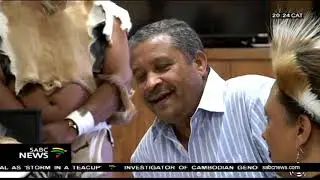
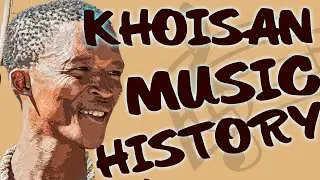
🐆 !KWHA TTU SAN CULTURE CENTRE: BUSHMEN SAN KHOISAN THE OLDEST TRIBE IN THE WORLD 🇿🇦
Автор: C Kology
Загружено: 2019-01-15
Просмотров: 2097
Описание:
#bushmen #khwattu #sanpeople #Khoisan
Khoisan is a catch-all term for the "non-Bantu" indigenous peoples of Southern Africa, combining the Khoekhoen (formerly "Khoikhoi") and the Sān or Sākhoen (also, in Afrikaans: Boesmans, or in English: Bushmen, after Dutch Boschjesmens; and Saake in the Nǁng language).
Khoekhoen, specifically, were formerly known as “Hottentots”, which was a derogatory onomatopoeic term (from Dutch hot-en-tot) referring to the click consonants prevalent in the Khoekhoe languages, as they are in all the languages grouped under "Khoesān".
In the contemporary era, Sān are popularly thought of as foragers in the Kalahari Desert and regions of Botswana, Namibia, Angola, Zambia, Zimbabwe, Lesotho and South Africa. The word sān is from the Khoekhoe language and simply refers, often in a derogatory manner, to foragers ("those who pick things up from the ground") who do not own livestock. As such it was used in reference to all hunter-gatherer populations of the Southern African region who Khoekhoe-speaking communities came into contact with, and was largely a term referring to a lifestyle, distinct from a pastoralist or agriculturalist one, not any particular ethnicity. While there are attendant cosmologies and languages associated with such a radical lifestyle, the term is thus essentially an economic designator, rather than a cultural or ethnic one.
In the 1990s, genomic studies of the world's peoples found that the Y chromosome of San men share certain patterns of polymorphisms that are distinct from those of all other populations.Because the Y chromosome is highly conserved between generations, this type of DNA test is used to determine when different subgroups separated from one another, and hence their last common ancestry. The authors of these studies suggested that the San may have been one of the first populations to differentiate from the most recent common paternal ancestor of all extant humans.
Various Y-chromosome studies since confirmed that the Khoisan carry some of the most divergent (oldest) Y-chromosome haplogroups. These haplogroups are specific sub-groups of haplogroups A and B, the two earliest branches on the human Y-chromosome tree.
Following the end of Apartheid in 1994, the term "Khoisan" has gradually come to be used as a self-designation by South African Khoikhoi as representing the "first nations" of South Africa vis-a-vis the ruling Bantu majority. A conference on "Khoisan Identities and Cultural Heritage" was organised by the University of the Western Cape in 1997. and "Khoisan activism" has been reported in the South African media beginning in 2015.
The South African government allowed Khoisan families (up until 1998) to pursue land claims which existed prior to 1913. The South African Deputy Chief Land Claims Commissioner, Thami Mdontswa, has said that constitutional reform would be required to enable Khoisan people to pursue further claims to land from which their direct ancestors were removed prior to 9 June 1913.
Повторяем попытку...

Доступные форматы для скачивания:
Скачать видео
-
Информация по загрузке: