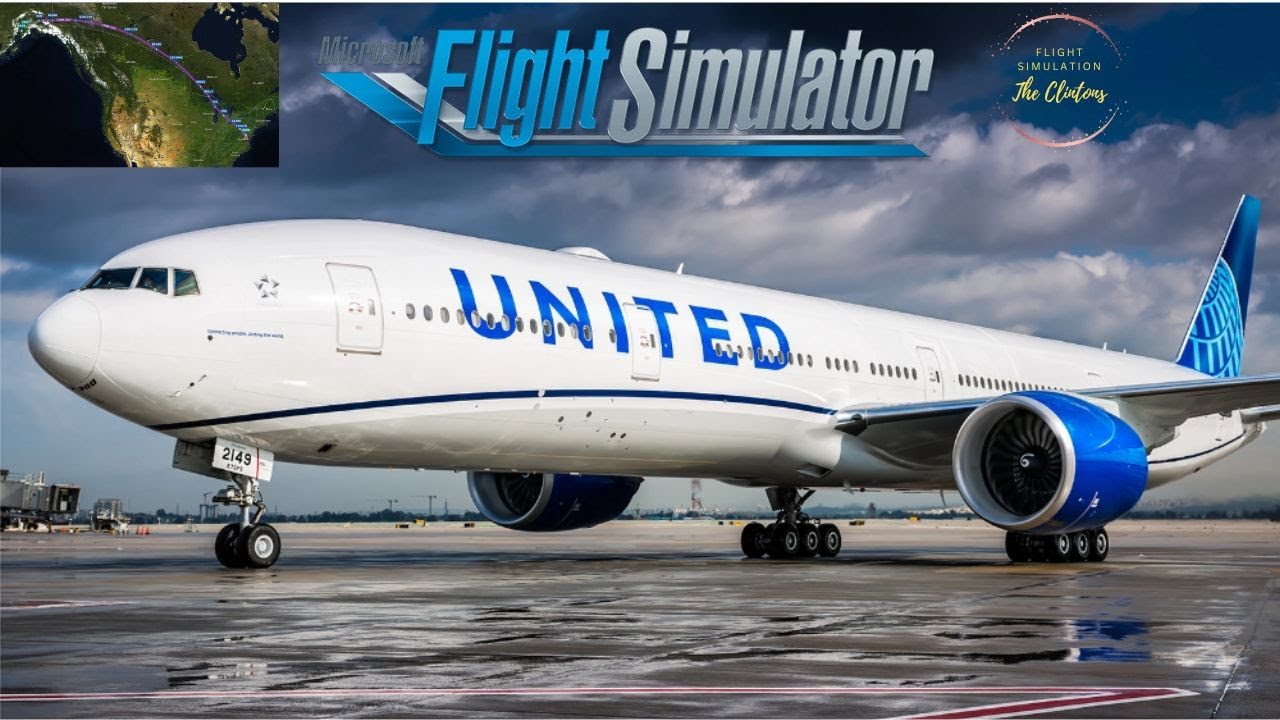
🔴Cargo Operations with PMDG Boeing 777F | Joint Base Andrews to Anchorage Alaska | MSFS 2020
Автор: The Clintons
Загружено: 2025-08-15
Просмотров: 184
Описание:
Join this channel to get access to perks:
/ @theclintonss
Get AMEX The Platinum Card® for the ultimate travel experience: https://bit.ly/clintons-amex
Recommended Logitech Products
Flight Yoke System | https://www.logitechg.com/en-gb/produ...
Flight Rudder Pedals | https://www.logitechg.com/en-gb/produ...
Flight Switch Panel | https://www.logitechg.com/en-gb/produ...
🔴Cargo Operations with PMDG Boeing 777F | Joint Base Andrews to Anchorage Alaska | MSFS 2020. The 777-8 Freighter joins the Boeing freighter family as the world’s most capable and fuel-efficient freighter for a sustainable future.
The Boeing 777, commonly referred to as the Triple Seven, is an American long-range wide-body airliner developed and manufactured by Boeing Commercial Airplanes. The 777 is the world's largest twinjet and the most-built wide-body airliner. The jetliner was designed to bridge the gap between Boeing's other wide body airplanes, the twin-engined 767 and quad-engined 747, and to replace aging DC-10 and L-1011 trijets. Developed in consultation with eight major airlines, the 777 program was launched in October 1990, with an order from United Airlines. The prototype aircraft rolled out in April 1994, and first flew that June. The 777 entered service with the launch operator United Airlines in June 1995. Longer-range variants were launched in 2000, and first delivered in 2004.
The Triple Seven can accommodate a ten–abreast seating layout and has a typical 3-class capacity of 301 to 368 passengers, with a range of 5,240 to 8,555 nautical miles [nmi] (9,700 to 15,840 km; 6,030 to 9,840 mi). The jetliner is recognizable for its large-diameter turbofan engines, raked wingtips, six wheels on each main landing gear, fully circular fuselage cross-section, and a blade-shaped tail cone. The 777 became the first Boeing airliner to use fly-by-wire controls and to apply a carbon composite structure in the tailplanes.
The original 777 with a maximum takeoff weight (MTOW) of 545,000–660,000 lb (247–299 t) was produced in two fuselage lengths: the initial 777-200 was followed by the extended-range -200ER in 1997; and the 33.25 ft (10.13 m) longer 777-300 in 1998. These have since been known as 777 Classics and were powered by 77,200–98,000 lbf (343–436 kN) General Electric GE90, Pratt & Whitney PW4000, or Rolls-Royce Trent 800 engines. The extended-range 777-300ER, with a MTOW of 700,000–775,000 lb (318–352 t), entered service in 2004, the longer-range 777-200LR in 2006, and the 777F freighter in 2009. These second-generation 777 variants have extended raked wingtips and are powered exclusively by 110,000–115,300 lbf (489–513 kN) GE90 engines. In November 2013, Boeing announced the development of the third generation 777X (variants include the 777-8, 777-9, and 777-8F), featuring composite wings with folding wingtips and General Electric GE9X engines, and slated for first deliveries in 2026.
As of 2018, Emirates was the largest operator with a fleet of 163 aircraft. As of June 2025, more than 60 customers have placed orders for 2,382 777s across all variants, of which 1,761 have been delivered. This makes the 777 the best-selling wide-body airliner, while its best-selling variant is the 777-300ER with 833 delivered. The airliner initially competed with the Airbus A340 and McDonnell Douglas MD-11; since 2015, it has mainly competed with the Airbus A350. First-generation 777-200 variants are to be supplanted by Boeing's 787 Dreamliner. As of May 2024, the 777 has been involved in 31 aviation accidents and incidents, including five hull loss accidents out of eight total hull losses with 542 fatalities including 3 ground casualties
Engines
The initial 777 models (consisting of the 777-200, 777-200ER, 777-300) were launched with propulsion options from three manufacturers, GE Aviation, Pratt & Whitney, and Rolls-Royce,[166] giving the airlines their choice of engines from competing firms.[102] Each manufacturer agreed to develop an engine in the 77,200–98,000 lbf (343–436 kN) of thrust class for the world's largest twinjet, resulting in the General Electric GE90, Pratt & Whitney PW4000, or Rolls-Royce Trent 800 engines. The Trent 800 is the lightest of the three powerplants as it weighs 13,400 lb (6.078 t) dry,[167] while the GE90 is 17,400 lb (7.89 t),[168] and the PW4000 is 16,260 lb (7.38 t).
✈ Get Your Favorite Flight Simulator
MSFS 2020: https://www.flightsimulator.com/
✈ Connect with The Clintons
YouTube: / @theclintonss
Discord: / discord
🎵The copyright-free music we use in all our videos: https://www.epidemicsound.com/referra...
#msfs2020 #pmdg #b777
Повторяем попытку...
Доступные форматы для скачивания:
Скачать видео
-
Информация по загрузке:




![BUSINESS 🇩🇪 Frankfurt - New York JFK 🇺🇸 Lufthansa Airbus A340-600 [FULL FLIGHT REPORT] Rare A340 !](https://image.4k-video.ru/id-video/1_395XdtBYQ)