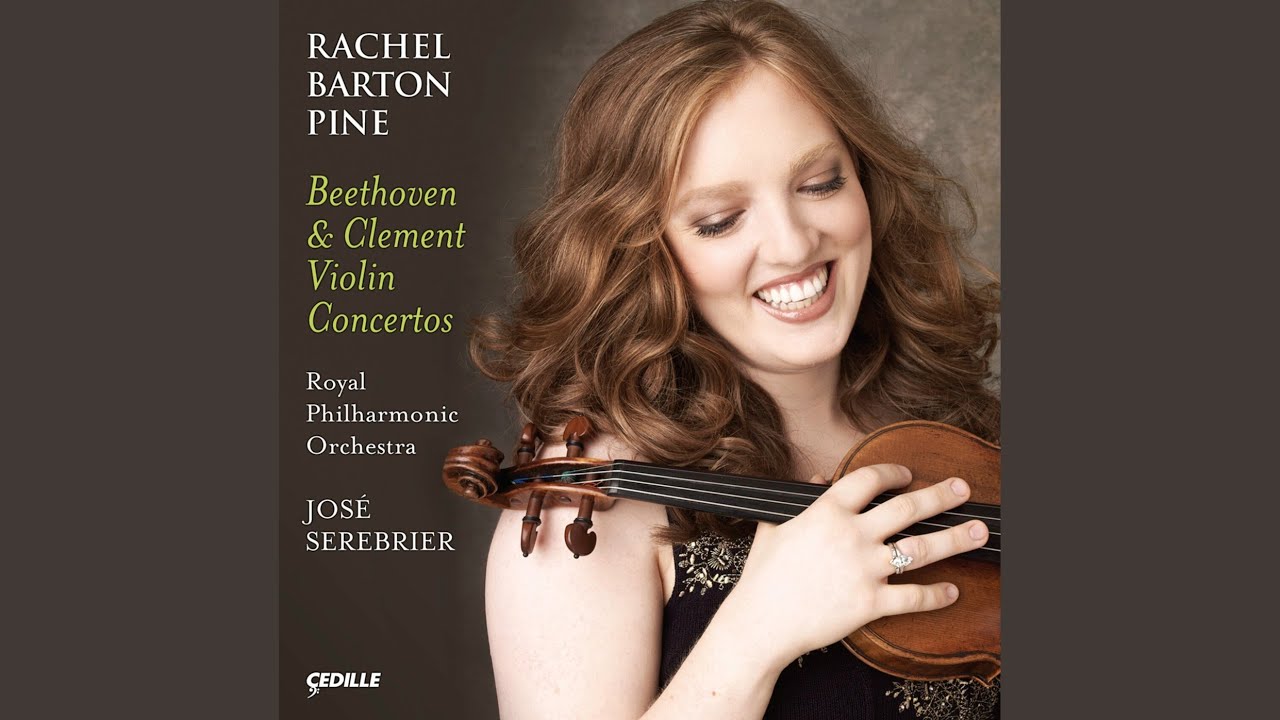
Franz Clement: Violin Concerto in D major, Rachel Barton Pine (violin)
Автор: sibarit101
Загружено: 2019-08-15
Просмотров: 10395
Описание:
Franz Clement - Violin Concerto in D major Rachel Barton Pine – violin, Royal Philharmonic Orchestra, Jose Serebrier – conductor (Cedille Records, 2008)
Cadenza by Rachel Barton Pine (there are no surviving cadenza)
I. Allegro maestoso – 00:00
II. Adagio – 16:08
III. Rondo: Allegro – 28:54
Franz Joseph Clement (November 17 or 18, 1780 – November 3, 1842), was an Austrian violinist, pianist, composer, conductor of ‚Theater an der Wien’, and a friend of Ludwig van Beethoven.
„Born in Vienna, Clement displayed his remarkable musical gifts at a very early age. He gave his first public concert when he was seven years old, and the following year performed at the court theatre and the Mehlgrube am Neuen Markt, playing several of his own compositions, including an early violin concerto. At that time he was taught by his father and by a Viennese violinist named Kurzweil. In 1790 Clement and his father undertook a concert tour through Germany and Belgium to England, where they stayed for two years, appearing at court and playing in concerts with Haydn, Salomon, and Bridgetower (for whom Beethoven later wrote the "Kreutzer" Sonata).
For more than a decade after Clement's return to Vienna, he was not only an extraordinary violinist, but also a fine pianist. His musical memory was phenomenal: after playing violin in Haydn's Creation several times, for instance, he was able, with the aid only of a libretto, to make a complete piano arrangement.
During the early part of his career Clement wrote a considerable amount of music. A list of his known compositions includes twenty-five concertinos and six concertos for violin, a piano concerto, and an opera, as well as orchestral and chamber music. Many of his compositions remained in manuscript and have disappeared without trace. Surviving copies of his published works are few and widely scattered, yet these show him to have been an exceptionally gifted composer, capable of handling the musical style of his day with confidence and imagination. By the second decade of the century, however, it became increasingly apparent that he was incapable of coping with the normal business of life. He fell into debt, no longer composed much, and even his career as a violinist faltered. In his later years he was often seen wandering the streets of Vienna like a vagrant.
Clement clearly recognised Beethoven's genius and was a notable champion of his music with the various professional and amateur ensembles of which he was leader (concertmaster). Clement also showed his appreciation in his compositions: his D major Violin Concerto owes much to the example of Beethoven's piano concertos in its musical language and structure. Clement's concerto may be seen, therefore, as a testimony to his admiration for Beethoven, and Beethoven's Violin Concerto, written just over a year later, as an affectionate and respectful acknowledgement of Clement's skills both as executant and composer. (Recently uncovered evidence suggests Clement's role in crafting the final version of Beethoven's violin concerto, published circa 1880, may have been greater than supposed. It seems altogether possible that the final published version resulted from their continuing collaboration).
This concerto, published in the second half of 1806 or early months of 1807, was premiered at Clement's benefit concert in the Theatre and der Wien on April 7, 1805. The concerto which has only just emerged today from two centuries of obscurity, now compels with renewed admiration. It shows a degree of imagination, seriousness of purpose, and flair that is worthy of many a better known composer; it teems with felicitous ideas that sustain the listener's interest; the orchestration is exceptionally sensitive and colourful; and the assured handling of form and the subtle and varied harmonic style, rather more chro-matic than Beethoven's, reveal an individual and sensitive appreciation of the Classical style. It is the work of a musician whose extraordinary potential was never fulfilled. but it is not unworthy to stand beside the masterpiece (Beethoven’s Violin Concerto) he helped to inspire. (excerpts from the Album review by Clive Brown, Professor of Applied Musicology at the University of Leeds, UK)
Повторяем попытку...

Доступные форматы для скачивания:
Скачать видео
-
Информация по загрузке: