Oral Argument on a prison shaving the hair of a Rastafarian: Landor v. Louisiana Dept of Corrections
Автор: Supreme Court Oral Argument Transcripts
Загружено: 2025-11-21
Просмотров: 5493
Описание:
Oral argument audio (including transcript) of case
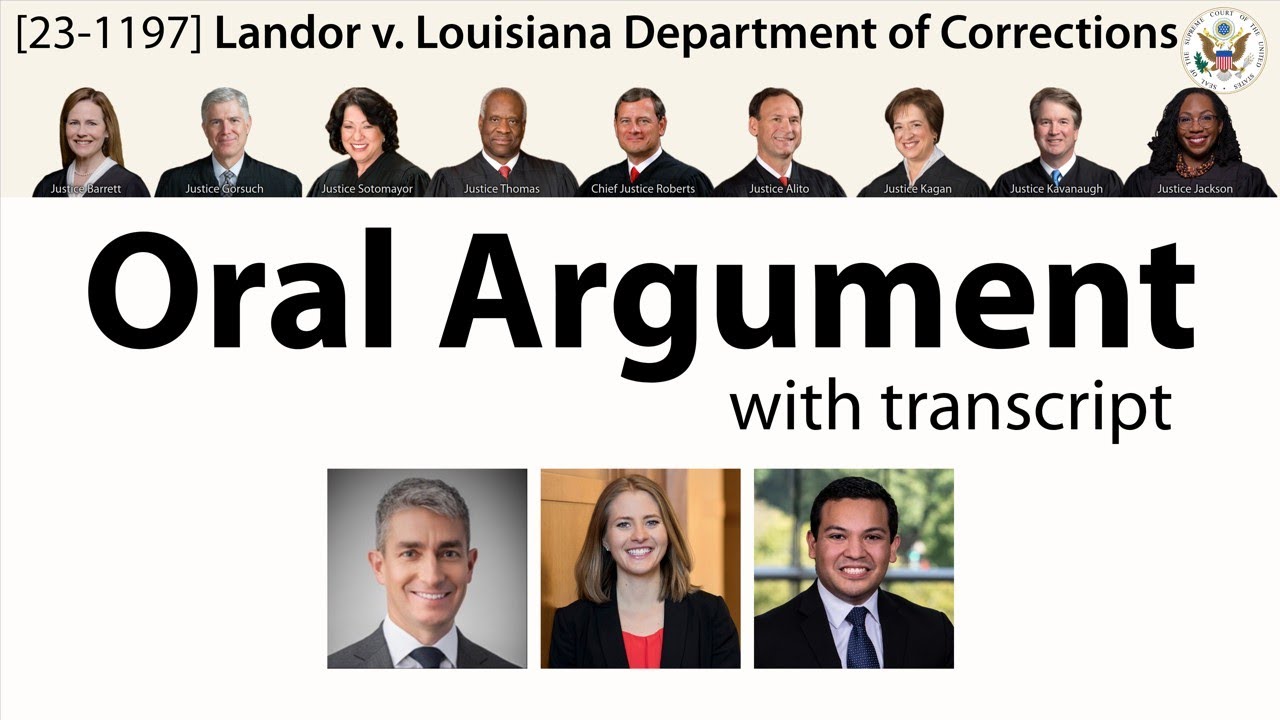
[23-1197] Landor v. Louisiana Department of Corrections
argued at the Supreme Court of the United States on Nov 10, 2025.
More information about the case:
Justia: https://supreme.justia.com/cases/fede... /
Docket: https://www.supremecourt.gov/docket/d...
Oyez.org: https://www.oyez.org/cases/2025/23-1197
Video produced based on information and transcripts on oyez.org, licensed under a CC-BY-NC License (https://creativecommons.org/licenses/....
Not affiliated with oyez.org or the Supreme Court.
Argued on Nov 10, 2025.
Petitioner: Damon Landor
Respondent: Louisiana Department of Corrections and Public Safety
Advocates:
Zachary D. Tripp (for the Petitioner)
Libby A. Baird (for the United States, as amicus curiae, supporting the Petitioner)
J. Benjamin Aguinaga (for the Respondents)
Chapters
0:00:00 Zachary D. Tripp
0:49:37 Libby A. Baird
1:19:57 J. Benjamin Aguinaga
1:47:39 Rebuttal: Zachary D. Tripp
Facts of the case (from oyez.org)
Damon Landor, a devout Rastafarian, vowed as part of his faith never to cut his hair—a religious commitment known as the Nazarite Vow. Incarcerated in 2020, Landor was first held at the St. Tammany Parish Detention Center and later at LaSalle Correctional Center, both of which allowed him to maintain his hairstyle in accordance with his religious beliefs. After approximately five months and with three weeks left in his sentence, Landor was transferred to Raymond Laborde Correctional Center. Upon arrival, Landor proactively explained his religious practices and presented documentation of previous accommodations, including a copy of a federal court decision supporting similar claims. An intake guard disregarded his documentation, summoned the warden, and upon Landor’s inability to produce immediate additional proof of his beliefs, guards forcibly handcuffed Landor and shaved his head.
Following his release, Landor sued the Louisiana Department of Corrections and Public Safety, its Secretary James LeBlanc, the correctional center, and Warden Marcus Myers, asserting claims under the Religious Land Use and Institutionalized Persons Act (RLUIPA) and 42 U.S.C. § 1983 for violations of his federal constitutional rights, as well as state law claims.
The U.S. District Court for the Middle District of Louisiana dismissed Landor’s individual-capacity RLUIPA claims for money damages, holding such relief unavailable under controlling Fifth Circuit precedent. The U.S. Court of Appeals for the Fifth Circuit affirmed, relying on its prior decision in Sossamon v. Lone Star State of Texas, and rejecting Landor’s arguments that subsequent Supreme Court authority or other legal developments altered that result.
Question
May an individual sue a government official in his individual capacity for damages for violations of the Religious Land Use and Institutionalized Persons Act (RLUIPA)?
Повторяем попытку...
Доступные форматы для скачивания:
Скачать видео
-
Информация по загрузке:


![Dobbs v. Jackson Women's Health Organization [Oral Argument]](https://image.4k-video.ru/id-video/11g5nAAPw4M)


