Bristol M1C Monoplane Scout - Shuttleworth Season Premiere & RAF Centenary Airshow 2018
Автор: High Flight
Загружено: 2018-05-16
Просмотров: 1598
Описание:
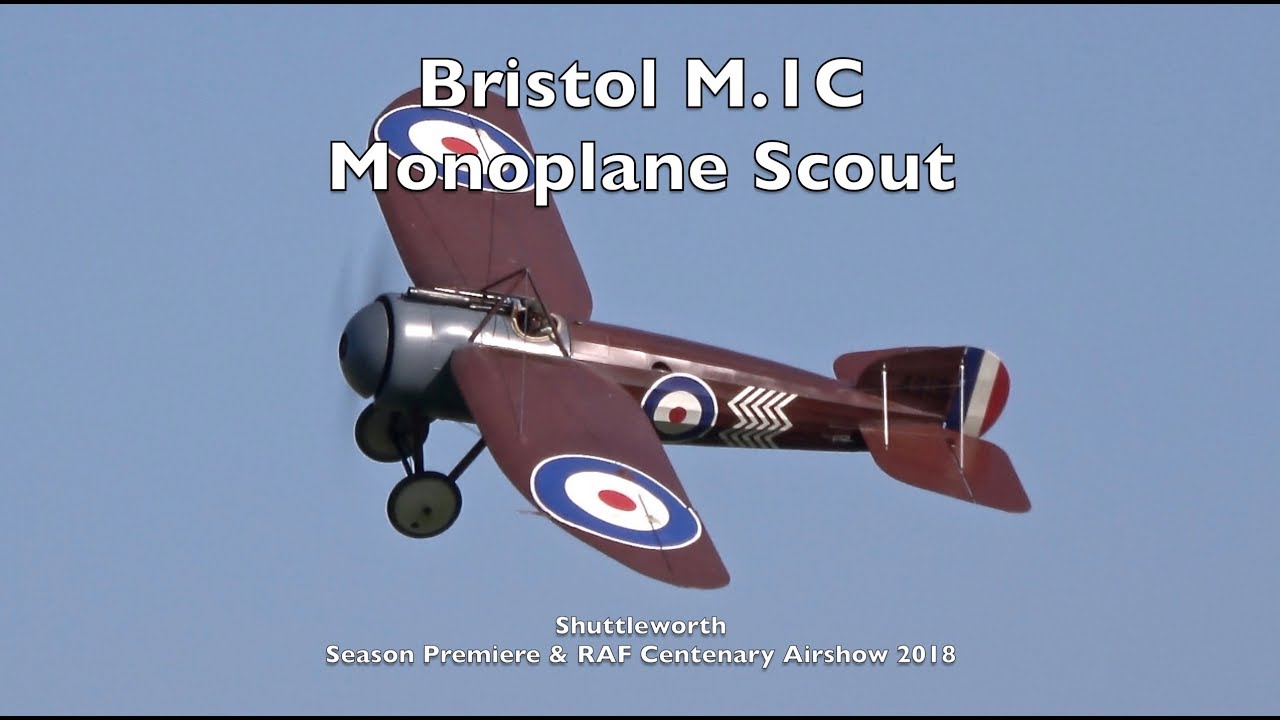
The Shuttleworth Collection's replica Bristol M1C Monoplane Scout, displaying during the Shuttleworth Season Premiere & RAF Centenary Airshow 2018.
The Bristol M.1A Scout Monoplane was produced by Bristol as a private venture, flying for the first time at Filton on 14th July 1916.
Designed by Frank Barnwell, the type featured shoulder-mounted wire braced monoplane wings and a large domed prop spinner closely faired to the circular cowling of its 110 hp Clerget rotary engine. This was mounted at the front of a faired circular-section fuselage. Barnwell had identified during the opening years of World War 1 that existing biplanes lacked performance and specifically configured a circular cross-section fuselage of wooden and fabric construction for maximum speed. The M.1A could achieve a maximum speed of 132 mph and could climb to 10,000 ft in 8 minutes 30 seconds. The only real criticism made by the War Office Evaluation pilots was poor forward and downward vision.
Four modified M.1B's were ordered with a pyramidical cabane structure and Vickers machine gun mounted in the port wing root, although the design was rejected for use on the Western Front due to its landing speed, which at 49mph was too fast for the majority of the French airfields. Despite it being up to 50mph faster than any enemy aircraft in the sky at the time, many also considered it inherently unsafe in combat.
The RFC imposed a ban on monoplanes after the crash of a Bristol Coanda monoplane and despite the 1913 Monoplane Committee clearing the type, the deep-rooted suspicion of single wing aeroplanes continued.
The production aircraft, of which 125 were ordered on 3rd August 1917, were the M.1C with a 110 hp Le Rhône engine and the single forward-firing Vickers gun mounted on the centreline. As a result of the lack of acceptance on the Western Front, the type was operationally based mainly overseas, flying in the Balkans and Middle East and in use in countries such as Chile.
After the War, a number of M.1Cs were operated by private owners and one aircraft (VH-UQI / G-AUCH) continued flying until 1938, having been re-engined with a Gipsy II.
The sole surviving Bristol M.1D Monoplane was a later, one-off conversion of a Bristol M.1C Monoplane, used for high speed testing of the Bristol Lucifer three cylinder radial engine.
Specifications:-
Powerplant-110 hp Le Rhône
Span-30 ft 9 in
Maximum Weight-1,350 lb
Capacity & Armament Single seat - one forward firing 0.303 Vickers machine gun
Maximum Speed-130 mph
Endurance-1.75 hours
Variants and number built:-
Bristol M.1A-Prototype - one only A5138
Bristol M.1B-4 aircraft
Bristol M.1C-Production model, 125 built
Survivors:-
Bristol M.1C (VH-UQI) Preserved at Minlaton, South Australia
Bristol M.1C Replica (G-BWJM / C4918) The Shuttleworth Collection, Old Warden - built by the Northern Aeroplane Workshops (Seen here).
Bristol M.1C Replica (G-BLWM / C4494) On static display at RAF Museum, Hendon - Built by Don Cashmore to the original drawings, flying in 1987 with a Warner Scarab engine;
Video and Audio content is
Copyright © 2017 S Keeler
This video and audio material may not be reproduced in any form (except as the videos Youtube embedded video option on any other website), without written permission.
Повторяем попытку...
Доступные форматы для скачивания:
Скачать видео
-
Информация по загрузке: