Trump presses ahead with tariffs despite Supreme Court ruling as Korea holds rates
Автор: Arirang News
Загружено: 2026-02-26
Просмотров: 86
Описание:
트럼프, 대법원 제동에도 관세 강화… 한은 2.5% 동결 속 한국 대응 시험대
Welcome to Within The Frame, where we bring the most pressing issues across the globe into focus. I'm Kim Mok-yeon.
U.S. President Trump has escalated his tariff strategy — even after the U.S. Supreme Court struck down his reciprocal tariffs in a 6-to-3 ruling.
Instead of retreating, the administration has rolled out new global tariffs and is reviewing additional sector-specific measures under national security laws.
At the same time, tensions involving Iran are adding fresh uncertainty to global oil markets.
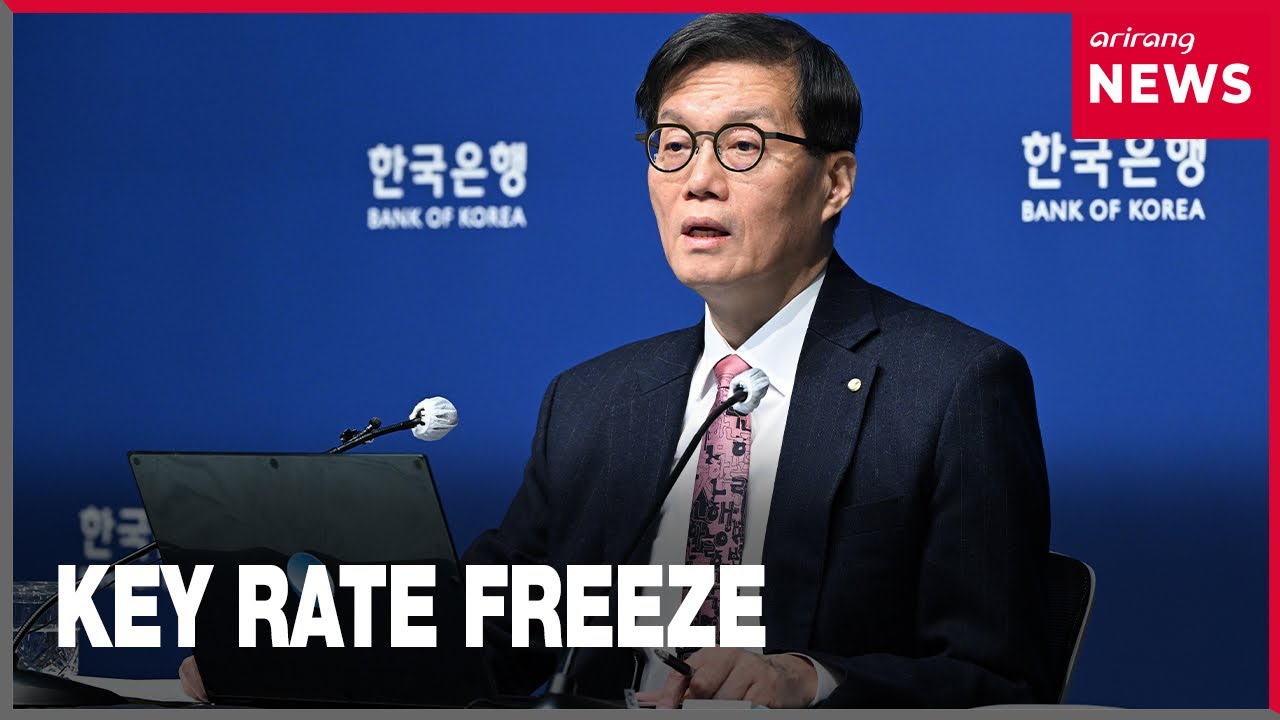
Here in Korea, the Bank of Korea has just held rates at 2.50 percent for a sixth straight meeting — while raising its growth forecast to 2.0 percent, signaling stronger momentum than previously expected.
So we are looking at a moment where global trade pressure, geopolitical risk, and shifting domestic policy signals are colliding.
Tonight, we examine what this means for Korea’s economy — and what policymakers should do next.
For this, we are joined by Yang Jun-sok, Professor of Economics at The Catholic University of Korea, here in the studio with us. Welcome.
Also joining us is Shim Myungkyu, Associate Professor of Economics at Yonsei University. Good to see you.
(YANG) 1. Let’s begin with the legal shock in Washington.
The U.S. Supreme Court ruled 6–3 that President Trump’s reciprocal tariffs were unlawful.
How significant is this ruling in terms of limiting presidential trade authority, and does it fundamentally alter the balance of power in U.S. trade policy?
(SHIM) 2. But President Trump didn’t back down.
He invoked Section 122 to impose a 10 percent — soon 15 percent — global tariff, and signaled possible use of Sections 232 and 301.
Are we now seeing a shift toward legally stronger — and potentially even tougher — tariff mechanisms?
(YANG) 3. We’re also hearing about new Section 232 tariffs under review for sectors like batteries, industrial chemicals, power grids and telecom equipment.
Looking at Korea’s export profile, where are we most exposed?
(SHIM) 4. Now, Korea had agreed to major investment commitments in exchange for lowering reciprocal tariffs from 25 to 15 percent — but those very tariffs were just ruled unlawful.
Does that weaken the basis of the agreement? Could Seoul seek adjustments?
(YANG) 5. There’s also the issue of refunds. The Court didn’t clearly address tariffs that have already been paid.
From a business standpoint, how should Korean companies assess their chances of getting money back — and what should they be doing now?
(SHIM) 6. Beyond trade, there is also a geopolitical layer. President Trump signaled that military options remain available regarding Iran.
If tensions escalate and oil prices rise, how would that shock transmit through Korea’s economy — from inflation to the exchange rate and eventually to interest rates?
(YANG) 7. And that brings us to the key question here at home.
The Bank of Korea has just decided to hold the benchmark rate at 2.50 percent.
With growth now also revised up to 2.0 percent, does this confirm that the easing cycle has come to an end?
(SHIM) 8. So, putting all these moving pieces together — a more assertive U.S. tariff strategy, Middle East uncertainty, and possible upward revisions to domestic forecasts — what should be Korea’s top priority now in coordinating trade and monetary policy going forward?
We'll have to leave our discussion right here, many thanks to Prof.Yang and Prof.Shim, we appreciate it.
#SouthKorea #UnitedStates #President #DonaldTrump #Tariffs #Interest_rate #YangJunsok #ShimMyungkyu #대한민국 #미국 #대통령 #도널드트럼프 #관세 #금리 #Arirang_News #아리랑뉴스
📣 Facebook : / arirangtvnews
📣 Youtube : / @arirangcokrarirangnews
📣 Homepage : https://v2.arirang.com/
2026-02-26, 20:30 (KST)
Повторяем попытку...

Доступные форматы для скачивания:
Скачать видео
-
Информация по загрузке:
![[FULL] NEWSCENTER (2026-02-26)](https://imager.clipsaver.ru/WG68djdLOT4/max.jpg)
![[Econ & Biz] Will Korean stocks continue their rally even though index has more than...](https://imager.clipsaver.ru/YIYAhTMKXBg/max.jpg)

![[FULL] THE DAILY REPORT (2026-02-26)](https://imager.clipsaver.ru/Ue6gUuW3lt0/max.jpg)



![[THE INTERVIEW] Connecting Korea, Global South through hope, solidarity and dance...](https://imager.clipsaver.ru/jx60XFevviI/max.jpg)