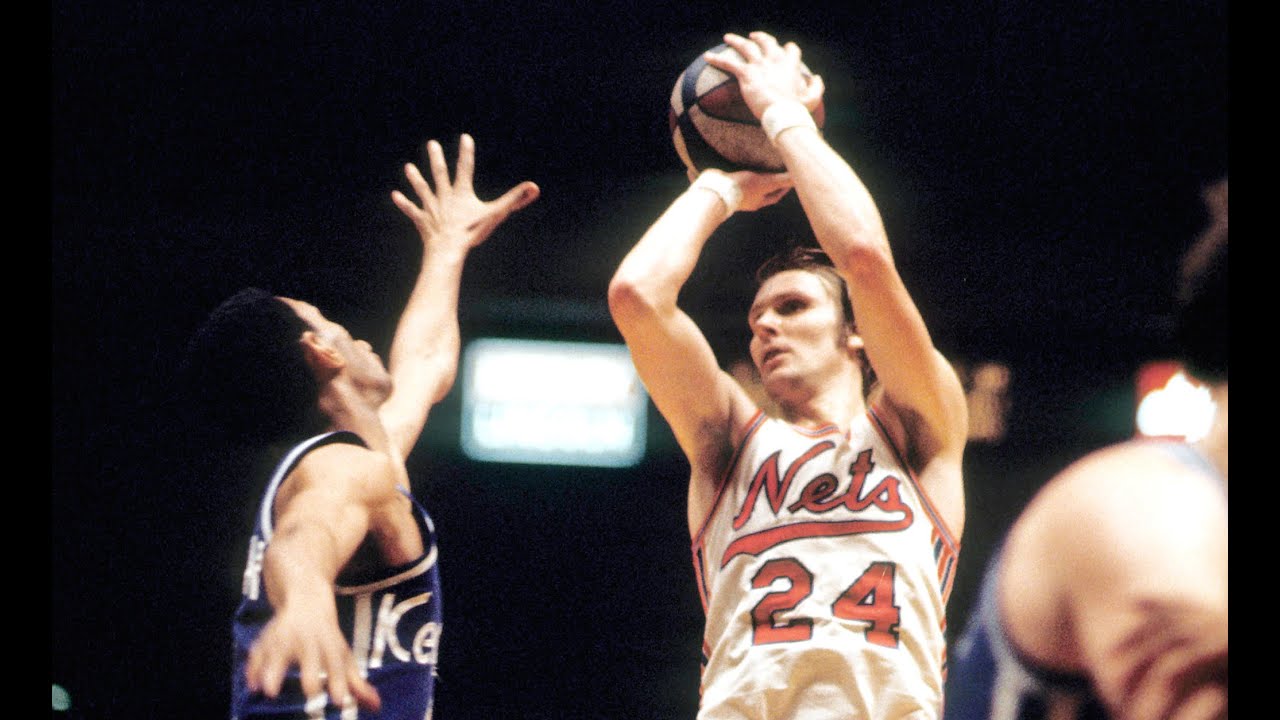
Remember The ABA: Rick Barry
Автор: ginoongkamote
Загружено: 2021-05-21
Просмотров: 7279
Описание:
Barry made basketball history on June 19, 1967, when he became the first marquee player to jump to the rival American Basketball Association. All NBA teams had one-year options on player contracts, however, and the Warriors were quick to exercise theirs, a move that prevented him from playing with the Oakland Oaks in the 1967–68 season. He worked on Oaks radio broadcasts during the ABA's first season instead.
Despite their on-court excellence, the Oaks were a disappointment at the gate, partly because of Barry's absence in the final five months of the season, partly because they were the only ABA member that competed in the same market as an NBA team, that being the more established Warriors across the bay. They averaged just 2,800 fans per home game at the state-of-the-art Oakland County Coliseum Arena, slightly more than the league average. By that time, entertainer-business entrepreneur Pat Boone had become the majority team owner, and after more than $2 million in losses over two seasons, he wanted out of the basketball business. In August 1968, the franchise was sold to a group headed by real estate attorney and former Baltimore Bullets owner Earl Foreman, who immediately moved it to Washington, D.C., even though there was no suitable arena in the vicinity at the time.
The Washington Caps became the Virginia Squires after the 1969–70 season, but Barry was openly despondent about playing in Virginia. At the same time, he wanted to continue playing in the ABA. Featured on the August 24, 1970, cover of Sports Illustrated in a Squires jersey,[7] he indicated that he would not return to the NBA if the league paid him "a million dollars a year." He denounced the Squires (and, subsequently, never suited up for them), saying he did not want his kids growing up with a Southern accent. On September 1, 1970, the Squires traded Barry to the New York Nets for a draft pick and $200,000. The negative comments were not the primary reason; rather, Squires owner Earl Foreman was mired in financial troubles and sold Barry to help meet expenses.
After the Squires dealt Barry to the New York Nets, he played in only 59 games in the 1970–71 season because of a knee injury but still made the ABA All Star team. He repeated as an ABA All Star during the 1971–72 season. During the 1970–71 season he led the league in scoring (29.4 points per game) and led the league again in 1971–72 with 31.5 points per game. In both of those years he also led the ABA in free throw percentage as he had in 1968–69. Barry also became the ABA record holder for most consecutive free throws in one game with 23.
In the 1970–71 season, the Nets finished 40–44, good for fourth place in the Eastern Division and a place in the 1971 ABA Playoffs. The Virginia Squires defeated the Nets 4 games to 2 in the Eastern Division semifinals. The 1971–72 Nets finished the season at 44–40, making the 1972 ABA Playoffs by claiming third place in the Eastern Division, 24 games behind the 68–16 Kentucky Colonels. In the Eastern Division semifinals the Nets shocked the ABA by defeating the Colonels 4 games to 2. The Nets then eked out a 4–3 game victory over the Virginia Squires in the Eastern Division finals. The Nets were then edged by the Western Division champion Indiana Pacers, 4 games to 2, in the 1972 ABA Finals.
On June 23, 1972, a United States District Court judge issued a preliminary injunction to prohibit Barry from playing for any team other than the Golden State Warriors after his contract with the Nets ended. On October 6, 1972, the Nets released Barry and he returned to the Warriors.
Повторяем попытку...
Доступные форматы для скачивания:
Скачать видео
-
Информация по загрузке: