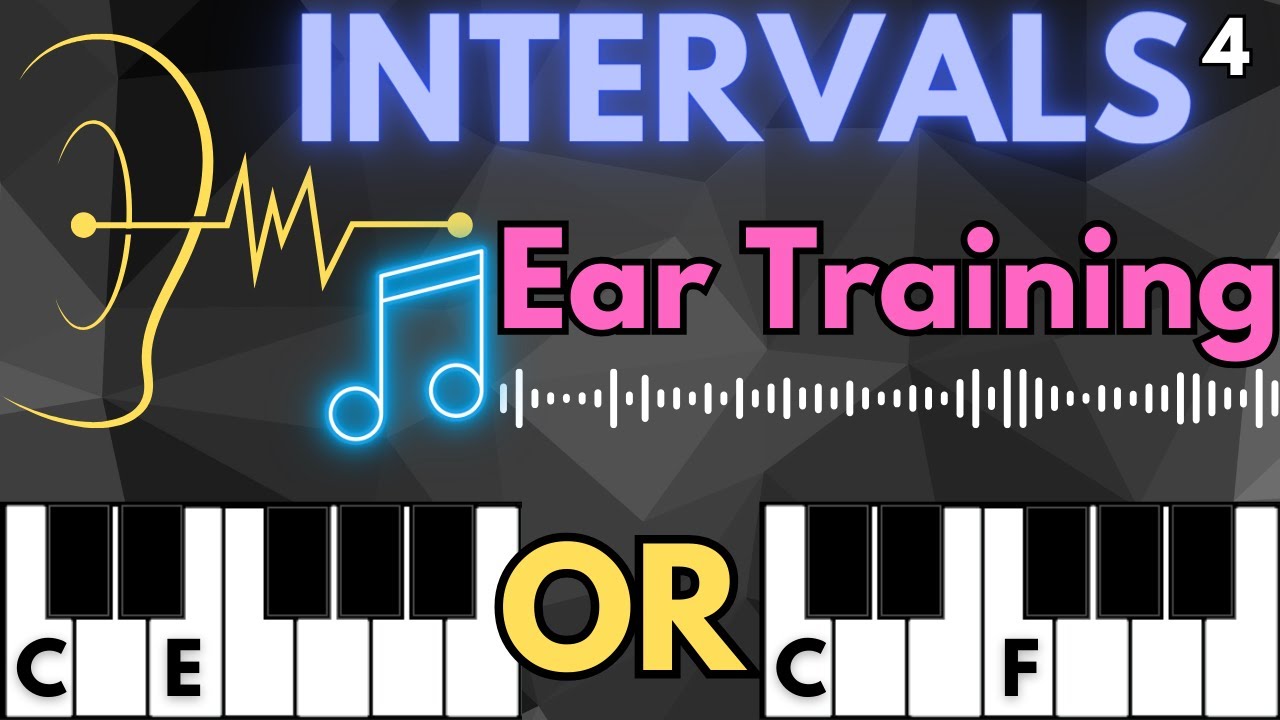
Diatonic Ascending Intervals, Fixed Root - Hands-Free Ear Training 4
Автор: Joe Luegers Music Academy
Загружено: 2023-09-27
Просмотров: 5275
Описание:
People always seem to get introduced to my channel because of my interval videos. While this is not the only ear training you should do, learning your intervals will allow your ear to instantly recognize the distance between any two pitches. Diatonic intervals are intervals between the first note in a scale to any other note in a scale. The full playlist is available on my Patreon for 1$ with audio downloads, but will gradually be made available on this channel for free. See below for links and a listener's guide.
PATREON: / joeluegersmusicacademy
FREE YOUTUBE PLAYLIST: • Hands-Free Ear Training
The popular way to learn intervals is to associate them with commonly known melodies. Let me tell you that this undeniably works, but also caution you to not only go with this method. The problem is that once you hear an interval in a different song under a different harmonic context, it might sound totally unfamiliar. So go ahead and learn the tune names, but also think about consonance vs. dissonance and the distance between the notes.
Major 2nd - The first two notes in a major scale, and also the distance between MOST notes in a major scale. The only exception is 3-4 and 7-1. Also known as a whole step. If the notes sound close together, it's probably this one. "Happy Birthday" begins with a major 2nd.
Major 3rd - The first two notes in a major chord. You might confuse this one with the major 2nd because they are both relatively small intervals. The major 3rd has a brightness that the major 2nd does not. "When the Saints Go Marching In" begins with a major 3rd.
Perfect 4th - Songs that use a perfect 4th tend to go from the 5th scale degree (dominant, or sol), to the 1st scale degree (tonic, or do.) This results in a very complete, resolved-sounding interval. However, if a song goes from 1 to 4 (tonic to subdominant, or do to fa), it will sound like it needs to resolve down a half step. This interval has less of a bright sound than the major 3rd, and I tend to describe it as "neutral" or "hollow." "Here Comes the Bride", "Hedwig's Theme", and "Auld Lang Syne" all begin with a perfect 4th.
Perfect 5th - It is common to mix up a perfect 5th for a perfect 4th, and vice-versa. However, unlike the perfect 4th, the perfect 5th typically doesn't sound like it wants to resolve anywhere. You could say that the perfect 5th is slightly "more perfect" than the perfect 4th. I've always found it to have a somewhat epic sound, which is consistent with some of the melodies that use it. "Star Wars Main Theme", "Top Gun Anthem", and the "Jurassic Park Theme" all begin with a perfect 5th, as well as the supremely epic "Twinkle Twinkle Little Star."
Major 6th - If you don't know what an interval is, just guess this one! People have trouble with 6ths because they aren't nearly as common as some of the other intervals. I like to imagine someone yodeling because yodeling tends to be in 6ths. When the major 6th is used in a song, it tends to be the 5th scale degree (dominant, or sol) leaping up to the 3rd scale degree (mediant, or mi). The major 6th is used in the NBC jingle and "My Bonnie Lies Over the Ocean".
Major 7th - This one is pretty distinct. It has a dissonant, or unresolved sound. The upper note will likely sound like it really wants to resolve upward. If you see this interval in a chord, such as a major 7th chord, it tends to give it a "dreamy" quality. It is used in the chorus of "Take on Me", as well as in "Pure Imagination" when Willy Wonka sings the words "A-World".
Octave- This is the most perfect of all intervals because it is the first in the overtone series and occurs between two notes with the same letter name. An A on a keyboard to the next A on the keyboard is an octave, and so on. It should sound perfectly in tune. Octaves are most commonly mixed up with perfect 5ths, but you should be able to hear that an octave is a much larger jump. It is the biggest melodic jump you're likely to see in most music. A famous example is the first two notes in "Somewhere Over the Rainbow".
Thanks to @BrandonWalid, Martin Shaw, Tóth Ákos, Austin Kwan, and Rafael Belor for proof-watching this video.
CONTACT: [email protected]
FOLLOW ME FOR THE LATEST NEWS ON CONTENT
Facebook: / joeluegersmusicacademy
Instagram: / joeluegersmusicacademy
Website: https://www.luegerswriter.com/
TikTok: / joeluegersmusicacademy
#joeluegersmusicacademy #eartraining #musictheory
Повторяем попытку...
Доступные форматы для скачивания:
Скачать видео
-
Информация по загрузке:


