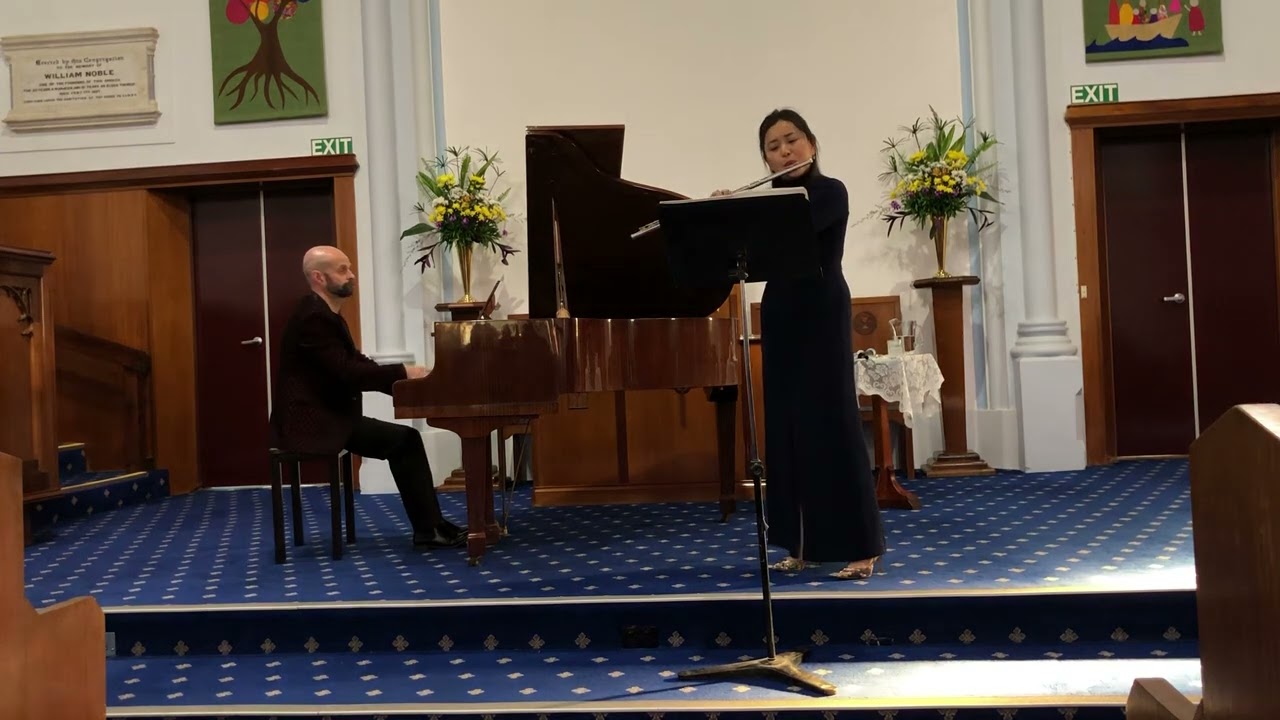
J.Haydn ''Adagio" (flute and piano).
Автор: Willie-Whistleblower
Загружено: 2026-02-10
Просмотров: 13
Описание:
• willie-whistleblower
The charming Adagio from the Symphony in D in the transcription for flute and keyboard by Louis Fleury.
Franz Joseph Haydn (31 March 1732 – 31 May 1809) was an Austrian composer of the Classical period. He was pivotal in the evolution of chamber music forms like the string quartet and piano trio. His contributions to musical form have led him to be called "Father of the Symphony" and "Father of the String quartet".
Haydn rose from humble origins, the child of working people in a rural village. He established his career first by serving as a chorister at St. Stephen's Cathedral, Vienna, then through an arduous period as a freelance musician. Eventually he found career success, spending much of his working life as music director for the wealthy Esterházy family at their palace of Eszterháza in rural Hungary. Though he had his own orchestra there, it isolated him from other composers and trends in music so that he was, as he put it, "forced to become original".
During this period his music circulated widely in publication, eventually making him the most celebrated composer in Europe. With the death of his patron Nikolaus Esterházy in 1790, Haydn was free to travel, and augmented his fame—now as a performer before the public—in both London and Vienna. The last years of his life (1803–1809) were spent in a state of debility, unable to compose due to poor health. He died in Vienna in 1809 at the age of 77...
Haydn was a friend and mentor of Mozart, a teacher of Beethoven, and the elder brother of composer Michael Haydn...
The remoteness of Esterháza, which was farther from Vienna than Eisenstadt, led Haydn gradually to feel more isolated and lonely. He longed to visit Vienna because of his friendships there. Of these, a particularly important one was with Maria Anna von Genzinger (1754–1793), the wife of Prince Nikolaus's personal physician in Vienna, who began a close, platonic relationship with the composer in 1789. Haydn wrote to Mrs. Genzinger often, expressing his loneliness at Esterháza and his happiness for the few occasions on which he was able to visit her in Vienna. Later on, Haydn wrote to her frequently from London. Her premature death in 1793 was a blow to Haydn, and his F minor variations for piano, Hob. XVII:6, may have been written in response to her death.
Besides teaching Beethoven, Haydn also befriended Mozart in Vienna, whom he had met sometime around 1784.
Impressed by Mozart's work, Haydn praised it unstintingly to others. Mozart returned the esteem in his "Haydn" quartets. (In 1785 Haydn was admitted to the same Masonic lodge as Mozart, the "Zur wahren Eintracht" in Vienna).
On 15 December 1790, after fond farewells from Mozart and other friends, Haydn departed from Vienna with the impressario Salomon arriving in Calais in time to cross the English Channel on New Year's Day of 1791. It was the first time that the 58-year-old composer had seen the sea. Arriving in London, Haydn stayed with Salomon, near Piccadilly Circus, working at the Broadwood piano firm nearby.
It was the start of a very auspicious period for Haydn: both the 1791–1792 journey, along with a repeat visit in 1794–1795 were greatly successful. Audiences flocked to Haydn's concerts; he augmented his fame and made large profits, thus becoming financially secure. Charles Burney reviewed the first concert thus: "Haydn himself presided at the piano-forte; and the sight of that renowned composer so electrified the audience, as to excite an attention and a pleasure superior to any that had ever been caused by instrumental music in England.".
While travelling to London in 1791, Haydn met the young Ludwig van Beethoven in his native city of Bonn. On Haydn's return, Beethoven came to Vienna and was Haydn's pupil up until the second London journey in 1794. Haydn took Beethoven with him to Eisenstadt for the summer, where Haydn had little to do, and taught Beethoven some counterpoint.
By the time he arrived on his second journey to England (1794–1795), Haydn had become a familiar figure on the London concert scene. The final benefit concert for Haydn ("Dr. Haydn's night"), at the end of the 1795 season, was a great success and was perhaps the peak of his English career. Haydn's biographer Griesinger wrote that Haydn "considered the days spent in England the happiest of his life. He was everywhere appreciated there; it opened a new world to him".
Haydn' final triumph occurred on 27 March 1808 when a performance of The Creation was organized in his honour. The very frail composer was brought into the hall in an armchair to the sound of trumpets and drums and was greeted by Beethoven, Haydn was both moved and exhausted by the experience and had to depart at intermission.
On 26 May Haydn played his "Emperor's Hymn" with unusual gusto three times; the same evening he collapsed and was taken to what proved to be his deathbed.
Повторяем попытку...

Доступные форматы для скачивания:
Скачать видео
-
Информация по загрузке:








![1960s Soul (1964) [Hidden Gems] Ray Charles & Sam Cooke Tribute – Sweet Emotion](https://imager.clipsaver.ru/-tpV80NFyvs/max.jpg)