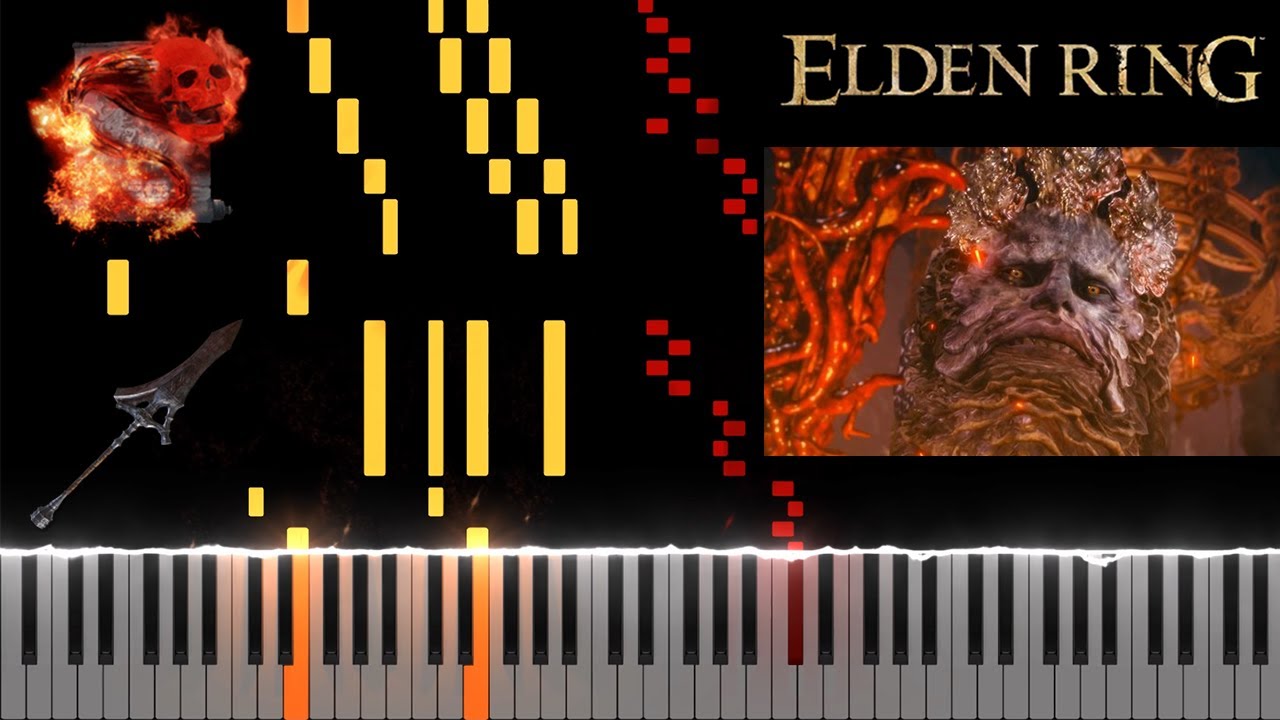
ELDEN RING - God-Devouring Serpent (Rykard's Theme) on Piano
Автор: Moonlapse Piano
Загружено: 2023-01-14
Просмотров: 15582
Описание:
Composer: Yoshimi Kudo
Arranged by: Moonlapse Piano
Sheets: https://musescore.com/user/37002291/s...
Discord: / discord
Hi everyone! I'm back with another Elden Ring arrangement. I'll never forget how overwhelming it was during this fight as the insane operatic end of phase 2 was playing while the endless hellfire of skulls rained down. This song also comes packed to the brim with incredibly interesting music theory concepts. I won't be able to cover all of it with the 5000 word limit here, but I am thinking about making a separate music theory blog (or dedicated theory videos) soon.
-Theory Breakdown-
0:32 sets the tone by introducing a concept which will repeat throughout the piece - abundant chromaticism. Here we have a main melody in F Phrygian. What's interesting about this is the overlaid chromatic ascending runs - they add a frenzied and demonic quality to the already dark-sounding phrygian modal backdrop. My takeaway from this is you can be pretty creative with chromatic runs like this and basically 'dress up' a different mode with them to add chaotic energy.
01:26 is a very strong progression which I absolutely love.
C#m C#m G#5/D# F#m C#m/E C#m/G# D#7/G D#7
C#m C#m G#5/D# F#m C#m/E C#m/G# A
Ignoring the bassline for a moment, we basically have (i, V, iv, i, II7) into (i, V, iv, i, VI). However, it's fascinating in that it has most of these chords as inversions for driving melodic bass movement that takes center stage. Especially when we get the i over its third (E), and then i over its fifth (G#), in order to set up a savage half step walk down to the II7 over its third (G). G is the flat 5 of the parent C# minor scale so using this note in the bassline especially gives it such a Soulsborne boss music quality, for lack of a better phrase. It's dark, twisted, bombastic, wild, evil-sounding, warped. In general, using the II7 in a minor progression is a great takeaway from this to achieve a similar sound, especially resolving down to the i. Having that flat 5 in there is just so potent. The second time around we get to an uplifting and epic major VI chord instead, which has even more impact since our ears were now expecting that gritty and warped flat 5 sound. Gorgeous - don't forget the chromatic runs over the top to add color/texture.
01:50 is actually my favorite section. The first chord is basically an expression of the F# whole tone scale (D E F# G# C). It feels dreamy and ambiguous but still dark. Then it moves to a Gsus type of sound, with notes C D F G A over G, so no third - also very ambiguous. These two chords back and forth work SO well together but they are really quite unusual and nonfunctional. I have seen a lot of whole tone stuff in music before to achieve that 'Alice in Wonderland' vibe but this chord progression demonstrates how whole tone can fit in a chord progression. We can also look at this 'whole tone context' as an F# 7#11b13, as it has some dominant function (though Yoshimi Kudo leaves out the major third here). In an effort to neatly package this: Anytime we are in the whole tone scale, we can move to a sus2 or 7sus2 chord that is a half step away from any note in the scale. I tried replacing the G7sus2 with others and it sounded really cool, like F7sus 2 or Eb7sus2.
At 02:46 we get a marvelous octatonic scale. This is the F whole-half diminished scale played blazing fast right on top of an F diminished chord. This is covered pretty well on the internet so I definitely recommend looking into it.
03:39 - the fabled outro. It's quite complex and erratic, but it's almost entirely in the D harmonic minor mode. While it isn't utilizing an usual harmonic cadence, what's crazy is how the inversions are used and how we only sit on the i or iv for very brief durations. Simplified, it is mainly going V7, i, iV, V, i - shards of a very common progression in classical music and souls music. It really gives that medieval, kingly, lordly overall vibe. We sit on some form of the dominant A7 for most of the section. However, it's dressed up - for example, the section opens up with a fierce A7b9/E. Later, we get a bass walkdown from E to C# to A, all parts of A7. is just one example of how a 'simple' chord sequence is obfuscated. Also, more chromatic runs on top. My overall takeaway is that we can use inversions in creative ways to hide the fact that we are actually doing very common chord progressions like i iv V i, or V i, etc. We can breathe new life into an A7 chord by putting it over its fifth, for example, and resolving that down a whole step to the root of the i. We can make a chord progression more chaotic and unstable by resolving to the i for a brief moment, only to leave and go right back to a dominant or diminished chord.
Thanks for reading! Join the discord linked at the top if you want to learn/talk/brainstorm about Soulsborne music or theory in general.
Повторяем попытку...
Доступные форматы для скачивания:
Скачать видео
-
Информация по загрузке:


![Prelude in G minor [Original composition]](https://image.4k-video.ru/id-video/L5e4H9NXqgU)
![Самые ОГРОМНЫЕ СУЩЕСТВА в Звёздных Войнах [РЕЙТИНГ]](https://image.4k-video.ru/id-video/POP_qawOsSk)


