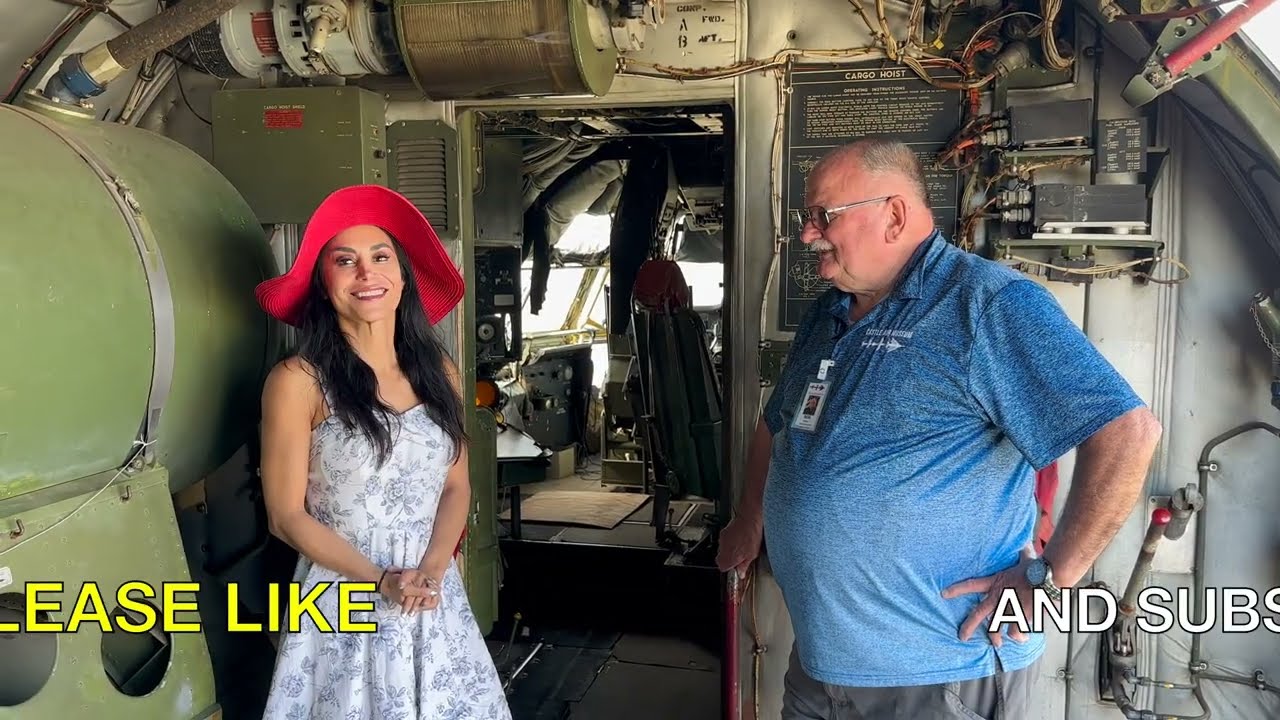
Inside the Douglas B-18 "Bolo" - Castle Air Museum
Автор: Castle Air Museum
Загружено: 2026-02-05
Просмотров: 6831
Описание:
The Douglas B-18 Bolo is an American twin-engined heavy bomber which served with the United States Army Air Corps and the Royal Canadian Air Force (as the Digby) during the late 1930s and early 1940s. The Bolo was developed by the Douglas Aircraft Company from their DC-2 as a replacement for the Martin B-10.
By 1940 standards, it was slow, had an inadequate defensive armament, and carried too small a bomb load. By 1942, surviving B-18s were relegated to antisubmarine, training and transport duties. A B-18 was one of the first USAAF aircraft to sink a German U-boat, U-654 on 22 August 1942 in the Caribbean.
In 1934, the United States Army Air Corps requested for a twin-engine heavy bomber with double the bomb load and range of the Martin B-10 then entering service. During the evaluation at Wright Field the following year, Douglas offered its DB-1. It was competing against the Boeing Model 299 (later developed into the Boeing B-17 Flying Fortress) and Martin 146.
While the Boeing design was clearly superior, the 299's four engines eliminated it from consideration despite being the favorite, and the crash of the prototype — caused by taking off with the controls still locked — put its purchase on hold. The Martin 146 was a minor improvement on the B-10, and was never seriously considered. During the depths of the Great Depression, the lower price of the DB-1 at $58,500 compared to $99,620 for the Model 299 also favored the Douglas entry, and it was ordered into immediate production in January 1936 as the B-18.
The DB-1 design was modified from that of the DC-2. The wingspan was 4.5 ft (1.4 m) greater, the fuselage was narrower and deeper, and the wings were moved up to a mid-wing position to allow space under the spars for an enclosed bomb bay. Added armament included manually operated nose, dorsal, and ventral gun turrets.
At one point, Preston Tucker's firm received a contract to supply Tucker remote controlled gun turrets but these were unsuccessful, and were never used in service.
More About Castle Air Museum
Castle Air Museum affords visitors from the region and throughout the world the opportunity to learn the costly sacrifices of the men and women who designed, built, maintained and flew these aircraft into hostile skies to defend freedom and liberty with many making the ultimate sacrifice. The Museum also serves to educate on the past milestones in aviation and what the future of aerospace may hold in store.
Castle Air Museum, located in the heart of California’s San Joaquin Valley is the largest aviation museum between Southern California and the State of Washington with over seventy restored vintage military aircraft on static exhibit with more to arrive in the future! The Museum is adjacent to the former Castle Air Force Base, now Castle Airport, and officially opened to the public in 1981 as a non-profit 501c3 organization with a mission “to preserve military aviation heritage for future generations.” Today the Museum has evolved into a premier showcase for families, history buffs, schools, tourists, and aviation enthusiasts.
Visit Castle Air Museum Online:
https://www.castleairmuseum.org
Повторяем попытку...

Доступные форматы для скачивания:
Скачать видео
-
Информация по загрузке: