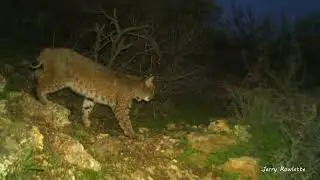
First lynx kittens ever documented in Voyageurs National Park
Автор: Voyageurs Wolf Project
Загружено: 2026-01-09
Просмотров: 6668
Описание:
Though this video might not look like much, it shows something pretty remarkable. This footage, which we captured this past September on the Kabetogama Peninsula, is the first confirmed observation of lynx kittens in Voyageurs National Park (and one of only a few observations of known lynx reproduction in the Greater Voyageurs Ecosystem).
Although lynx have been observed/documented in the park sporadically for several decades, there has never been evidence of kittens in the park (i.e., a breeding population of lynx). As a result, most lynx in and around Voyageurs are likely transitory individuals roaming large area.
From 2000 to 2004, biologists with the National Park Service made a concerted effort to study lynx in the park. They only documented the presence of one male and one female, and concluded “lynx were either transient or present at a low density”.
Another study from 2007-2008 in and around Voyageurs National Park using trail cameras and snow tracking did not detect the presence of lynx. However, they noted that there were some sightings of lynx outside of the park with one unconfirmed report of a female lynx with a kitten observed to the west of the park.
The researchers concluded that “even though patches of high-density snowshoe hare habitat exist in the Voyageurs National Park area, the low density of snowshoe hares at the landscape level would not support resident lynx”.
Based on this research and some subsequent work, researchers with the park concluded in 2015 “it does not appear that there are currently resident lynx”.
In fact, the researchers in 2012 concluded: ‘only three confirmed observations of adult lynx have occurred within the boundaries of VNP since 2001”.
Obviously, studying these elusive animals in places like Voyageurs has historically been difficult because trail camera technology was not what it is today (or did not exist). However, trail cameras have provided a great tool to observe and understand lynx in places like Voyageurs.
Skip forward to today: we now routinely get numerous observations of lynx each year in Voyageurs National Park as well as outside the park. Many observations are likely of the same few individuals wandering around, though, based on physical appearances, it seems we are capturing observations of more than 1 or 2 lynx.
That said, in general, our trail camera data generally supports the conclusions of the Voyageurs National Park researchers. Most lynx likely are transient individuals, and certainly lynx are at low densities in and around Voyageurs.
Nonetheless, this observation of a lynx with two kittens shows that lynx can reproduce in this area, though such occurrences are likely rare. One observation of reproduction is not evidence of a self-sustaining resident population but it suggests it might be possible.
Anyway, this finding just highlights how our trail cameras, which are deployed to study wolves, simultaneously capture rare and valuable data on other wildlife species that have been traditionally difficult to study.
Sources:
Route et al. 2009. Status of Canada lynx in Voyageurs National Park, Minnesota, 2000-2004. National Park Service Report.
Moen et al. 2010. Lynx habitat suitability in and near Voyageurs National Park. Natural Areas Journal.
Moen and WIndels. 2015. Lynx Habitat Suitability. Voyageurs National Park Website.
Learn more about the Voyageurs Wolf Project:
Website: http://www.voyageurswolfproject.org
Facebook: / voyageurswolfproject
Instagram: / voyageurswolfproject
Twitter: / voyawolfproject
Threads: https://www.threads.net/@voyageurswol...
Повторяем попытку...

Доступные форматы для скачивания:
Скачать видео
-
Информация по загрузке: