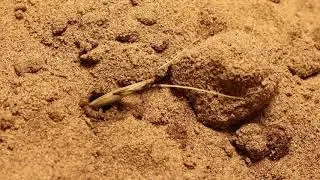
WILD OAT (Avena fatua)
Автор: BYUI Applied Plant Science Department
Загружено: 2019-11-26
Просмотров: 7992
Описание:
How to Identify Wild Oat (Avena fatua)
This is wild oat, a member of the grass family Poaceae. It is native to Europe and has become a common weed in North America, Asia, and Africa. It is an annual that sets seed from early to late summer.
The plant has tall, thin hollow stems that reach 1 to 4 feet tall. The stems are usually hairless but may be sparsely hairy.
The leaves are long and usually twisted counter-clockwise. They are rolled in the bud and have membranous ligules with toothed or jagged edges. There are no auricles, and the base of the leaves and the sheaths are covered in soft hairs. The leaves themselves are covered in tiny, stiff hairs that give them a rough texture.
The seeds are borne on an open panicle that has several drooping spikelets, which each contain two or three seeds. The seeds are black and the hulls have stout awns, which will curl and uncurl as moisture conditions change This will creates a drilling actions that will bury the seeds into the soil, where they can remain dormant for as long as 10 years before germinating.
The plants have extensive, deep fibrous root systems, and only reproduce via seed.
Wild oat is common in cultivated fields, pastures, rangelands, gardens, grasslands, and waste areas.
The plant is edible, and can make good livestock forage, but the awns of the seed hulls are highly irritating to cattle.
Wild oat can be distinguished from domestic oat by the presence of the awns. Domestic oat has a much denser panicle, and tends to have much larger, wider leaves as well.
Wild oat can be a seriously damaging weed that will invade valuable grain crops, contaminating the grain, rapidly drying the soil, and acting as a disease vector for various fungal pathogens.
Sources:
Weeds of the West, 5th Edition (1991) by Tom D. Whitson, published by the Western Society of Weed Science
University of California Agriculture and Natural Resources IPM – Weed Gallery
http://ipm.ucanr.edu/
United States Department of Agriculture – Plant Database
https://plants.usda.gov
Повторяем попытку...

Доступные форматы для скачивания:
Скачать видео
-
Информация по загрузке: