Merkles Trees, Merkle Proofs & Hash functions for blockchains (whiteboard EP1)
Автор: the more technical whiteboard channel
Загружено: 2025-01-16
Просмотров: 1947
Описание:
Merkle trees are fundamental to blockchain technology, serving as the cornerstone of transaction verification. At their core, they solve a critical problem: How can you verify your transaction is included in the blockchain without downloading the entire chain?
Twitter: gogoDiegoCrypto
The Problem With Traditional Verification
Imagine you want to verify transaction D in a blockchain. Without Merkle trees, you'd need to:
Download the entire blockchain from the first block
Search through everything until you find your transaction
Verify its inclusion
This process is incredibly inefficient and resource-intensive. This is where Merkle trees come in, offering an elegant solution through Merkle proofs.
"how do i know if my tx is included?"
Understanding Hash Functions:
Before diving into Merkle trees, we need to understand hash functions:
Takes arbitrary-sized input data
Outputs a fixed-size string (hash)
Most famous: SHA-256 (outputs 64 characters)
Key Properties of Hash Functions:
Deterministic: Same input always produces the same output
Irreversible: Can't reverse-engineer the original data from the hash
Avalanche Effect: Small input changes create completely different hashes
For example: Using SHA-256
Input "1" → unique hash
Input "2" → completely different hash
Even changing one digit in 100,000 digits of pi creates a totally different hash (instead of just 1 digit of that changing)
Merkle Trees: Structure and Function
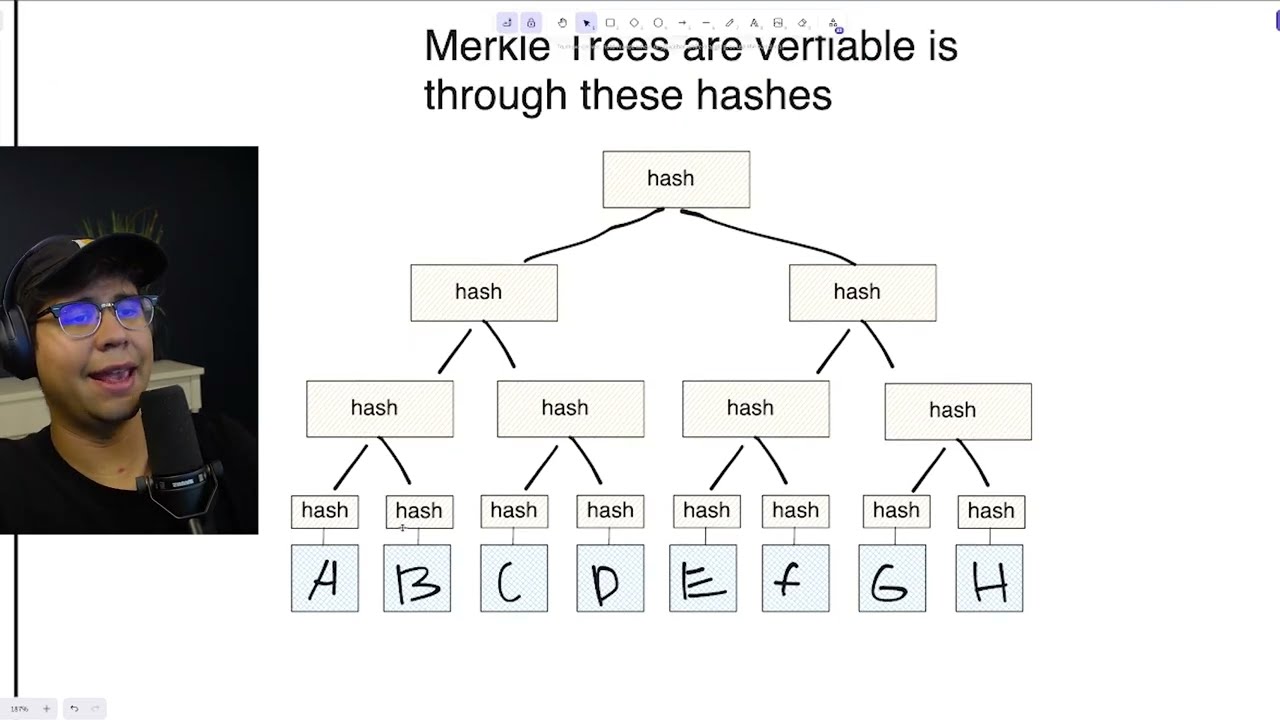
A Merkle tree is structured as follows:
Bottom Layer: Leaf nodes (transaction data hashes)
Middle Layers: Branch nodes (combined hashes)
Top: Single Merkle root
The Building Process:
Hash each transaction (A through H) to create leaf nodes
Combine pairs of hashes (AB, CD, EF, GH)
Hash these combinations
Continue until reaching a single root hash
Verifiability Through Cascading Changes
What makes Merkle trees secure:
Modifying any transaction changes its hash
Changed hash affects all parent hashes
Changes cascade up to the root
Can't modify a transaction without changing the root hash
For example:
Changing transaction A to K creates a new hash
New hash combines with B's hash
Creates different branch hash
Process continues until root
Final root hash doesn't match original
Real-World Applications
Merkle trees, despite being slow are crucial in:
Blockchain transaction verification
Bridging protocols like Inter-blockchain Communication (IBC) light client proofs
Proof of transaction inclusion
showing how 2 blockchains can use merkle proofs to with light clients prove transaction inclusion
The technology's battle-tested nature makes it a reliable choice for critical blockchain infrastructure, particularly in cross-chain communication and verification systems.
This combination of mathematically robust hash functions and tree-like data structures creates a powerful system for verifying data integrity without requiring complete data downloads, making it an essential component of modern blockchain architecture.
Повторяем попытку...
Доступные форматы для скачивания:
Скачать видео
-
Информация по загрузке: