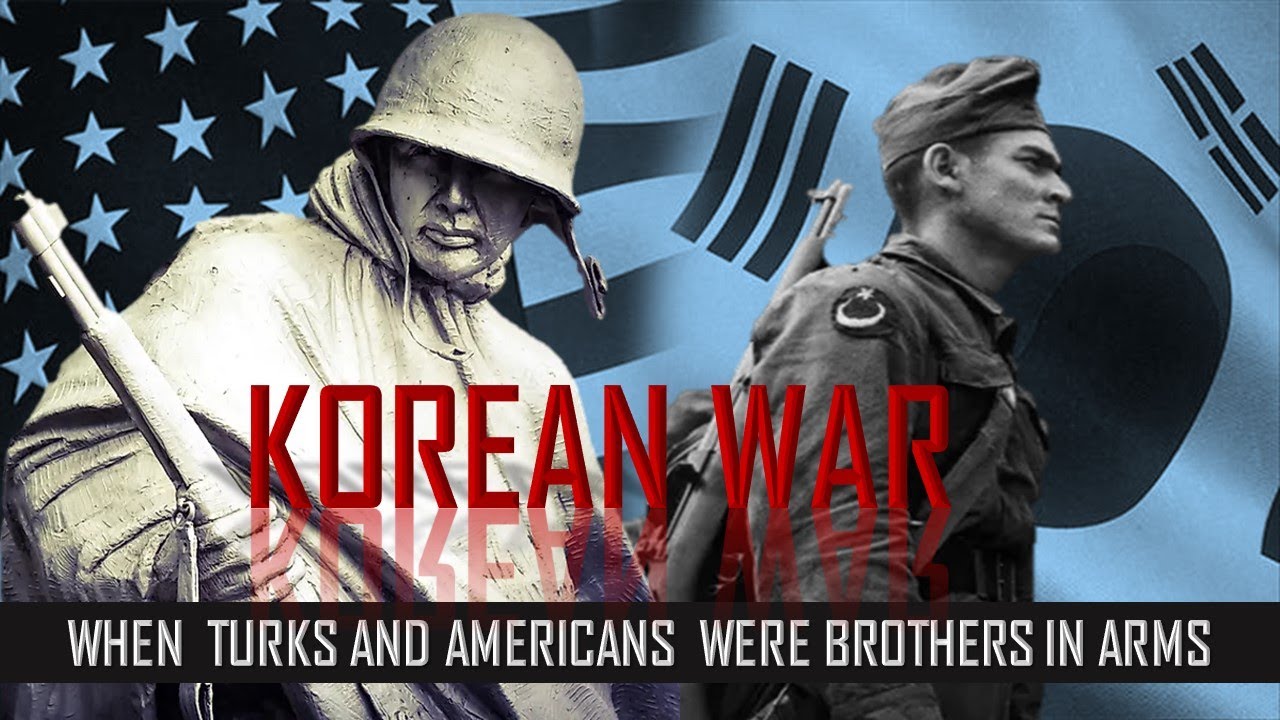
KOREAN WAR WHEN TURKS AND AMERICANS WERE BROTHERS IN ARMS
Автор: Artichaeology
Загружено: 2024-03-14
Просмотров: 985
Описание:
In 1910, the Empire of Japan had annexed Korea as a colony for 35 years until its surrender at the end of World War II on 15 August 1945. The United States and the Soviet Union had liberated and then divided Korea along the 38th parallel into two zones of occupation.
In 1948 the occupation zones became two sovereign states.
After failed attempts to unify the Koreas, North Korean forces crossed the 38th parallel on 25 June 1950 into South Korea.
The Korean War was fought between North Korea and South Korea from 1950 to 1953. The war began on 25 June 1950 when North Korea invaded South Korea. The war ceased with an armistice on 27 July 1953. North Korea was supported by China and the Soviet Union while South Korea was supported by the United States and the United Nations.
Soviet generals with extensive combat experience from the Second World War were sent to North Korea as the Soviet Advisory Group. These generals completed the plans for the attack by May. But Stalin made it clear that Soviet forces would not openly engage in combat, to avoid a direct war with the U.S. Throughout 1949 and 1950, the Soviets continued arming North Korea. After the communist victory in the Chinese Civil War, ethnic Korean units in Chinese army were sent to North Korea. these troops brought with them not only their experience and training, but also their weapons and other equipment, changing little but their uniforms. After the decision by united nations, United nations forces were joined into the war. These troops were consist of the soldiers of countries like England, Canada, Australia, France, Greece and some others.
The United Nations Security Council denounced North Korea's actions and authorized the formation of the United Nations Command and the dispatch of forces to South Korea to repel the invasion. Twenty-one countries of the United Nations eventually contributed to the UN force, with the United States providing around 90% of the military personnel.
Second biggest force in size was from Turkey. Turkey was one of 22 countries to contribute manpower to U.N. forces, and one of sixteen to provide military personnel. The first 5,000 troops of the Turkish Brigade arrived on 19 October 1950, shortly after the outbreak of hostilities in June, and remained in varying strengths until the summer of 1954. Attached to the U.S. 25th Infantry Division, the Turkish Brigade was the only U.N. unit of its size permanently attached to a U.S. division throughout the Korean War.
Three different Turkish Brigades served in the Korean War. The core of the 1st Turkish Brigade was the 241st Infantry Regiment. Brigadier General Tahsin Yazıcı, a veteran of the Gallipoli Campaign, commanded the 1st Brigade.
The Turkish Brigade took part in several actions, most notably in the Battle of Kunuri, where their fierce resistance was decisive in delaying the enemy's advance. Its actions earned the brigade Unit Citations from Korea and the U.S., and it subsequently developed a reputation for its fighting ability, stubborn defense, commitment to mission, and bravery.
The Battle of Wawon or Kunu-ri, was a series of actions of the Korean War that took place from 27–29 November 1950. After the collapse of the US Eighth Army's right flank during the Battle of the Ch'ongch'on River, the Chinese Army advanced rapidly towards the critical road junction at Kunu-ri in an effort to cut off United Nations forces' retreat route. In what was considered to be Turkey's first real combat action since the aftermath of World War I, the Turkish Brigade attempted to delay the Chinese advances at Wawon. Heavy resistance from the Turks managed to drive back the Chinese advances. Then the entire advance battalion was engulfed by the Chinese; sword and bayonet fighting ensued, resulting in 400 Turkish casualties. Although during the battle the Turkish Brigade was crippled after being encircled by Chinese forces with superior numbers, they were still able to breach the Chinese trap and rejoin the US 2nd Infantry Division. Delay of the chinese advance after meeting with heavy Turkish resistance helped the other United Nations forces to withdraw without suffering many casualties and reassemble later in December.
United Nations Forces Commander in Chief, General Douglas MacArthur, described the Turkish Brigade's contribution to the war:
''The military situation in Korea is being followed with concern by the whole American public. But in these concerned days, the heroism shown by the Turks has given hope to the American nation. It has inculcated them with courage. The American public fully appreciates the value of the services rendered by the Turkish Brigade and knows that because of them the Eighth American Army could withdraw without disarray. The American public understands that the United Nations Forces in Korea were saved from encirclement and from falling into the hands of the communists by the heroism shown by the Turks.
Повторяем попытку...
Доступные форматы для скачивания:
Скачать видео
-
Информация по загрузке: