2025 Stanford PMH Symposium_Shaping the Future of Precision Mental Health with Human-Centered AI
Автор: Precision Mental Health at Stanford
Загружено: 2025-10-10
Просмотров: 157
Описание:
5th Annual Precision Mental Health Symposium | Bridging Psychiatry, Neuroscience & AI
September 26, 2025 | Stanford University
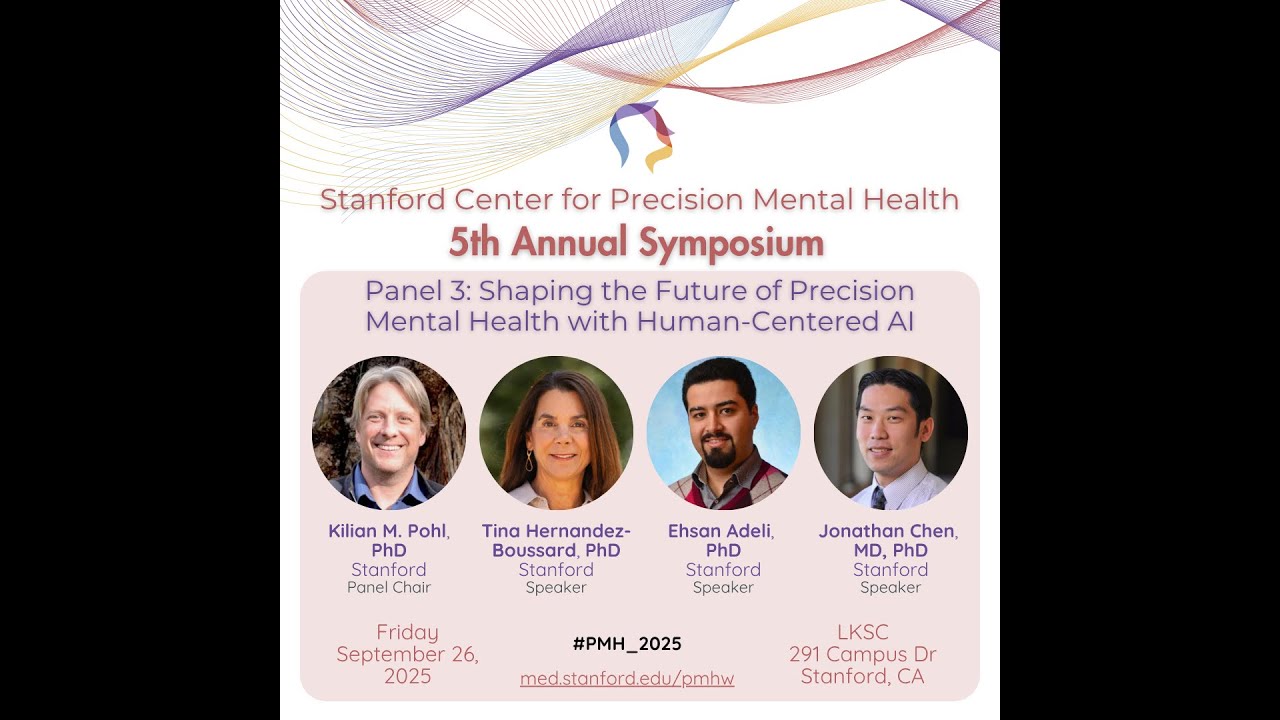
Shaping the Future of Precision Mental Health with Human-Centered AI
Panel Chair: Kilian M. Pohl, PhD
Tina Hernandez-Boussard, PhD | Advancing AI Research, Education, Policy, and Practice to Service the Collective Needs of Humanity
Ehsan Adeli, PhD | Precision Mental Health Meets Translational AI: Neural Mechanisms and Individualized Digital Biomarker Trajectories
Jonathan Chen, MD, PhD | AI for Detection and Support of Mental Health Needs
Discussion
For more information, visit: https://med.stanford.edu/pmhw
Bios:
Kilian Pohl, PhD, is a Professor (Research) in Psychiatry and Behavioral Sciences at Stanford University, with a courtesy appointment in Electrical Engineering. He directs a research program grounded in computational science, focused on identifying biomedical phenotypes to improve the mechanistic understanding, diagnosis, and treatment of neuropsychiatric disorders. Dr. Pohl’s lab embraces the diversity and complexity of mental illness through data-driven, machine learning approaches applied to large-scale biological, neuroimaging, cognitive, and behavioral datasets. His work supports national initiatives, including the Adolescent Brain Cognitive Development (ABCD) study and the National Consortium on Alcohol and Neurodevelopment in Adolescence (NCANDA). He is a faculty affiliate of the Stanford Institute for Human-Centered Artificial Intelligence, Bio-X, and the Wu Tsai Neurosciences Institute. Dr. Pohl also serves as Senior Editor for Medical Image Analysis and Associate Editor for IEEE Transactions on Medical Imaging.
Tina Hernandez-Boussard, PhD, MPH, MS, is Associate Dean of Research and Professor of Medicine (Biomedical Informatics), Biomedical Data Science, Surgery, and Epidemiology & Population Health (by courtesy) at Stanford University. With a multidisciplinary background in biomedical informatics, health services research, and epidemiology, she leads efforts to advance healthcare through the development, evaluation, and application of innovative data science methods. Her research leverages real-world clinical data to monitor, measure, and predict healthcare outcomes, with the goal of improving patient care, optimizing health systems, and informing health policy. A core focus of her work is on mitigating algorithmic bias and promoting equity in artificial intelligence applications. By rigorously evaluating how AI is used in clinical settings, Dr. Hernandez-Boussard aims to ensure that emerging technologies support fair and effective healthcare delivery. Her work is helping to shape a future in which data-driven tools contribute to more equitable, efficient, and patient-centered care.
Ehsan Adeli, PhD, is an Assistant Professor of Psychiatry and Behavioral Sciences, by courtesy, of Biomedical Data Science, and of Computer Science at Stanford University. He leads the Stanford Translational Artificial Intelligence (STAI) in Medicine and Mental Health Lab, where his research focuses on leveraging AI to advance clinical care and understanding in the context of aging and neurodegenerative disorders. Dr. Adeli also serves as Co-Director of both the Stanford AI for Mental Health Initiative and the Stanford AGILE Consortium (Advancing technoloGy for fraIlty & LongEvity).
Jonathan Chen MD, PhD, leads a research group focused on combining human and artificial intelligence to improve clinical care. His work leverages real-world clinical data—such as electronic health records—to uncover the latent knowledge embedded in medical practice, translating it into actionable clinical decision support. Dr. Chen continues to practice medicine, which grounds and inspires his research. Prior to medical training, he co-founded a company that transformed his computer science graduate work into an expert system for organic chemistry, with applications in drug discovery and education. His contributions span over 100 publications in leading clinical and informatics venues, and his work has been recognized by the NIH, National Library of Medicine, and the American Medical Informatics Association. Dr. Chen’s goal is to build a continuously learning health system by harnessing informatics and machine learning to deliver the collective wisdom of healthcare back to clinicians, patients, and systems.
Повторяем попытку...
Доступные форматы для скачивания:
Скачать видео
-
Информация по загрузке: