Kreb's cycle | pyruvic acid oxidation | Citric acid cycle | Tricarboxylic acid cycle
Автор: Visible Science
Загружено: 2023-04-01
Просмотров: 7866
Описание:
Aslam o alikum
I am Hassam ur Rahman and I am teaching Fsc biology since 2014 .I am always trying to improve myself and provide best lecture to students.i am taking content for the lecture from authentic and relevant sources but human errors are possible . you are requested to please highlight the mistakes.My lectures are equally reliable for Fsc and mdcat students
#visiblescience #mdcatbiology #alevelbiology #neetbiology # fsc biology #krebscycle #citricacidcycle #triglycericacidcycle
This lecture is about
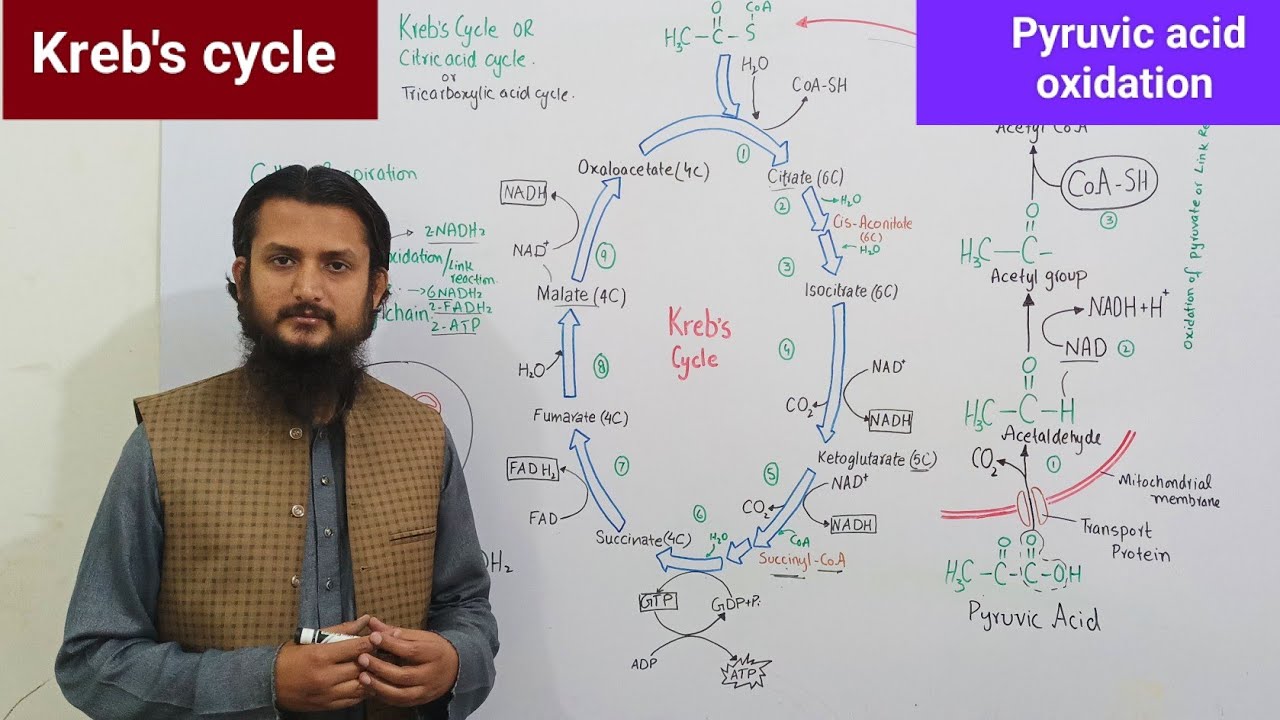
ii. Pyruvic add oxidation: Pyruvic acid (pyruvate), the end product of glycolysis, does not
enter the Krebs cycle directly. The pyruvate (3- carbon molecule) is irst changed into 2-carbon
acetic acid molecule. One carbon is released as CO2
(decarboxylation). Acetic acid on entering the
mitochondrion unites with coenzyme-A (Co A) to form acetyl Co A (active acetate). In addition, more
hydrogen atoms are transferred to NAD (Fig. 11.13).
iii. Krebs cyde or citric add cycle: Acetyl CoA now enters a cyclic series of chemical reactions
during which oxidation process is completed. This series of reactions is called the Krebs cycle (after
the name of the biochemist who discovered it), or the citric acid cycle. The irst step in the cycle
is the union of acetyl CoA with oxaloacetate to form citrate. In this process, a molecule of CoA is
regenerated and one molecule of water is used. Oxaloacetate is a 4-carbon acid. Citrate thus has 6
carbon atoms.
After two steps that simply result in forming an isomer of citrate, isocitrate another NAD- mediated
oxidation takes place. This is accompanied by the removal of a molecule of CO2
. The result
is a-ketoglutarate. It, in turn, undergoes further oxidation (NAD + 2H ----NADH) followed by
decarboxylation (CO2
) and addition of a molecule of water. The product then has one carbon atom
and one oxygen atom less. It is succinate. The conversion of a-ketoglutarate into succinate is
accompanied by a free energy change which is utilised in the synthesis of an ATP molecule. The next
step in the Krebs cycle is the oxidation of succinate to fumarate. Once again, two hydrogen atoms
are removed, but this time the oxidizing agent is a coenzyme called lavin adenine dinucleotide
(FAD), which is reduced to FADH2
With the addition of another molecule of water, fumarate is converted to malate. Another NAD
mediated oxidation of malate produces oxaloacetate, the original 4-carbon molecule. This
completes the cycle. The oxaloacetate may now combine with another molecule of acetyl CoA to
enter the cycle and the whole process is repeated (Fig. 11.13).
Повторяем попытку...
Доступные форматы для скачивания:
Скачать видео
-
Информация по загрузке: