First Hearing: Virtual Performance of Andrea Bernasconi's Stabat Mater in G minor (part 1)
Автор: Settecentista
Загружено: 2020-05-09
Просмотров: 769
Описание:
Andrea Bernasconi served the electoral court of Munich from 1753 to his death in 1784. He wrote several opere serie and a great deal of church music. The manuscripts of the church music were preserved in the Allerheiligen-Hofkirche in Munich until 1944, when the entire collection was destroyed by Allied bombing. Fortunately a few of the sacred works survive in other libraries, including the Miserere in D minor (available in a modern edition by Christoph Riedo and a fine recording accessible on Youtube) and settings of the Stabat Mater in C minor and G minor. I’m working on an edition of the two Stabat Mater settings, which (as far as I know) have not been performed since the eighteenth century.
Bernasconi demonstrated in the Stabat Mater in G minor, as he did in his other surviving large-scale sacred works, a command of a wide range of styles, from the most charming operatic galant (as in the tenor solo “Eia Mater”) to the sternest stile antico (as in the motet-like choral movements “Pro peccatis” and “Fac me tecum” and the final fugue, “Fac ut anima donetur.”
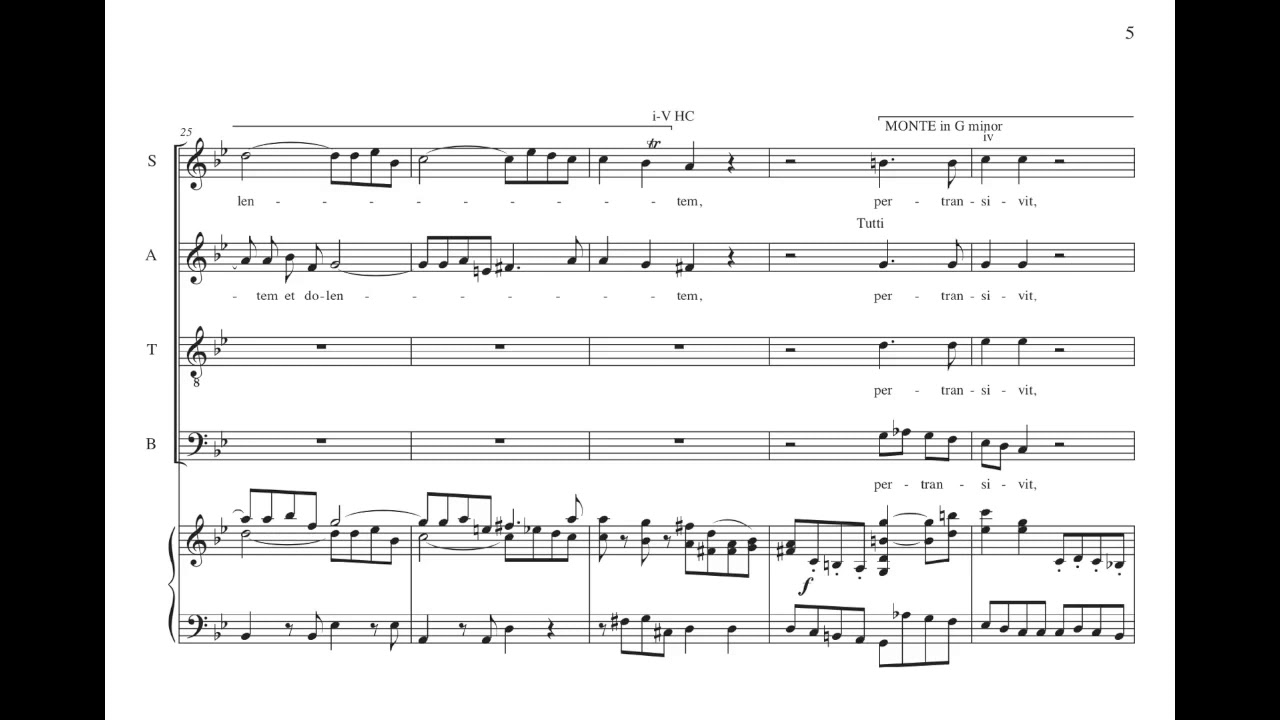
The opening movement may seem strange to us, because it begins and ends in different keys, and with music in completely different styles. A setting of the first two stanzas of the poem as a chorus in G minor, common time, and Larghetto, is followed immediately, without a break, by a setting of the third and fourth stanzas for alto solo in E flat major, but with the same meter and tempo as the chorus. Since both the chorus and the alto solo are in binary form, I refer to them in the score as “binary structure 1” and “binary structure 2.”
I have used annotations to point out some of the galant schemata that Bernasconi used, including:
00:00 Lully, Le-Sol-Fi-Sol,
00:50 Cadenza doppia
1:03 Sol-Fa-Mi, Circle of Fifths Prinner
1:24 Monte, Cadenza tripla
1:49 Sol-Fa-Mi, Lully, Converging Cadence
2:22 Fonte
2:47 Volta
Here is a first hearing of the opening movement in a “virtual performance” (using Finale), which I hope will encourage choral conductors to perform it “live.”
Повторяем попытку...
Доступные форматы для скачивания:
Скачать видео
-
Информация по загрузке: