Water Flow Rate Test Demo by Sterlitech
Автор: Sterlitech Corporation
Загружено: 2019-01-31
Просмотров: 2234
Описание:
Steve shows us how to get ready, perform, and clean up after testing a syringe filter's flow rate. Flow rate specifications indicate what volume of fluid (in this case clean water) can pass through the membrane filter in a given amount of time. Flow rate varies based on pore size and other membrane characteristics.
0:05 Set-up Bubble Point Test Apparatus
3:07 Establish flow rate
3:30 Measure flow for a minute
4:18 Measure water collected
4:45 Repeat measurement
5:36 Compare measurement values
6:16 Remove filter and store
6:50 Turn Bubble Point Test Apparatus off
Sterlitech Membrane Disc Filters
Sterlitech offers a comprehensive selection of polymeric and inorganic membrane filter materials, enabling users to perform everything from solvent filtration to gas venting.
Our pre-cut membrane disc filters are produced using the highest quality manufacturing standards. These filters are designed to increase efficiency, reduce cost, and expand the capabilities of microfiltration applications.
Available membrane disc filters (more on our website):
MCE Membranes - High protein binding, high flow rate
Silver Membranes - Inorganic, chemical and temperature resistant
Aluminum Oxide Membranes - Inorganic, transparent when wet
Cellulose Acetate Membranes - Low protein binding, high throughput, low extractables
Ceramic Membranes - Inorganic, chemical and temperature resistant
Glass Fiber Filters - High flow rate, high purity, high operating temperatures
Nylon Membranes - Superior strength, high protein binding, chemically compatible
==================
You retract the ring. Hold this side, push with this side. Let go.
Next step, turn on the gauge, make sure it's reading zero. Check to make sure that's out. Go ahead and turn it on.
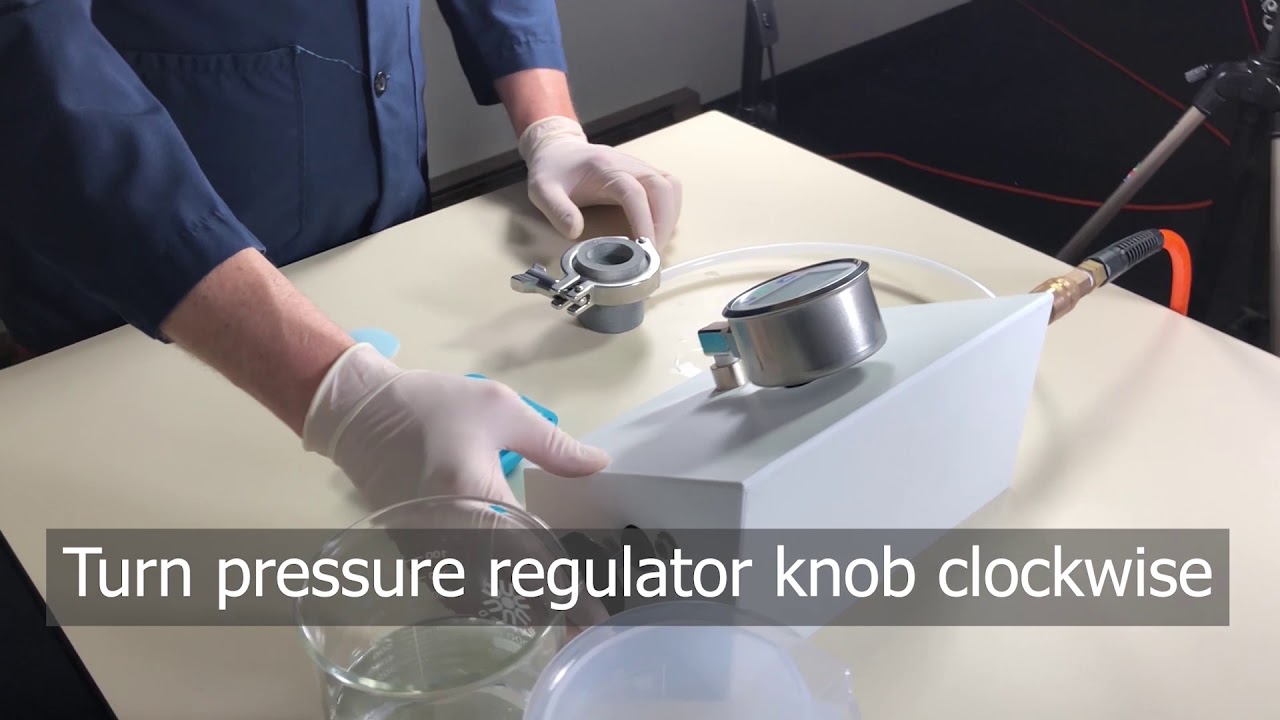
We'll disconnect the test fitting, push down on this flange and the host pulls out. We'll connect to the pressure pot. Just by pressing, we are ready to go.
We'll connect the outlet tubing to the pressure pot.
Before we apply pressure, we want to make sure the vent on the pressure pot is closed. We want to make sure this valve is closed, the water outlet is closed. Then we'll turn on the gauge to make sure it reads zero.
Turn the gauge Turn the mobile point tester on and then adjust the pressure carefully to 10 PSI, eventually. Now we're pressurizing the pressure vessel. 10 plus or minus 0.1 or 2. I think I said 0.2. Yeah, plus or minus 0.2. So we'll live with the 10.1. That's good.
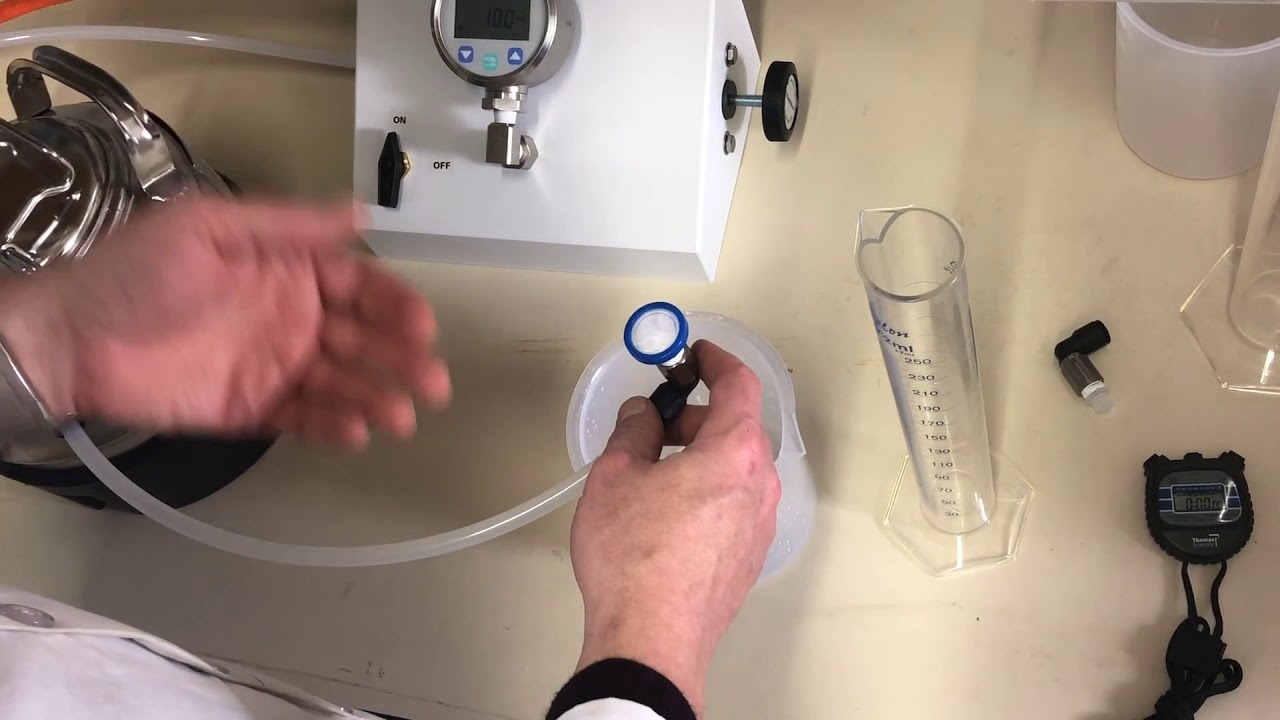
Then we take our test filter and a beaker. We'll gather our graduated cylinder as well.
We turn the fitting so that it's facing upward on the outlet tubing. Attach the test filter by installing and twisting until it's tight. Then we'll open the water while the filter outlet is facing up to make sure that we don't trap any air in the line.
Then once flow is established, we'll turn the filter over, and I think I still air locked it.
While the filter is facing up, the idea is that if there's any air trapped in there, the air passes through first before the water. Before the water encounters the membrane.
See, now we got flow. Once the flow is established, you get your stopwatch, and then measure the flow for one minute, exactly.
At the end of exactly one minute, we'll remove the filter back to the beaker, and then we'll measure the amount of water collected for one minute, which is 68. I'll grab the 100 milliliter.
After you measure that and record, you dump it into the beaker and repeat the measurement. So we'll stop the watch. Then we'll start it again and measure for one more minute.
Once it hits 60, we move it off at the same time. And we'll see if our measurement repeated. And it's about 69, so we're very close. That's good.
We devalue at the bottom of the meniscus. Then we'll stop the flow. We finish the test.
The pressure should be pretty stable. Then we'll dump this into the collection beaker, and then we've finished.
You rotate that up, you rotate counterclockwise to remove the filter, and it's on to the next one.
Make sure that's closed, the valve is closed. Unscrew filter to remove it, then store it in the dish full of water. Store it iin water just to make sure that it stays wet prior to bubble point testing.
Then when we're finished flow testing, we adjust the regulator all the way out till the gauge reads zero.
Turn the tester off. Open the vent on the pressure pot just to make sure that it is indeed reading zero. Make sure this is closed.
==================
Interested in Sterlitech membrane filters? Meet your application requirements by browsing our available options here: https://tinyurl.com/5x46rua4
For more information, contact us here: https://tinyurl.com/5wpnfn9a or call us at 1-877-544-4420
#waterflowrate #flowrate #bubblepointtest #bubblepointtesting #membranediscfilter #membranefilter #membranefiltration #filtration #microfiltration #sterlitech #bestpractice #demo #tutorial #sterlitech
Повторяем попытку...
Доступные форматы для скачивания:
Скачать видео
-
Информация по загрузке: