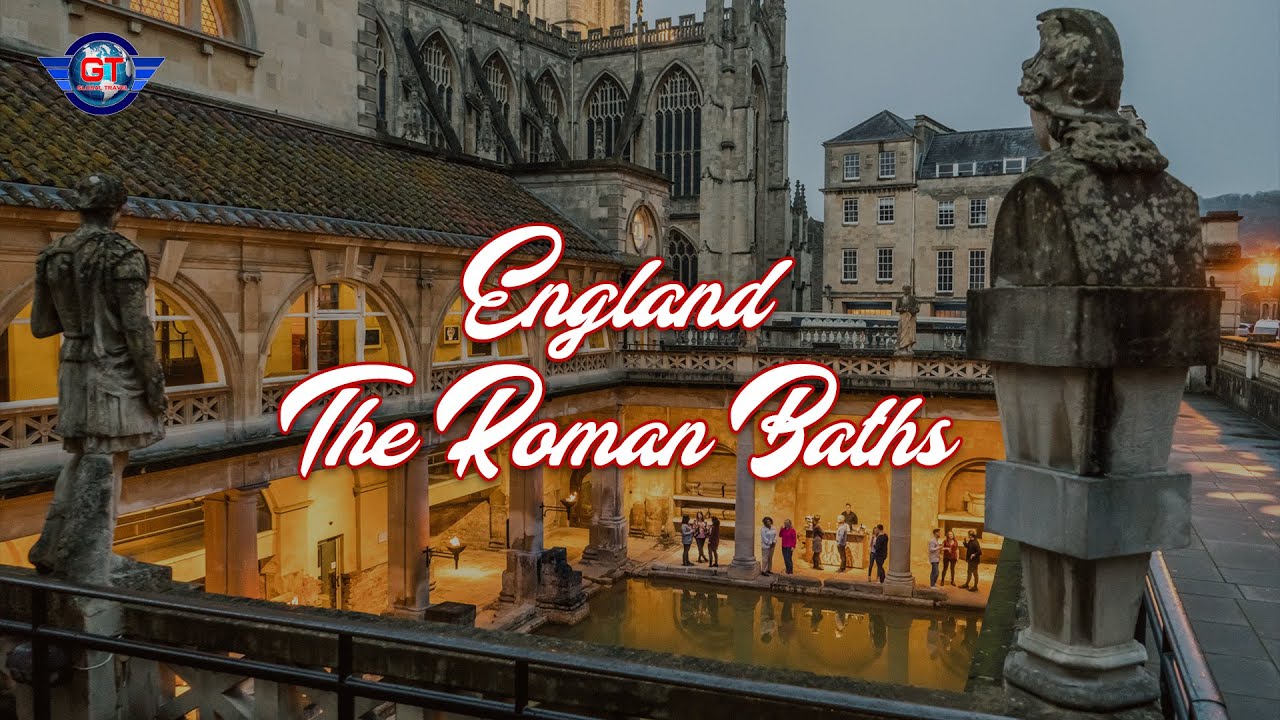
ENGLAND - THE ROMAN BATHS | GLOBAL TRAVEL VIDEOS
Автор: Global Travel
Загружено: 2020-08-02
Просмотров: 123
Описание:
England - The Roman Baths | Global Travel Exclusive Videos...
Roman Baths are a well-preserved thermae in the city of Bath, located in Somerset, England. A temple was constructed on the site between 60-70CE in the first few decades of Roman Britain. Its presence led to the development of the small Roman urban settlement known as Aquae Sulis around the site. The Roman baths, which were used for public bathing, were used until the end of Roman rule in Britain in the 5th Century CE.
The Anglo-Saxon Chronicle, the original Roman baths were in ruins a century later. The area around the natural springs was re-developed, several times during the Early and Late Middle Ages. Roman Baths are preserved in four main features: the Sacred Spring, the Roman Temple, the Roman Bath House, and a museum which holds artefacta from Aquae Sulis.
All buildings at street level date from the 19th century. It is a major tourist attraction in the UK, and together with the Grand Pump Room, receives more than 1.3 million visitors annually. Visitors can tour the baths and museum but cannot enter the water. The water which bubbles up from the ground at Bath falls as rain on the nearby Mendip Hills. It percolates down through limestone aquifers to a depth of between 2,700 and 4,300 metres, where geothermal energy rises the water temperature to between 69 and 96 °C.
Under pressure, the heated water rises to the surface, along fissures and faults in the limestone. This process is similar to an enhanced geothermal system, which also makes use of the high pressures and temperatures below the earth's crust. Hot water at a temperature of 46 °C rises here at the rate of 1,170,000 litres every day, from a geological fault. In 1982, a new spa water bore-hole was sunk, providing a clean and safe supply of spa water for drinking in the Pump Room.
Bath was charged with responsibility for the hot springs in a Royal Charter of 1591 granted by Elizabeth I. This duty has now passed to Bath and North East Somerset Council, who carry out monitoring of pressure, temperature and flow rates. The thermal waters contain sodium, calcium, chloride and sulphate ions in high concentrations. Roman Baths are no longer used for bathing.
The newly constructed Thermae Bath Spa nearby, and the refurbished Cross Bath, allow modern-day bathers to experience the waters via a series of more recently drilled boreholes. Archaeological evidence indicates that the site of the baths may have been a centre of worship used by Celts. The springs were dedicated to the goddess Sulis, whom the Romans identified with Minerva. Geoffrey of Monmouth in his largely fictional Historia Regum Britanniae describes how the spring was discovered by the pre-Roman British king Bladud who built the baths there.
Early in the 18th century Geoffrey's obscure legend was given great prominence as a royal endorsement of the waters' qualities, with the embellishment, that the spring had cured Bladud and his herd of pigs of leprosy through wallowing in the warm mud. The name Suliis continued to be used after the Roman invasion, leading to the town's Roman name of Aquae Sulis ("the waters of Sulis"). The temple was constructed in 60–70 CE and the bathing complex was gradually built up over the next 300 years.
During the Roman occupation of Britain, and possibly on the instructions of Emperor Claudius, engineers drove oak piles to provide a stable foundation into the mud, and surrounded the spring with an irregular stone chamber, lined with lead. In the 2nd century, it was enclosed within a wooden barrel-vaulted building, and included the caldarium (hot bath), tepidarium (lukewarm bath), and frigidarium (cold bath). After the Roman withdrawal from Britain in the first decade of the 5th century, these fell into disrepair and were eventually lost due to silting up, and flooding. The Anglo-Saxon Chronicle suggests, the original Roman baths were destroyed in the 6th century. About 130 curse tablets have been found. Many of the curses are related to thefts of clothes, whilst the victim was bathing.
The baths have been modified on several occasions, including the 12th century, when John of Tours built a curative bath over the King's Spring reservoir, and the 16th century, when the city corporation built a new bath (Queen's Bath) to the south of the spring. The spring is now housed in 18th-century buildings, designed by architects John Wood, the Elder and John Wood, the Younger, father and son.
Visitors drank the waters in the Grand Pump Room, a neo-classical salon which remains in use, both for taking the waters and for social functions. Victorian expansion of the baths complex followed the neo-classical tradition established by the Woods. In 1810, the hot springs failed and William Smith opened up the Hot Bath Spring to the bottom, where he found that the spring had not failed, but had flowed into a new channel. Smith restored the water to its original course.
Повторяем попытку...
Доступные форматы для скачивания:
Скачать видео
-
Информация по загрузке: