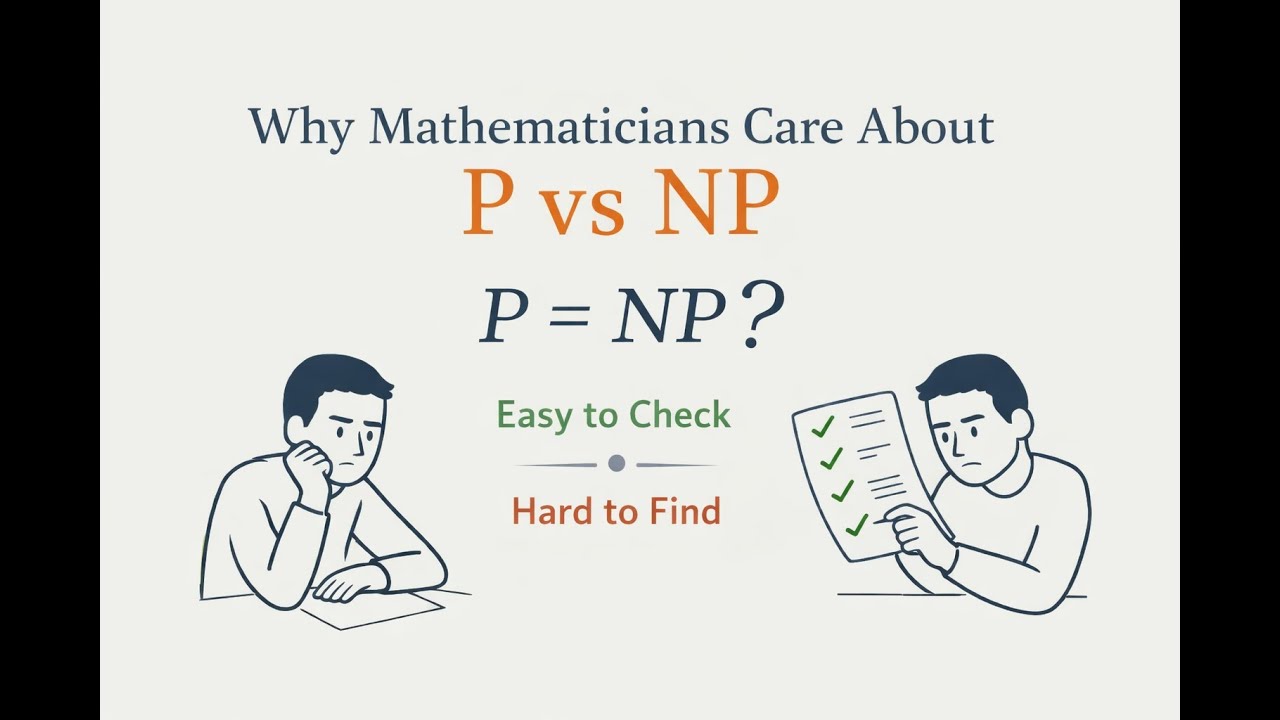
Why Computer Scientists Obsess Over P vs NP
Автор: Thinking In Math
Загружено: 2026-01-09
Просмотров: 115
Описание:
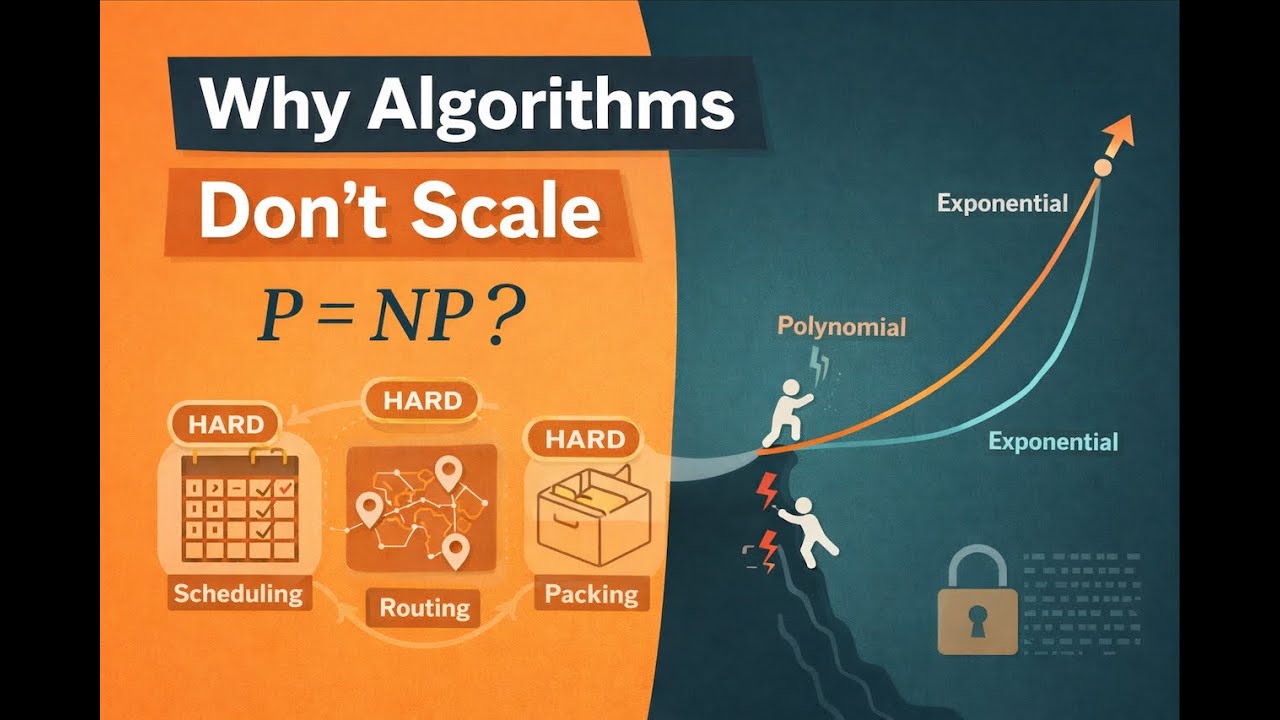
Why do so many real-world problems feel hard in the same way? In this mini-lecture, we explore the famous P vs NP question as a practical map of what algorithms can and cannot do at scale.
We start with scaling: polynomial vs exponential growth, and why running times like T(n) = n^2 and T(n) = 2^n separate the doable from the impossible as input sizes grow. Then we introduce NP and NP-complete problems as a shared “master difficulty class,” using SAT and other classic examples to show how thousands of problems are secretly linked.
You’ll see why modern SAT solvers, optimizers, and schedulers work brilliantly on many instances, yet can suddenly fall off a worst-case cliff—and how attackers in security can deliberately push systems there. We’ll also contrast two hypothetical worlds, P = NP and P ≠ NP, to understand the stakes for cryptography, AI, and large-scale optimization.
This video is for CS students, self-taught programmers, and anyone curious about algorithms, computational complexity, cryptography, and NP-completeness.
Keywords: P vs NP, NP-complete, polynomial time, exponential time, SAT solvers, computational complexity, cryptography, algorithms, optimization, scaling, worst-case complexity.
If you find this helpful, please like the video, subscribe for more math and CS mini-lectures, and share your own “impossible to perfectly optimize” problems in the comments.
Повторяем попытку...
Доступные форматы для скачивания:
Скачать видео
-
Информация по загрузке: