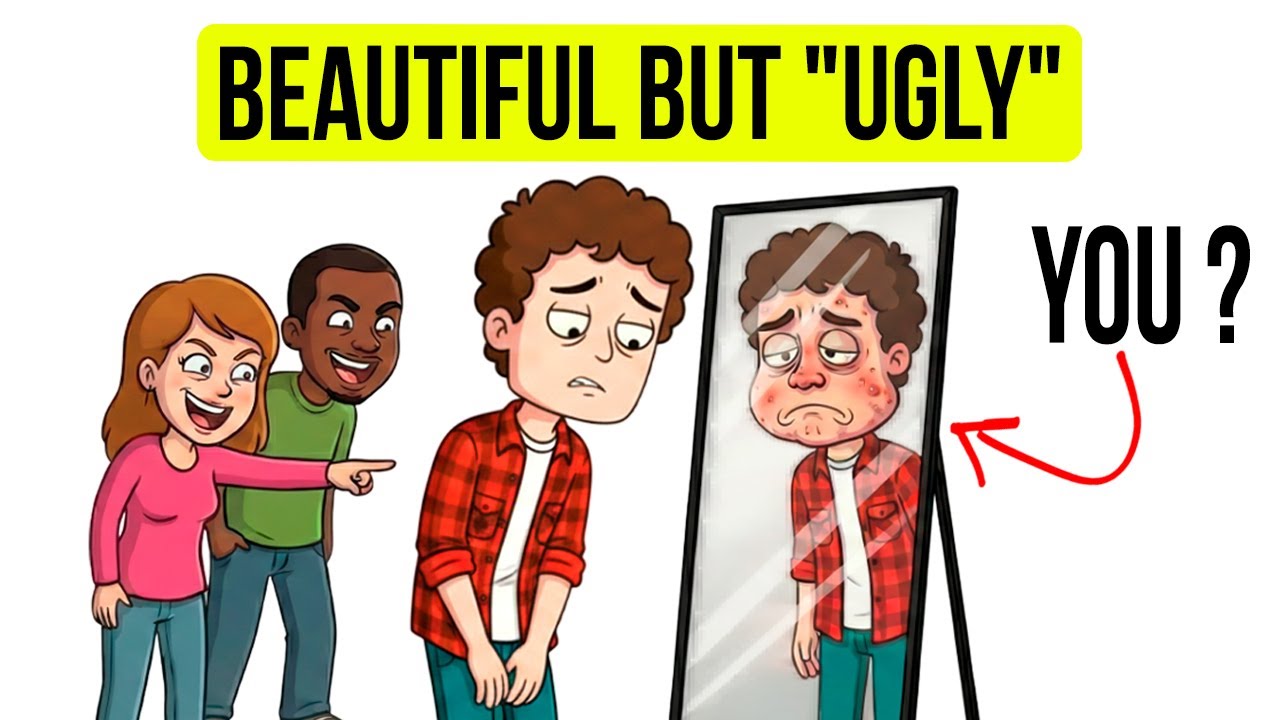
Psychology of People Who Consider Themselves Ugly
Автор: Psychology Signals
Загружено: 2026-01-25
Просмотров: 18
Описание:
In this video, we explore the deep psychology of negative self-perception, uncovering why so many people are convinced they are "ugly" regardless of their actual appearance. From the mechanisms of Body Dysmorphic Disorder (BDD) to the cognitive distortions that warp our self-image, this deep dive explains the mental framework behind feeling unattractive.
You will learn about the "Spotlight Effect"—the psychological phenomenon where we overestimate how much others notice our flaws—and how the brain’s visual processing system can sometimes fixate on minute details rather than the whole picture. We also explain Social Comparison Theory, the evolutionary drivers behind our obsession with physical appearance, and why feeling "ugly" is often more about internal emotional regulation than physical reality.
If you would like to support the channel and help make more videos, consider clicking "Join" to become a channel member. Your support is appreciated. Click "Join" or become a member here: /@PsychologySignals-l1s
This video is ideal for anyone who: • Constantly checks the mirror or avoids reflections entirely • Has a friend or partner who feels "ugly" despite being attractive • Is interested in how social media impacts brain chemistry and self-esteem • Wants to understand the difference between normal insecurity and Body Dysmorphia
Topics covered include: • The "Spotlight Effect": Why you think everyone is looking at you • Cognitive Distortions: How "Magnification" and "Mental Filtering" warp reality • The Neuroscience of BDD: Visual processing differences (Detail vs. Holistic) • Social Comparison Theory: The psychology of "upward comparison" • Evolutionary Psychology: The primal roots of beauty and status anxiety • The "Phantom Ugly": Why plastic surgery often fails to fix the internal feeling
If you have ever looked in the mirror and wondered, "Why do I see flaws that no one else sees?" this video will give you clear, scientific answers.
Watch until the end to learn practical cognitive strategies to retrain your brain’s self-perception and break the cycle of negative self-talk.
Disclaimer: This channel is for educational and informational purposes only and does not replace professional psychological, medical, or therapeutic advice. If you are struggling with BDD or severe depression, please consult a mental health professional.
–––––––––––––––––––––––––– Sources & Further Reading (used for research):
• American Psychological Association (APA): Entries on Body Dysmorphic Disorder, Self-Schema, and Social Comparison Theory. • Phillips, K. A. (2005). The Broken Mirror: Understanding and Treating Body Dysmorphic Disorder. Oxford University Press. • Festinger, L. (1954). A theory of social comparison processes. Human Relations. • Gilovich, T., Medvec, V. H., & Savitsky, K. (2000). The spotlight effect in social judgment: An egocentric bias in estimates of the salience of one's own actions and appearance. Journal of Personality and Social Psychology. • Veale, D. (2004). Cognitive-behavioural therapy for body dysmorphic disorder. Advances in Psychiatric Treatment.
Повторяем попытку...
Доступные форматы для скачивания:
Скачать видео
-
Информация по загрузке: