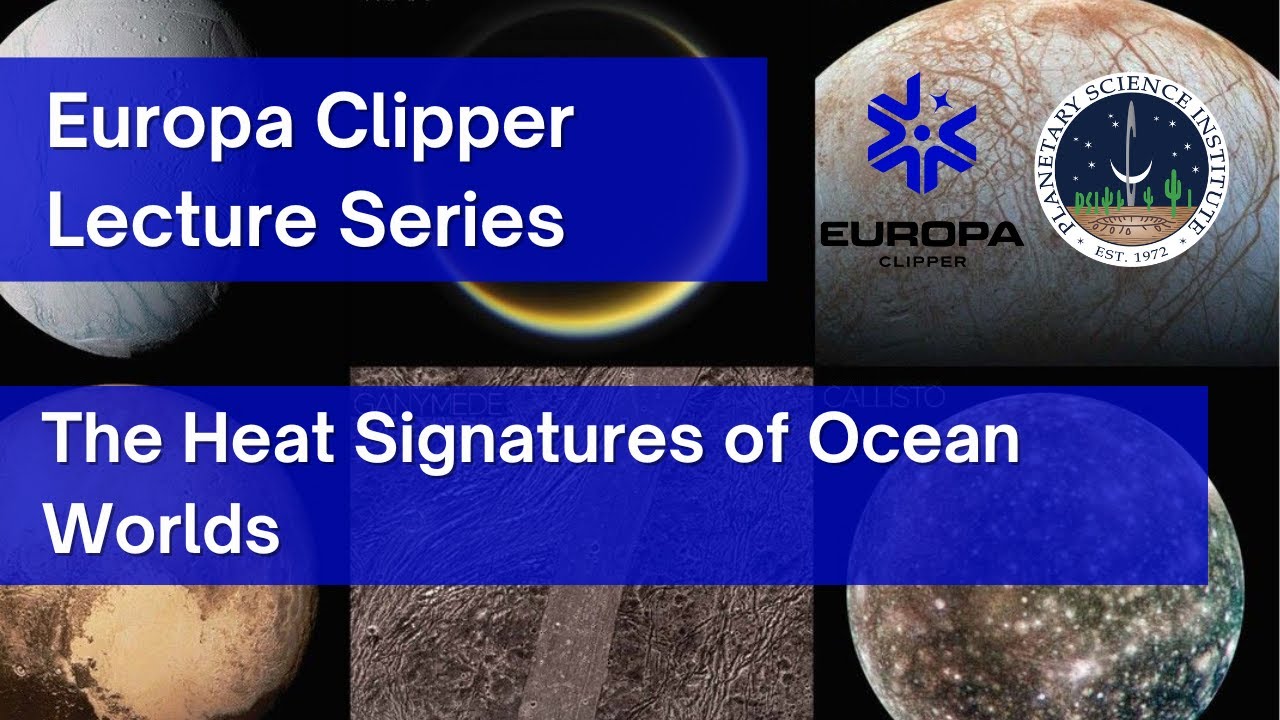
Europa Clipper Lecture Series: "The Heat Signatures of Ocean Worlds"(12/9/2025)
Автор: Planetary Science Institute
Загружено: 2026-02-05
Просмотров: 13
Описание:
Alyssa Rhoden, a staff scientist and group leader at Southwest Research Institute in Boulder, discusses the heat signatures of ocean worlds.
Abstract: The presence of an ocean within an icy moon will change the thermal structure of its ice shell and may enable tidal heating that can increase the moon's thermal budget. Hence, surface heat flow measurements may be viable for detection of oceans in candidate ocean worlds. Heat flow measurements may also enable characterization of ice shell thickness and the overall thermal budget of confirmed ocean worlds, which are valuable for assessing habitability. Here, we present the results of heat flow studies for Europa, Mimas, and Miranda to address questions of ice shell thickness variations and ocean detection. We will show predictive ice shell thickness maps for Europa using a sophisticated tidal model and measured surface temperature for different assumptions of Europa's internal heat budget. We then ground our predictions with recent Juno results. For Mimas and Miranda, we present measurement requirements that would enable ocean detection using surface heat flow measurements to facilitate future missions to these enigmatic moons.
This is part of the Europa Clipper Lecture Series (ECLS), hosted by the Europa Clipper mission and recordings of the monthly lectures are posted here when agreed to by the speaker. This lecture series covers a variety of topics, usually from recently published papers, relevant to understanding the habitability of Europa. Sign up for notices for upcoming talks: http://tinyurl.com/ECLS-signup
----------------------------------------------------------------------------------------------------------------------------------------
The Planetary Science Institute is a private, nonprofit 501(c)(3) corporation dedicated to Solar System exploration. It is headquartered in Tucson, AZ, where it was founded in 1972. In 2016 PSI established a second office in Lakewood, CO (near Denver).
PSI scientists and educators are involved in numerous NASA and international missions, the study of Mars, Earth, and other planets, the Moon, asteroids, comets, interplanetary dust, impact physics, the origin of the solar system, extrasolar planet formation, dynamics, the rise of life, and other areas of research. They conduct fieldwork on all continents of the Earth to understand our planet and others. They are also actively involved around the world in science education and public outreach through school programs, children's books, popular science books, podcasts, and art.
To support our education and outreach activities, please donate here: https://psi.edu/support
For the latest in planetary science news and content from PSI, come find us on all our media sites:
Twitter: / planetarysci
Facebook: / planetarysci
Instagram: / planetary.sci
LinkedIn: / planetary-science-institute
Please like, subscribe, and ring the bell for notifications!
Повторяем попытку...
Доступные форматы для скачивания:
Скачать видео
-
Информация по загрузке:





![Massive Attack • Portishead • Thievery Corporation- Special Coffeeshop Selection [Seven Beats Music]](https://imager.clipsaver.ru/YPJD1hF2kIY/max.jpg)