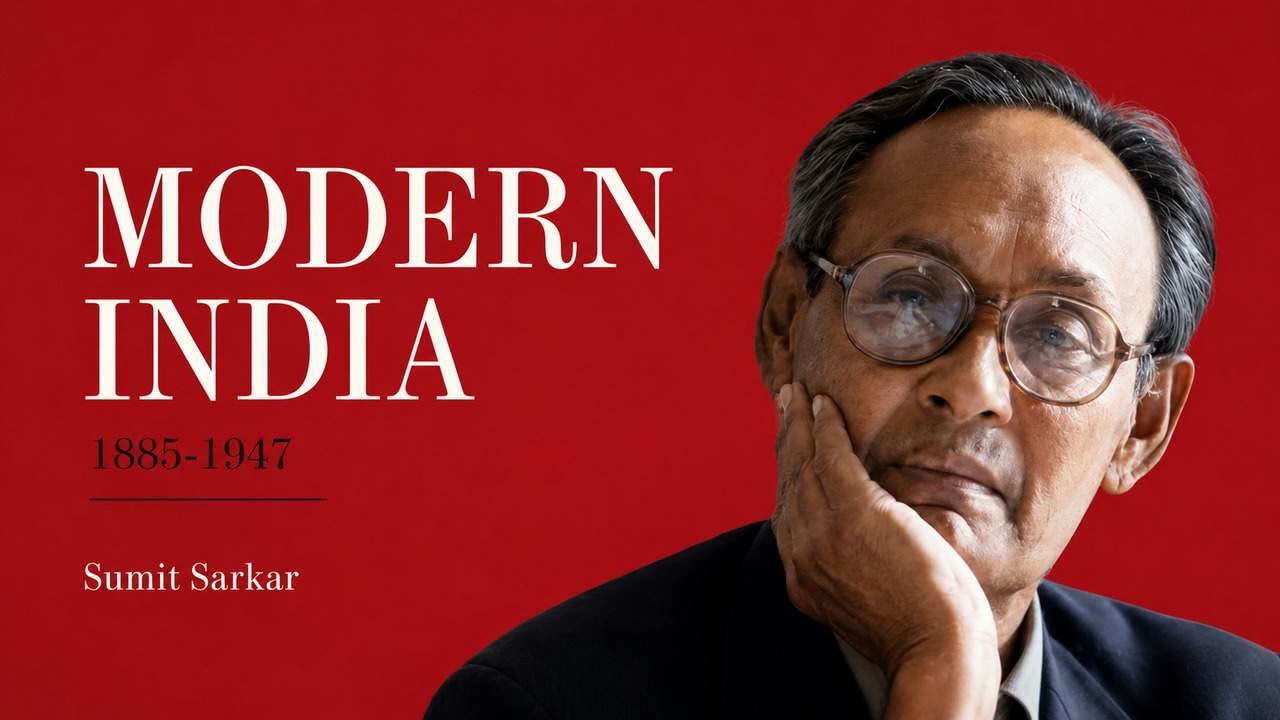
Modern India 1885–1947 (1983) | Sumit Sarkar
Автор: Epistemophilia
Загружено: 2026-08-16
Просмотров: 185
Описание:
Sumit Sarkar’s Modern India 1885–1947, first published in 1983, is presented as a major contribution to post-independence Indian historiography. The work challenges both celebratory nationalist histories and the Cambridge School’s tendency to interpret Indian politics primarily through elite factional competition. Sarkar instead attempts to construct a “history from below,” focusing on the experiences, consciousness, and political agency of peasants, workers, tribal communities, and other groups who had often remained marginal in conventional historical narratives. His approach combines Marxist historical materialism with an emerging concern for subaltern agency.
A central argument of the book is that Indian independence represented a remarkable historical transformation but remained incomplete because political freedom did not produce an equivalent restructuring of Indian society. Sarkar therefore examines nationalism within the wider framework of colonial exploitation, class relations, racial discrimination, and economic inequality. He describes the British Raj as fundamentally autocratic and argues that constitutional reforms were generally responses to political pressure rather than genuine preparations for democratic self-government. His discussion of the colonial economy examines the drain of wealth, deindustrialisation, agrarian exploitation, and the restricted development of indigenous capitalism.
The commitment to history from below becomes especially visible in Sarkar’s treatment of tribal uprisings, peasant resistance, labour movements, caste mobilisation, and communal politics. Movements such as Birsa Munda’s Ulgulan are interpreted not as irrational or primitive disturbances but as meaningful responses to colonial dispossession. Sarkar also demonstrates how colonial census practices contributed to the consolidation of caste identities. His analysis of communalism avoids both the assumption that Hindus and Muslims were naturally antagonistic and the nationalist belief that communal conflict was created entirely by British divide-and-rule policies.
The chapters on nationalism trace its transformation from an elite political movement into a mass phenomenon. The Partition of Bengal and the Swadeshi movement receive particular attention, with Sarkar distinguishing constructive Swadeshi, political extremism, and revolutionary terrorism. He argues that the limitations of these movements were partly social: they struggled to connect nationalist objectives with the immediate economic concerns of peasants and workers. Similarly, revolutionary terrorism, despite its sincerity and courage, remained socially narrow and could not develop into a broad-based revolutionary programme.
Sarkar’s interpretation of Gandhi is equally complex. He recognises Gandhi’s extraordinary ability to organise mass politics through disciplined non-violent action while pointing out the gap between popular expectations and Gandhian objectives. Peasants sometimes imagined Gandhi as a figure who would abolish zamindari and radically transform rural society, whereas Gandhi sought controlled mass participation. The Non-Cooperation and Civil Disobedience movements therefore reveal both the enormous mobilising capacity of nationalism and the limits imposed by Congress leadership and bourgeois interests.
The later chapters examine the Depression, Congress ministries, the Left, the Second World War, Quit India, and Partition. Sarkar highlights the contradictory relationship between Congress, business interests, labour, peasants, and communal politics. Quit India demonstrated the depth of popular anti-colonial resistance, while the movements of 1945–46 helped make continued British rule increasingly difficult. Yet independence ultimately arrived alongside Partition, revealing the limits of both elite nationalist politics and popular mobilisation.
Overall, Modern India 1885–1947 is valued for its sophisticated class analysis, regional sensitivity, attention to grassroots agency, and balanced treatment of nationalist leaders. Its limitations include an incomplete realisation of the history-from-below project, insufficient attention to gender, a somewhat underdeveloped cultural analysis, and a tendency to view history through the trajectory leading toward 1947. Nevertheless, Sarkar’s central achievement lies in showing that Indian nationalism can be understood critically: independence was both a profound achievement and an incomplete social transformation.
#SumitSarkar #ModernIndia #IndianHistory #IndianHistoriography #HistoryOfIndia #IndianNationalism #ColonialIndia #AntiColonialism #HistoryFromBelow #SubalternHistory #SubalternStudies #MarxistHistoriography #Colonialism #BritishRaj #IndianIndependence #FreedomMovement #SwadeshiMovement #NonCooperationMovement #CivilDisobedience #QuitIndiaMovement #PartitionOfIndia #PeasantMovements #TribalResistance #WorkingClassHistory #Communalism #Nehru #SubhasChandraBose #HistoricalStudies
Повторяем попытку...
Доступные форматы для скачивания:
Скачать видео
-
Информация по загрузке: