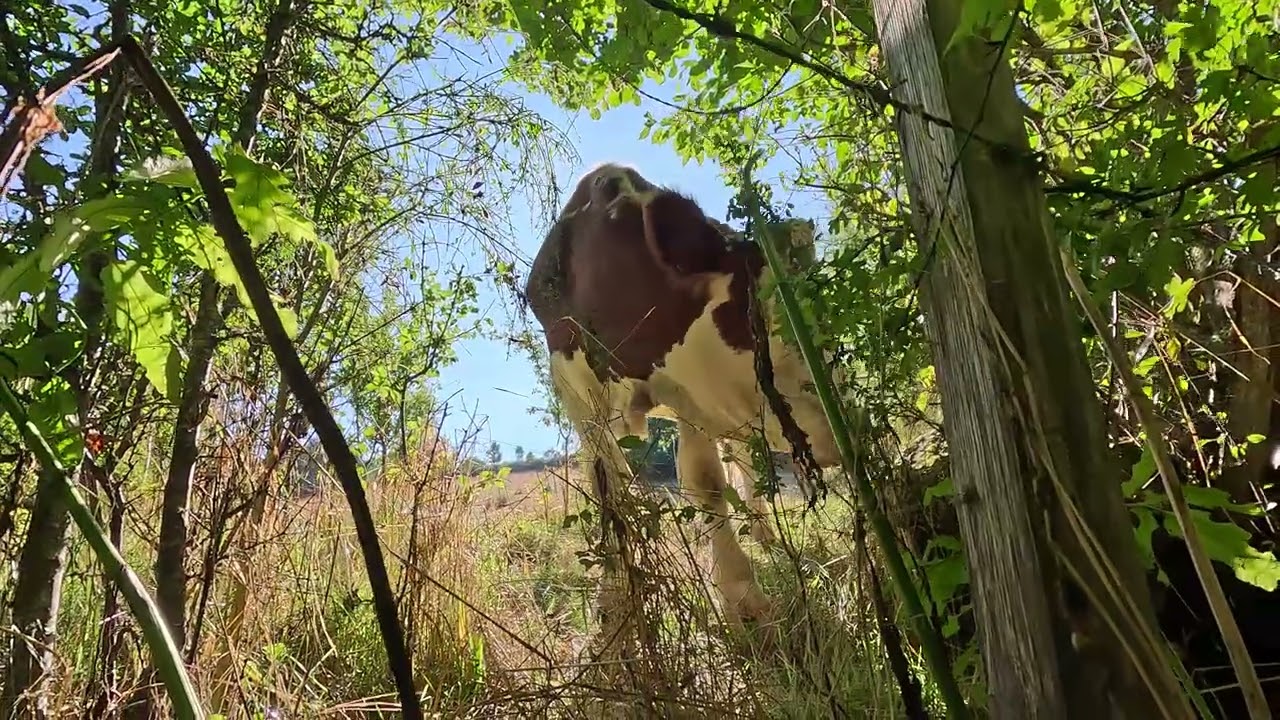
Cow on Via Podiensis, Le Puy Camino (GR 65), France
Автор: Rob Hofmann
Загружено: 2025-09-06
Просмотров: 13
Описание:
From Wikipedia re. The Via Podiensis or the Le Puy Camino
The Via Podiensis or the Le Puy Route is one of the four Camino routes through France on the pilgrimage to the tomb of St. James the Great in Santiago de Compostela in Galicia in northwest Spain. It leaves from Le-Puy-en-Velay and crosses the countryside in stages….to the French town of Saint-Jean-Pied-de-Port and crossing the Pyrenees Mountains and the Spanish border…to the principal pilgrimage route across Spain, known as the Camino francés.
Before le Puy, the via Gebennensis leaves from Geneva, gathering Swiss and German pilgrims and feeding into the via Podiensis. Though it bears a Latin name, the via Gebennensis is a modern route laid out in 1980-90, though the numerous hospitals it passes testify to the passage of pilgrims along this route in earlier ages.
From Geneva to the Pyrenees, the two routes (via Gebennensis and via Podiensis) are waymarked as one of the French major hiking routes, the GR 65.
According to the A Guide for the Traveller compiled by Aymeric Picaud in the 12th century, four routes lead to Santiago de Compostela:
• the via Turonensis, leaving from Paris, passing through Tours
• the via Lemovicensis, leaving from Vézelay, passing through Limoges
• the via Podiensis, leaving from Puy-en-Velay, passing through Cahors and Moissac
• the via Tolosane, leaving from Arles, passing through Toulouse
In 950 or 951, Godescalc, bishop of Le Puy-en-Velay, set off on a pilgrimage to Santiago de Compostela. He was the first non-Hispanic to undertake the pilgrimage, leading a large caravan that included members of the clergy, their staff and servants, various nobles and gentlemen, their retainers and men at arms.
From : bluegreenatlas.com re. The Massif Central
The Massif Central is the very heart of France, a great area of volcanic mountains & basins. Many of the extinct volcanoes swell into domes, others are formed into craters as assuming the shape of a volcanic cone. In some instances, the lava streams may still be traced from the very lips of the crater out of which they originally flowed for miles over the country, capping the hill tops and filling up the valleys. Castles of the feudal ages abound in this region and adorn the landscape. In the volcanic country they are usually perched on a platform of basalt crowning some peak.
Located in south-central France, the Massif Central ('Central Plateau') occupies about one-sixth of the total area of France. It is part of the ancient highland system of Central Europe. Most of this plateau, which averages around 1,000 meters (3,000 feet) in height, is composed of ancient crystalline rocks. Among other things, the region is known for its awe-inspiring volcanic relief. Formed millions of years ago, the volcanic Massif Central predates both the Alps and the Pyrenees. It is best known for its volcanic cones, called "puys".
The western and southeastern margins of the plateau are composed of limestone and the scenery is of the “karst” type. These regions are known as Causses, and are characterized by deep valleys and disappearing rivers. The plateaus are arid and barren, but the rivers which flow through them make the deep valleys fertile.
In the center the ancient mountains appear as round-topped hills lifted out of the original plateau. Here there are table-lands, rounded hillocks, interspersed with the valleys, carved into gorges by the rivers tumbling down toward the basins of Paris and Aquitaine.
On its eastern side the plateau drops steeply to the Rhone valley and is known as the Cevennes. It is wild and rugged. Le Puy, with its fantastic position and strange buildings, is the chief town of the district. The mountains of the Cevennes are a natural citadel, a labyrinth of canyons with mountain peaks and ridges; passes and gorges; forests, mountain paths, and caves.
The north has high crests, peaks, and deep valleys, and mountains such as the famous Puy-de-Dôme have kept the form of cones or craters and still seem ready to belch forth flames or streams of lava. Rising above the ancient surface, these steep extinct volcanoes are one of the great spectacles in France. This is the district of the Auvergne, the heart of the Massif Central with views that are wide and panoramic. These volcanic cones give the landscape a unique aspect. The finest view-point is the Puy de Dome (1,464 m, 4,803 ft).
The plateaus of Massif Central are wild and naked, but the rivers which flow through them, make the deep valleys fertile. A large number of lakes have filled the volcanic craters. Some of France’s best-known rivers originate in the region: the Dordogne, Allier, Lot, and Loire. Many of its rivers, including the powerful Loire, flow into the Atlantic Ocean. Thus, it is a mountainous region with an abundance of water and scenic valleys, where most of the population is settled.
Повторяем попытку...
Доступные форматы для скачивания:
Скачать видео
-
Информация по загрузке: