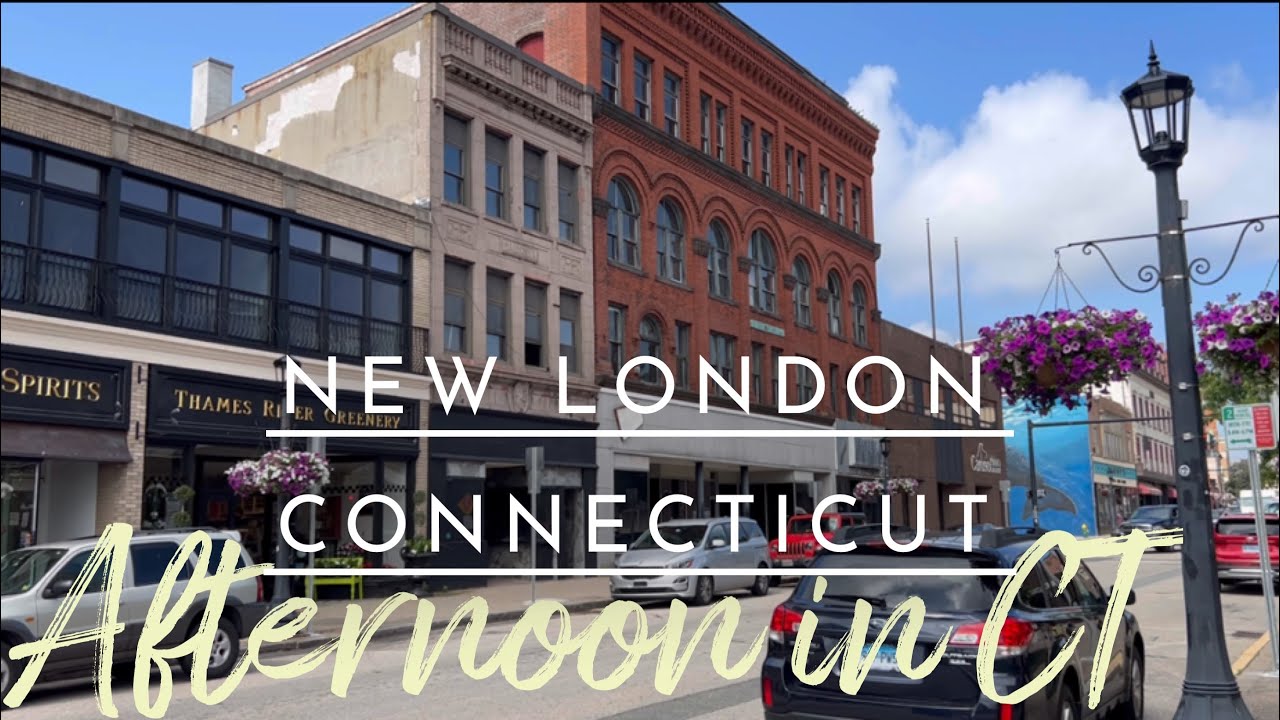
New London Connecticut CT TOUR!
Автор: Afternoon in Connecticut
Загружено: 2023-07-24
Просмотров: 18146
Описание:
#newlondon #newlondonct #afternooninCT
New London Connecticut CT walk and drive around
From Wikipedia
Colonial era
The area was called Nameaug by the Pequot Indians. John Winthrop, Jr. founded the first English settlement here in 1646, making it about the 13th town settled in Connecticut. Inhabitants informally referred to it as Nameaug or as Pequot after the tribe. In the 1650s, the colonists wanted to give the town the official name of London after London, England, but the Connecticut General Assembly wanted to name it Faire Harbour. The citizens protested, declaring that they would prefer it to be called Nameaug if it could not be officially named London.[5][6] The legislature relented, and the town was officially named New London on March 10, 1658.
American Revolution
The harbor was considered to be the best deep water harbor on Long Island Sound,[7] and consequently New London became a base of American naval operations during the American Revolutionary War and privateers where it has been said no port took more prizes than New London with between 400–800 being credited to New London privateers including the 1781 taking of supply ship Hannah, the largest prize taken during the war. Famous New Londoners during the American Revolution include Nathan Hale, William Coit, Richard Douglass, Thomas and Nathaniel Shaw, Gen. Samuel Parsons, printer Timothy Green, and Bishop Samuel Seabury.
New London was raided and much of it burned to the ground on September 6, 1781 in the Battle of Groton Heights by Norwich native Benedict Arnold in an attempt to destroy the Patriot privateer fleet and supplies of goods and naval stores within the city. It is often noted that this raid on New London and Groton was intended to divert General George Washington and the French Army under Rochambeau from their march on Yorktown, Virginia. The main defensive fort for New London was Fort Griswold, located across the Thames River in Groton. It was well known to Arnold, who had already informed the British of this so that they could avoid its artillery fire. British and Hessian troops subsequently attacked and captured New London's Fort Trumbull, while other forces moved in to attack Fort Griswold across the river, then held by Lieutenant-Colonel William Ledyard. The British suffered great casualties at Fort Griswold before the Americans were finally forced to surrender—whereupon Arnold's men stormed into the fort and slaughtered most of the American troops who defended it, including Ledyard. All told, more than 52 British and 83 American soldiers were killed, and more than 142 British and 39 Americans were wounded, many mortally. New London suffered over 6 defenders killed and 24 wounded, while Arnold's men suffered an equal amount.
Connecticut's independent legislature made New London one of the first two cities brought from de facto to formalized incorporations in its January session of 1784, along with New Haven.
19th century
After the War of 1812 broke out, the Royal Navy established a blockade of the East Coast of the United States, including New London. During the war, American forces unsuccessfully attempted to destroy the British ship of the line HMS Ramillies while it was lying at anchor in New London's harbor with torpedoes launched from small boats. This prompted the captain of Ramillies, Sir Thomas Hardy, 1st Baronet, to warn the Americans to cease using this "cruel and unheard-of warfare" or he would "order every house near the shore to be destroyed". The fact that Hardy had been previously so lenient and considerate to the Americans led them to abandon such attempts with immediate effect.[9]: 693
For several decades beginning in the early 19th century, New London was one of the three busiest whaling ports in the world, along with Nantucket and New Bedford, Massachusetts. The wealth that whaling brought into the city furnished the capital to fund much of the city's present architecture. The New Haven and New London Railroad connected New London by rail to New Haven and points beyond by the 1850s. The Springfield and New London Railroad connected New London to Springfield, Massachusetts, by the 1870s.
Повторяем попытку...
Доступные форматы для скачивания:
Скачать видео
-
Информация по загрузке:


