Sri Lanka,ශ්රී ලංකා,Ceylon,Sawmill Lumber Yard Coconut Wood,Cocos Nucifera
Автор: NickVenture1
Загружено: 2013-10-27
Просмотров: 2357
Описание:
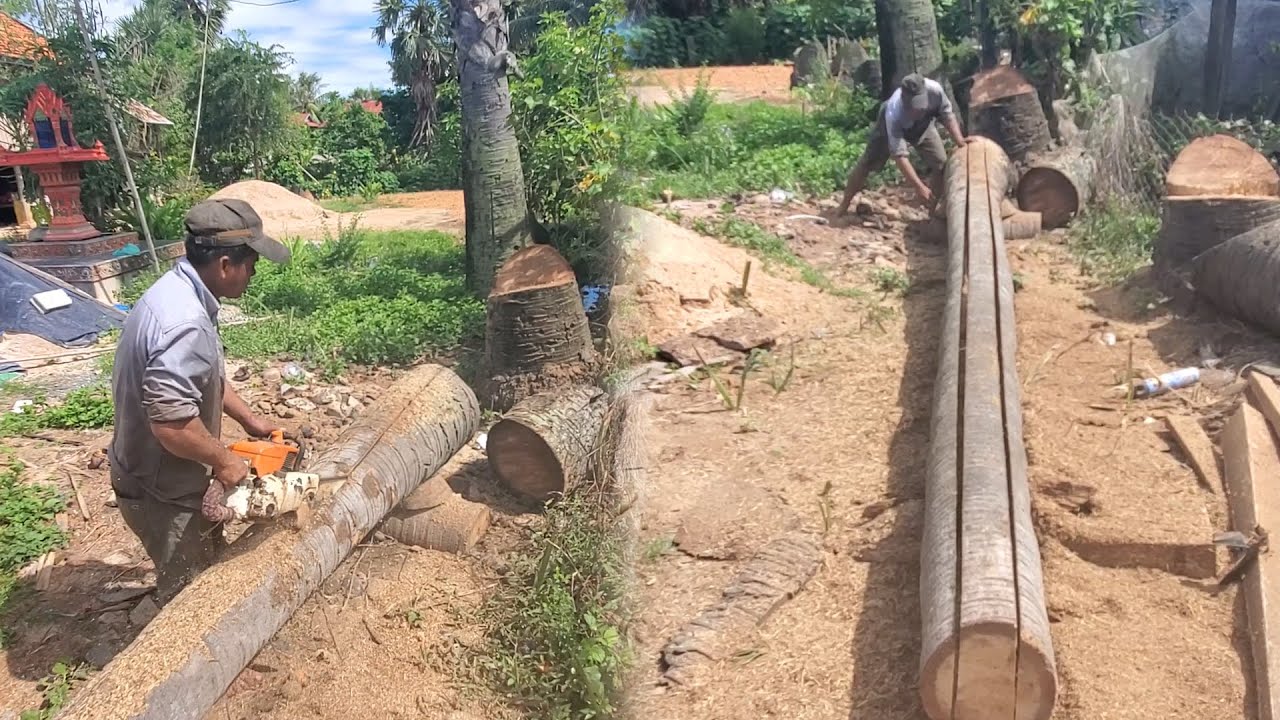
Coconut trees are sliced into several trunks and further processed by hand to become reliable very weather resistant lumber for the construction of roofs and many other applications in the local building activities.
The coconut tree (Cocos nucifera) is a member of the palm tree family (Arecaceae) and the only living species of the genus Cocos.The term "coconut" (or the archaic "cocoanut") can refer to the whole coconut palm, the seed, or the fruit, which botanically is a drupe, not a nut. The name comes from the old Portuguese and Spanish word coco, meaning "head" or "skull", after the three indentations on the coconut shell that resemble facial features. They are ubiquitous in coastal tropical regions and are a cultural icon of the tropics.It is one of the most useful trees in the world and is often referred to as the "tree of life". It provides food, fuel, cosmetics, folk medicine and building materials, among many other uses. The inner flesh of the mature seed, as well as the coconut milk extracted from it, form a regular part of the diets of many people in the tropics and subtropics. Coconuts are distinct from other fruits because their endosperm contains a large quantity of clear liquid, called coconut water or coconut juice. Mature, ripe coconuts can be used as edible seeds, or processed for oil and plant milk from the flesh, charcoal from the hard shell, and coir from the fibrous husk. Dried coconut flesh is called copra, and the oil and milk derived from it are commonly used in cooking – frying in particular – as well as in soaps and cosmetics. The hard shells, fibrous husks and long pinnate leaves can be used as material to make a variety of products for furnishing and decoration.
The coconut has cultural and religious significance in certain societies, particularly in India, where it is used in Hindu rituals. It forms the basis of wedding and worship rituals in Hinduism, a coconut religion in Vietnam, and features in the origin myths of several societies. The falling nature of their mature fruit has led to preoccupation with death by coconut.
Coconuts have been used by humans for thousands of years and may have spread to their present range because of Pacific island settlers. The evolutionary origin of the coconut is under dispute, with theories stating that it may have evolved in Asia, South America, or on islands in the Pacific. Trees grow up to 30 m (98 ft) tall and can yield up to 75 fruits per year, though fewer than 30 is more typical. Plants are intolerant of cold weather and prefer copious precipitation, as well as full sunlight. Many insect pests and diseases affect the species and are a nuisance for commercial production. About 74% of the world's supply of coconuts derives from Indonesia, the Philippines, and India combined.
The name coconut is derived from the 16th-century Portuguese and Spanish word coco, meaning 'head' or 'skull' after the three indentations on the coconut shell that resemble facial features. Coco and coconut apparently came from 1521 encounters by Portuguese and Spanish explorers with Pacific islanders, with the coconut shell reminding them of a ghost or witch in Portuguese folklore called coco (also côca). In the West it was originally called nux indica, a name used by Marco Polo in 1280 while in Sumatra. He took the term from the Arabs, who called it جوز هندي jawz hindī, translating to 'Indian nut'. Thenga, its Malayalam name, was used in the detailed description of coconut found in Itinerario by Ludovico di Varthema published in 1510 and also in the later Hortus Indicus Malabaricus.Cocos nucifera is a large palm, growing up to 30 m (100 ft) tall, with pinnate leaves 4–6 m (13–20 ft) long, and pinnae 60–90 cm (2–3 ft) long; old leaves break away cleanly, leaving the trunk smooth.On fertile soil, a tall coconut palm tree can yield up to 75 fruits per year, but more often yields less than 30. Given proper care and growing conditions, coconut palms produce their first fruit in six to ten years, taking 15 to 20 years to reach peak production.
Many different varieties are grown, including the Maypan coconut, King coconut, and Macapuno. These vary by the taste of the coconut water and color of the fruit, as well as other genetic factors. Dwarf varieties are also available.Botanically, the coconut fruit is a drupe, not a true nut.Like other fruits, it has three layers: the exocarp, mesocarp, and endocarp. The exocarp and mesocarp make up the "husk" of the coconuts. The endosperm is initially in its nuclear phase suspended within the coconut water. As development continues, cellular layers of endosperm deposit along the walls of the coconut, becoming the edible coconut "flesh".Coconuts sold in the shops of nontropical countries often have had the exocarp (outermost layer) removed. The mesocarp is composed of a fiber, called coir, which has many traditional and commercial uses. The shell has three germination pores (micropyles) or "eyes" that are clearly visible.(Wikipedia)
Повторяем попытку...

Доступные форматы для скачивания:
Скачать видео
-
Информация по загрузке: